
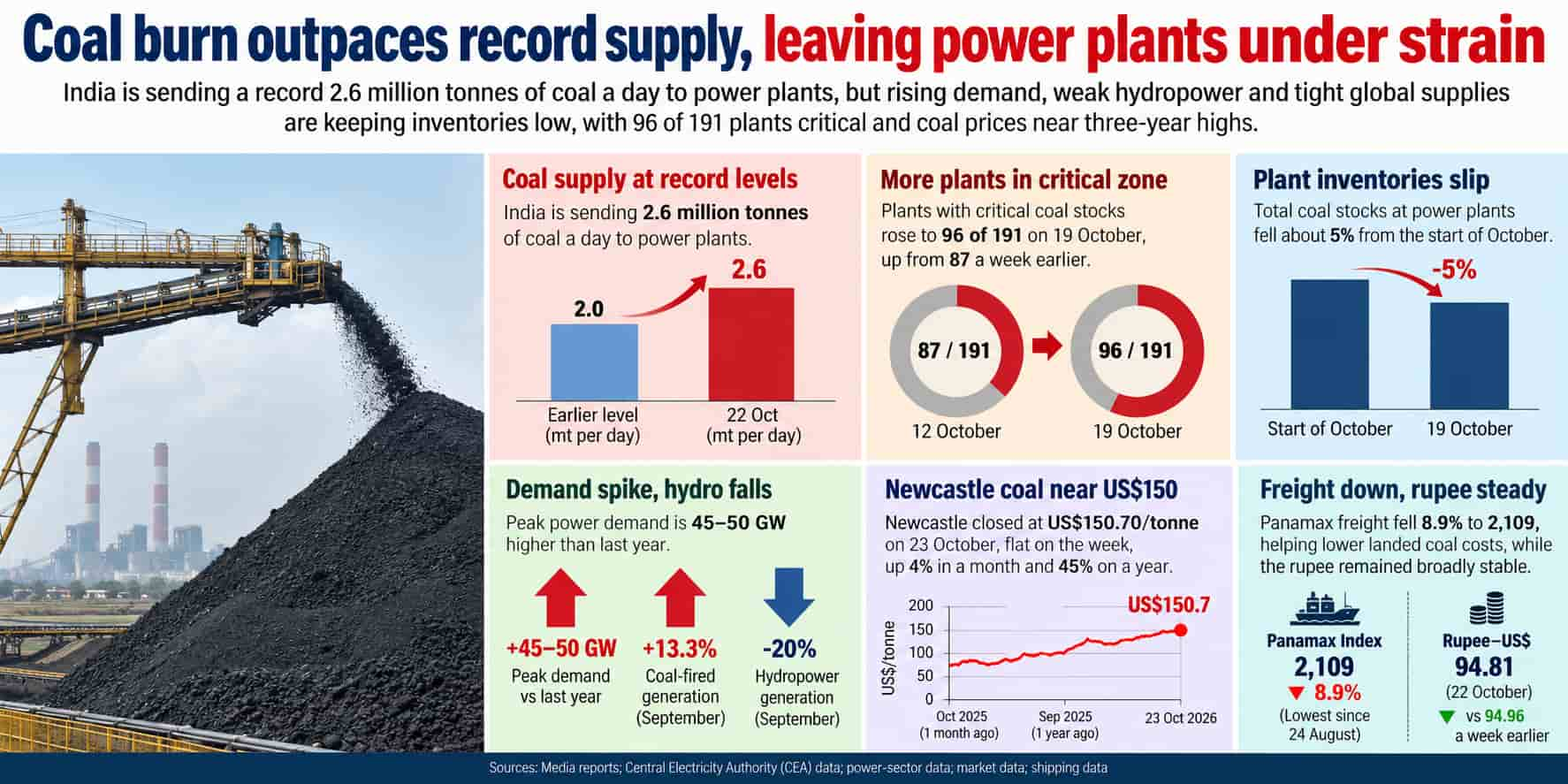
On 22 October, a senior Power Ministry official said India was sending a record 2.6 million tonnes of coal a day to power plants and expected supplies to normalise soon, according to a media report. The same report shows the strain growing. The Central Electricity Authority (CEA) counted 96 of 191 plants as critical on 19 October, up from 87 a week earlier.
Total plant inventories also fell about 5% from the start of October, reporting based on CEA data shows. Last week the Ministry of Coal said stocks had steadied. Our last analysis named rebuilding before festive demand as the test. That test has not been passed.
The explanation is consumption, not supply. Peak demand is running 45–50 GW above last year. Coal-fired generation rose 13.3% in September while hydropower fell 20%, power-sector data shows. A record flow can still lose to a faster-rising burn.
“Record supply is only good news if consumption stops rising with it. Right now, whatever arrives is burnt within the day,” an executive at a leading thermal utility said.
Evening peaks expose the thinnest margin
Gujarat asked factories to curb evening electricity use as state demand hit a record. Weak hydropower and wind add to evening reliance on coal and gas. The Centre allocated extra power to the state, and the official said it faced no shortage of power or coal. The request was voluntary, but the two messages sit uneasily together.
Evening is when solar fades, so this is a flexibility and storage problem as much as a coal one. Indoen has traced the same pattern in Tamil Nadu’s evening price spike.
“Supply is being redistributed to the plants that need it most, and inventories should recover as the mining areas dry out,” a senior official at the Ministry of Power said.
One caution on long-term planning. The CEA’s talk of 105–150 GW of extra coal capacity is a possibility, not an adopted revision of the 97 GW framework, the same reporting notes.
 Newcastle holds at US$150 on a supply squeeze
Newcastle closed at US$150.70 a tonne on 23 October, flat on the week, up about 4% in a month and about 45% on a year, market data shows.
The driver is supply, not demand. China’s raw coal output fell 6.8% in September, its thermal generation fell 1.4% and its imports fell 5.7%, yet prices rose. Indonesia’s exports are projected at about 495 million tonnes this year, against 517 million last year, and unresolved approvals have slowed 2027 contract talks, recent data indicates.
That is the sharper insight. Demand from the world’s biggest buyer is easing while prices stay near three-year highs, so the rally rests on constrained sellers. It could unwind if the larger Indonesian approval of about 700 million tonnes, reported last week, turns into cargoes. Until then, India pays a supply-shock premium for imports it needs more of. Imports rebounded last week, as Coal Watch showed.
Landed cost: Freight offsets a flat rupee
The rupee ended the week little changed. It closed at 94.38 on 21 October and 94.81 on 22 October, pushed back by costlier crude and Houthi attacks on Saudi energy facilities, forex reports show. That compares with 94.96 a week earlier.
Freight helped. The Baltic Dry Index rose 5.9% to 2,660 on capesize strength. The panamax index, which covers ships that often carry coal, fell 8.9% to 2,109, its lowest since 24 August. Supramax rose 1.2%, shipping data shows. With Newcastle flat and the rupee marginally firmer, cheaper mid-size freight left landed cost slightly lower. Last week currency did the work. This week freight did.
What it means
A 20% fall in hydropower turned a weak monsoon into a coal problem.
A fleet running flat out cannot be rested for maintenance, as last week’s analysis noted, and that leaves little room if winter demand arrives before stocks recover. The flexibility debate is now a security question.
Follow us on : X | LinkedIn | Facebook | Bluesky