


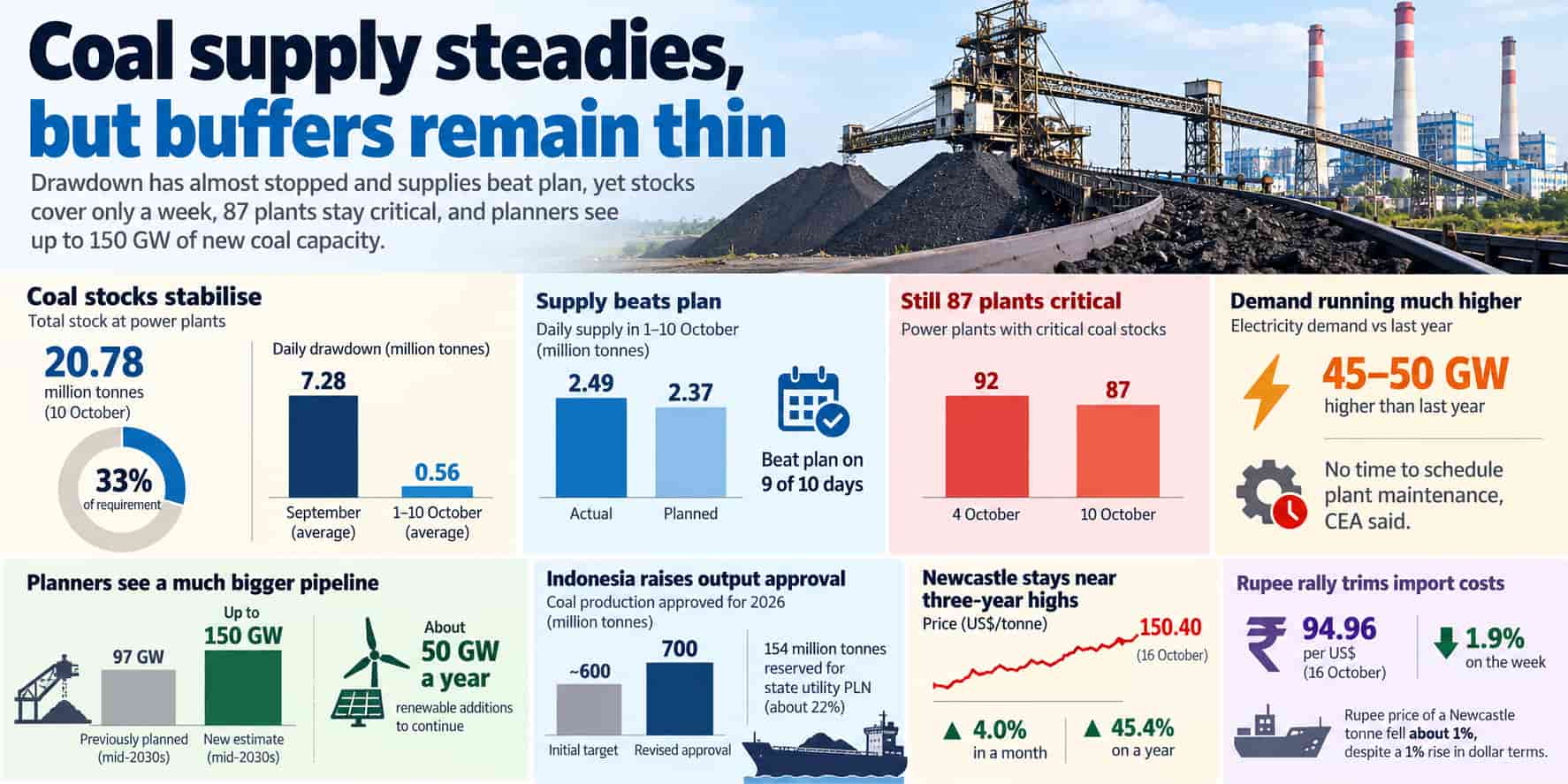
The slide has nearly stopped. Stocks at plants running on domestic coal stayed above 18 million tonnes through the first ten days of October. The drawdown in that period was just 0.56 million tonnes, against 7.28 million tonnes in all of September, the Ministry of Coal said on 12 October. Supply averaged 2.49 million tonnes a day against a plan of 2.37 million, and beat the plan on nine of ten days.
The base is still thin. Total stock was 20.78 million tonnes on 10 October, or 33% of the requirement. Eighty-seven plants were critical, down from 92 on 4 October.
The next day brought a sterner note. The CEA head said stocks were still depleting almost daily. Demand was running 45–50 GW above last year, leaving no time to schedule plant maintenance, as per a media report.
Both statements can be true. A plant with about a week of cover cannot shut a unit for repairs without risking supply.
“Stable is not the same as safe. The stock has stopped sliding, but there is no room left to schedule maintenance,” an executive at a leading thermal utility said.
Planners start thinking bigger
Planners are drawing a long-term conclusion from this stress. The CEA now says the 97 GW of new coal capacity planned for the mid-2030s could rise to as much as 150 GW, according to the same report. It added that renewable additions of about 50 GW a year would continue.
Two cautions apply. The figure is an estimate, not an approved programme. It also rests on a year when a weak monsoon cut hydropower, which is a thin base for a decade-long plan.
“Planning a decade on the basis of one dry monsoon would be a mistake, but planning for none of it would be a bigger one,” a senior power-sector planner said.
Policy in the meantime is domestic-first. The Power Secretary has ruled out mandatory imported-coal blending this year, citing fuel costs and a focus on domestic output and logistics. NTPC plans to buy 10–15 million tonnes from commercial mines this fiscal, as reported earlier this month. That sharpens the transition debate Indoen has tracked since August: plants must be both more flexible and more numerous.
 Indonesia loosens its grip as Newcastle holds high
Newcastle closed at US$150.40 a tonne on 16 October, up 4.0% in a month and 45.4% on a year, market data shows. Buyers in Asia and Europe are stocking ahead of winter, and coal is far cheaper than LNG on an energy basis. Indonesia’s August shipments fell 23%, and the IEA expects its output to drop by over 12 million tonnes this year.
Supply policy turned on 16 October. Jakarta approved about 700 million tonnes of production under its revised 2026 plan, with 154 million tonnes reserved for state utility PLN, trade reports indicate. That is up from the roughly 600 million tonnes first targeted.
Indonesia supplied about four-fifths of India’s power-sector coal imports in August, so a larger quota could ease the price floor over time. But PLN’s share is over a fifth of the total, so exports will not flood back.
Landed cost: the rupee does the work
Imported coal got cheaper in rupee terms this week, for a reason outside the coal market. The rupee gained 1.9% on the week to close at 94.96, its first close below 95 since 8 September, helped by Reserve Bank dollar-supply measures, currency data shows. Newcastle was about 1% higher in dollars than its US$148.85 of 9 October. Net, the rupee price of a Newcastle tonne fell about 1%.
Freight was mixed. The Baltic Dry Index closed at 2,511, its lowest since 30 June and down 14% on the week, with capesize down 25%. Panamax slipped 4.5% while supramax gained 2.8%, shipping data shows. Those mid-sized ships carry much of the coal on shorter routes, so importers saw less relief than the capesize slump suggests.
The saving is fragile. Traders say crude prices and foreign outflows cap rupee gains, and the currency was near record lows only a week earlier. A reversal would erase it.
What it means
The week shows a system that has stopped getting worse, not one that has got better. Cover is still about a week, demand is far above last year, and planners are preparing for a coal-heavier decade. The test is whether stocks rebuild before festive and winter demand, as the ministry hopes, a theme last week’s analysis flagged.