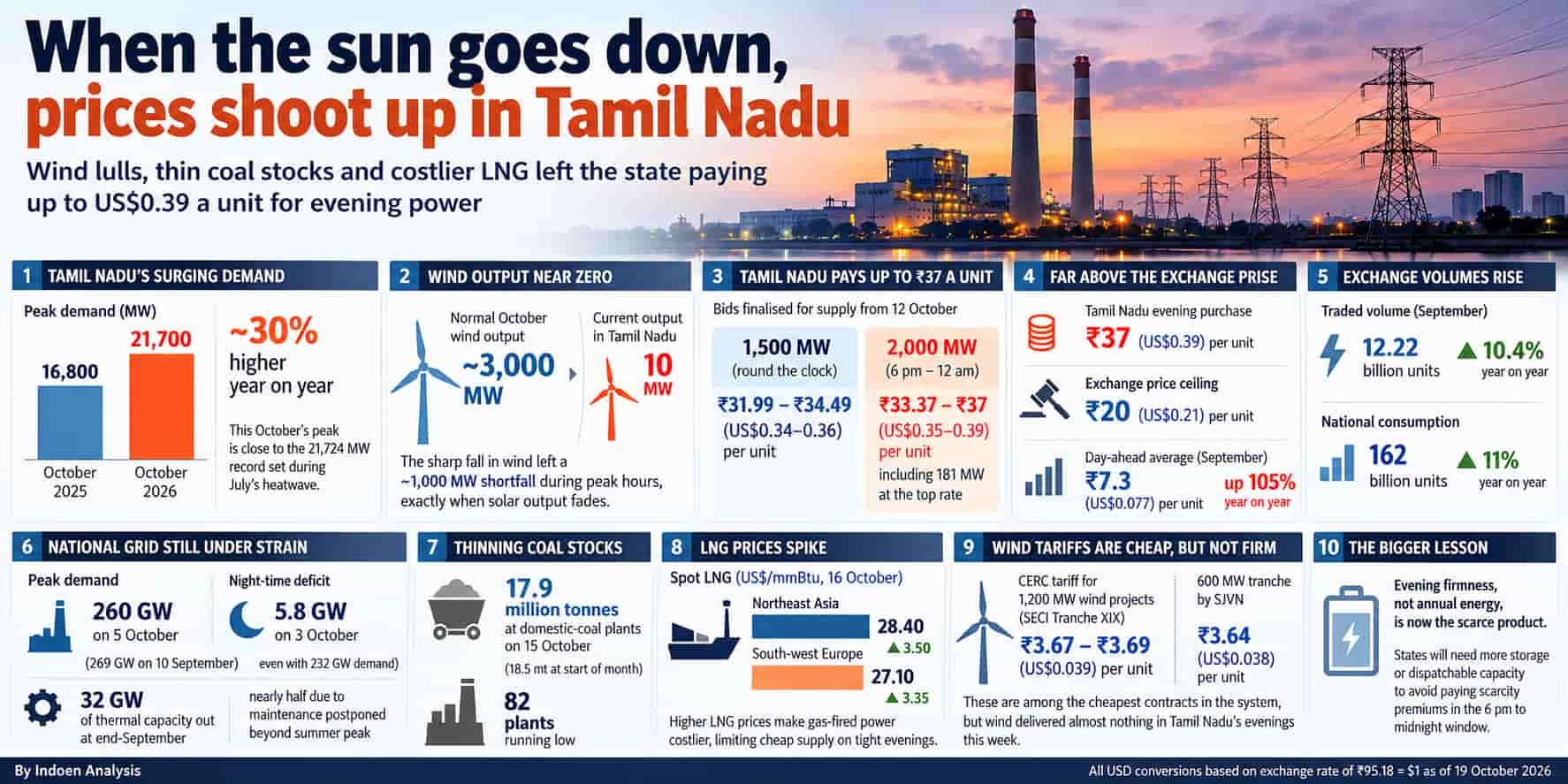
Tamil Nadu’s peak demand has touched nearly 21,700 MW this October, almost 30% above the roughly 16,800 MW of a year ago, according to a media report. That is within a whisker of the 21,724 MW record set during July’s heatwave. The usual October cooling has not arrived, and the northeast monsoon is still awaited.
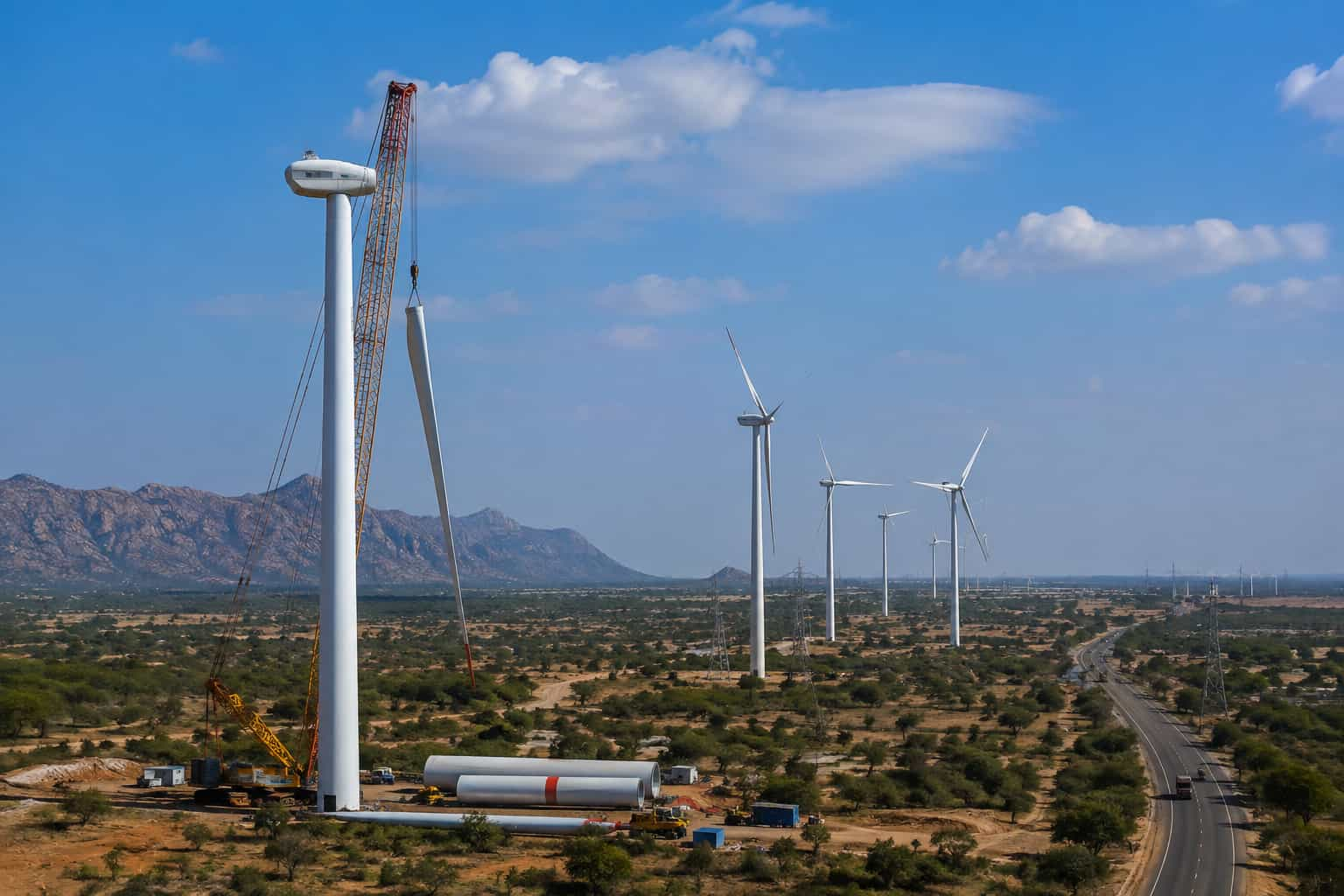
Wind, which normally supplies about 3,000 MW in the state, fell to a negligible 10 MW. That left a peak-hour shortfall of around 1,000 MW, as per a regional editorial. The gap opens exactly when solar fades. That timing, not total energy, drives the price.
Beyond the exchange ceiling
Tamil Nadu’s distribution utility invited bids for 4,500 MW only on 6 October, for supply from 12 October. It finalised about 1,500 MW round the clock at ₹31.99 to ₹34.49 (US$0.34–0.36) a unit. It also bought 2,000 MW for the 6 pm to midnight window at ₹33.37 to ₹37 (US$0.35–0.39), with 181 MW at the top rate.
The comparison is striking. The exchange ceiling is ₹20 (US$0.21) a unit, and the day-ahead average for September was ₹7.3 (US$0.077), up 105 % year on year. Traded volume rose 10.4% to 12.22 billion units, while national consumption grew 11% to 162 billion units, industry data shows. A state that goes to market a week ahead can thus pay nearly double the ceiling and about five times the monthly average. The cap binds on the exchange, not on bilateral short-term deals.
“The ceiling protects buyers on the exchange, but a state that goes to market a week before it needs power meets a seller’s market with no ceiling at all,” said an analyst tracking India’s power markets.
There is a counter-view. The state’s electricity minister has said only gas-based power was available at bidding, and that the extra cost would be ₹5 crore to ₹7 crore (about US$1 million) a day. Gas plants charge a fixed cost of just ₹1 a unit if supply is cancelled, which gives flexibility, and drawal has been limited to 1,500 MW from 15 October.
Critics point to Andhra Pradesh, which bought 150 MW at ₹16 to ₹20 (US$0.17–0.21) on 9 September, and West Bengal, which secured ₹14.5 (US$0.15) for 11 to 19 October.
 National grid: Thin evenings, thinner coal
The squeeze is not confined to the south. Peak demand reached 260 GW on 5 October after touching 269 GW on 10 September.
A night-time deficit of 5.8 GW was recorded on 3 October even though demand was only 232 GW. About 32 GW of thermal capacity was out at the end of September, nearly half of it due to maintenance postponed beyond the summer peak. Maximum available wind output was down by almost a third, according to a media report.
Fuel adds to the strain. Coal stock at domestic-coal plants stood at 17.9 million tonnes on 15 October, down from 18.5 million tonnes at the start of the month. Some 82 plants were running low, and exchange prices stayed above ₹7 (US$0.074) a unit, as per recent trade data.
Weak monsoon rains had already cut hydro output, so thermal and gas units carry the post-sunset load. The emergency order on 112 captive coal plants, covered in Indoen’s look at the September supply squeeze, remains in force until 31 December.
Global: LNG raises the price of flexibility
Spot LNG in Northeast Asia jumped US$3.50 to US$28.40 per mmBtu on 16 October. South-west Europe gained US$3.35 to US$27.10, as worries over European storage and Middle East uncertainty pulled cargoes, industry data shows.
For India, the consequence is direct. Gas-fired plants are the flexible source on tight evenings, and at these prices their power cannot be cheap. That explains why only gas-based supply was on offer to Tamil Nadu. It also extends the repricing Indoen traced in its analysis of how Europe’s thin winter buffer and Qatar’s silence are repricing India’s gas.
Regulation: Cheap tariffs, wrong hour
The Central Electricity Regulatory Commission was busy on the supply side. It adopted tariffs of ₹3.67 to ₹3.69 (US$0.039) per kWh for 1,200 MW of inter-state wind projects, as per recent trade data. A separate 600 MW tranche developed by SJVN received ₹3.64 (US$0.038) per kWh. These are among the cheapest contracts in the system, roughly one-tenth of what Tamil Nadu paid for evening power.
Yet cheap energy is not firm power. The same technology delivered almost nothing in Tamil Nadu’s evenings this week. The lesson is not against wind. It is for pairing wind with storage or dispatchable capacity, so that low energy prices come with assured availability after sunset.
The transition test
This links the week to India’s wider grid-modernisation debate. Storage tenders are growing, as Indoen noted in its look at a 176.66 GWh battery pipeline. But tenders do not supply evening power until they are built. Until then, states will keep paying scarcity premiums at the margin.
“Evening firmness, not annual energy, is now the scarce product, and contracts will have to be written around the 6 pm to midnight window,” said a senior official at a central power sector agency.
The forward risk is seasonal. Cooler November weather may ease prices and hide the problem. But a winter LNG squeeze and slower coal logistics mean the same evening gap can return.