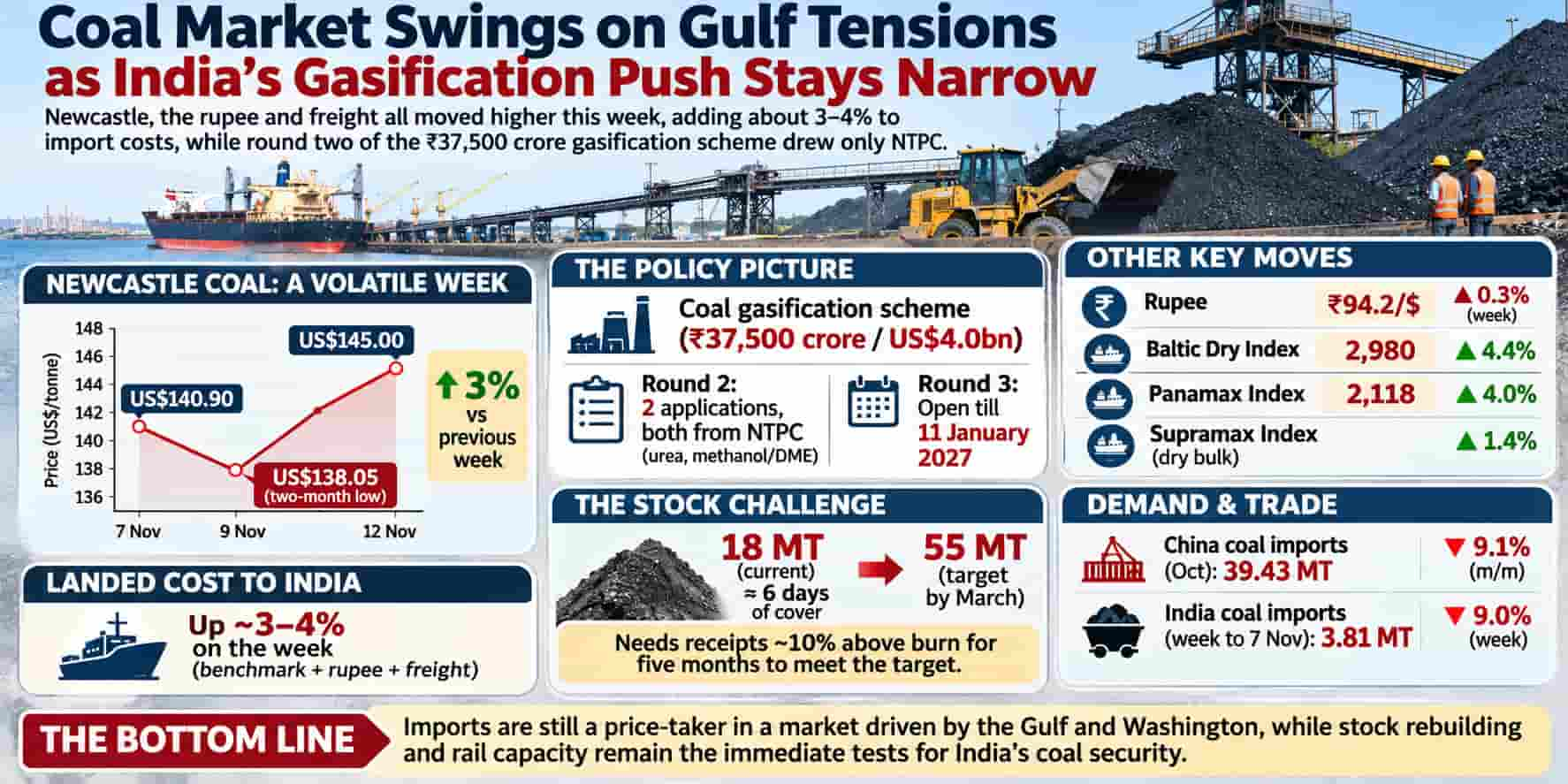
Newcastle thermal coal fell to US$138.05 a tonne on 9 November, its lowest in about two months. Crude and LNG had slid on hopes that the US midterm result would speed an Iran deal. By 12 November it had recovered to US$145, after Washington said it no longer needed a deal and Tehran demanded an end to the blockade first, market data shows. That left it about 3% above the previous Friday’s US$140.90, as per futures data.
A benchmark that moves about 5% in three sessions on diplomatic news behaves like a hedge against gas and oil disruption. Indian buyers cannot hedge that with domestic policy. Any import-led rebuilding of stocks, including the 55-million-tonne target set for March, will be priced off these headlines.
“Importers are buying a geopolitical premium, not just coal. When talks stall, the premium returns within days,” an analyst tracking Indian thermal coal markets said.
China offered little support. Its October coal imports were 39.43 million tonnes, down 9.1% on September and 5.5% on a year earlier, customs data shows. Softer Chinese buying may have eased competition for Indonesian and Australian cargoes early in the week. India’s own imports fell 9.0% to 3.81 million tonnes in the week to 7 November, as Coal Watch recorded.
The rupee and freight claw back the gain
The rupee closed near 94.2 on 13 November, about 0.3% weaker on the week. The dollar index reached a 19-month high on Fed-tightening expectations, and crude rebounded, currency reports show. A week earlier it had closed at a six-month high.
Freight added to the pressure. The Baltic Dry Index rose 4.4% to 2,980, its fourth weekly gain. The panamax index, which covers ships that often carry coal, gained 4% to 2,118, its highest since 22 October, and supramax rose 1.4%, shipping data shows.
Together, a dearer benchmark, a softer rupee and firmer freight raised the rupee cost of an imported Newcastle tonne by about 3–4% on the week. It is still about 4% below end-October levels. Landed cost has now swung by several per cent in each of the last two weeks, on events far from India’s coalfields.
 Policy: A USUS$4bn crore scheme with one applicant
On 10 November, the Ministry of Coal said round two of its ₹37,500 crore (USUS$4.0bn) gasification scheme had closed with two applications, both from NTPC. One proposes urea, the other methanol and dimethyl ether (DME). Round three opened the same day and runs to 11 January 2027, as per an official release. In September, the ministry rejected reports of no applications, saying Talcher Fertilisers and NTPC had already applied.
The pattern matters. The biggest coal-burning PSU is leading gasification, not private chemical or fertiliser companies. That keeps the scheme alive but narrows its reach, and it tempers expectations of quickly cutting urea and methanol imports.
“We see the early applications as a vote of confidence, and the third round gives others time to prepare,” a senior official at the Ministry of Coal said.
The effect on coal is slow. Gasification will draw domestic coal only after plants are built, so the near-term balance still depends on stocks and rail capacity. Indoen has also examined the fiscal exposure of coal-dependent states in its analysis of coal’s costly exit.
Stocks remain the binding constraint
Stocks were last reported near 18 million tonnes, about six days of cover, against the 55-million-tonne target for March, according to a media report. Meeting it needs receipts about a tenth above burn for five months, as last week’s analysis showed. A volatile import market makes that harder to plan, not easier.
For energy security, this week’s lesson is about dependence. Coal is both the system’s reserve and a price-taker in a market driven by the Gulf and Washington. Rebuilding the buffer through domestic mines and rail, not cargoes, reduces that exposure, which is why the ministries’ target leans on railways and miners. The next test comes on 31 December, when the Section 11 order on captive plants lapses.