India wants 100 GW of nuclear power by 2047. It has about 8.8 GW today, as per recent reporting. The destination is agreed. The fare is not.
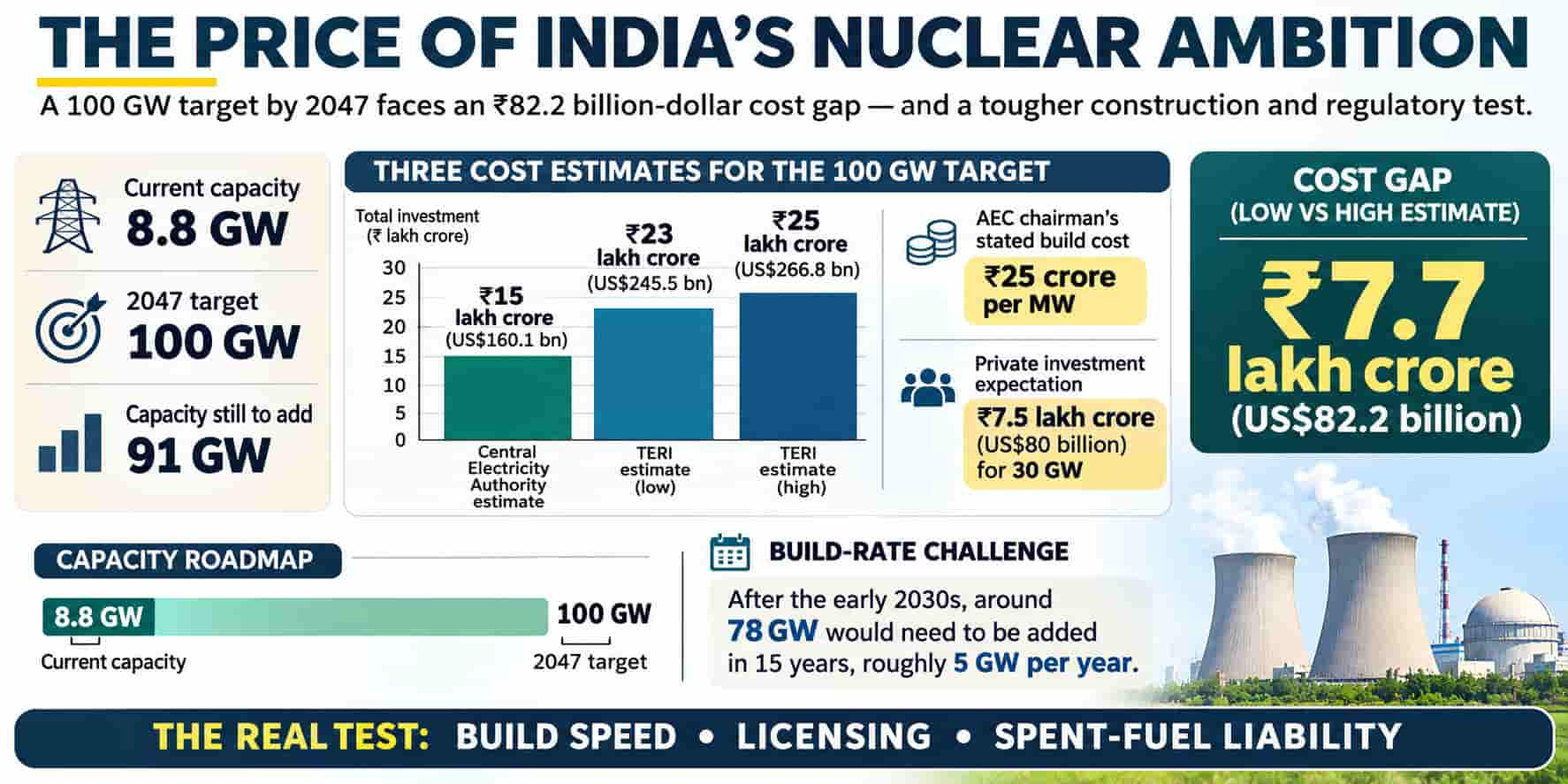
Three estimates now sit side by side. The Central Electricity Authority chairman has said the 91 GW still to be added needs around ₹15 lakh crore (US$160.1 billion). The Atomic Energy Commission (AEC) chairman has said it costs about ₹25 crore (US$3 million) to build 1 MW. He expects private players to invest ₹7.5 lakh crore (US$80.0 billion) for 30 GW.
A study by The Energy and Resources Institute (TERI) assumes ₹22 crore to ₹25 crore (US$2 million to US$3 million) per MW. It reaches ₹23 lakh crore to ₹25 lakh crore (US$245.5 billion to US$266.8 billion) for the full target.
Put them on one scale. The first works out to about ₹16,500 crore (US$1.8 billion) a gigawatt, by simple division. The other two sit near ₹22,000 crore to ₹25,000 crore (US$2.3 billion to US$2.7 billion). Apply that difference to 91 GW and the gap is roughly ₹7.7 lakh crore (US$82.2 billion). That is close to the entire private contribution the AEC expects.
None of the reports explains the spread. The likely reasons are easy to guess. Indigenous 700 MW units may cost less than imported designs, and a media report says French utility EDF has already discussed its EPR reactor with the power ministry. Small modular reactors add another unknown. India targets five indigenous units by 2033, backed by ₹20,000 crore (US$2.1 billion) under the Nuclear Energy Mission.
Money is not the scarce thing
Spread out, the annual need looks modest. ₹15 lakh crore over 21 years is about ₹71,000 crore (US$7.6 billion) a year. TERI’s range is ₹1.0 lakh crore to ₹1.2 lakh crore (US$10.7 billion to US$12.8 billion) a year. NTPC alone plans to invest ₹17 lakh crore (US$181.4 billion) through FY2037 across all fuels. About ₹7 lakh crore (US$74.7 billion) of that falls in the next five years. That is ₹1.4 lakh crore (US$14.9 billion) a year for one utility. The comparison is rough, but it shows nuclear is not beyond India’s balance sheets.
The global picture is heavier. The World Nuclear Association says USUS$6 trillion will be needed by 2050, averaging over USUS$250 billion a year. It adds that this is a requirement, not committed money. India’s ₹15 lakh crore is about 2.7% of that total. Yet its 91 GW would be about 8% of the net new capacity implied if global nuclear grows from 395 GW in 2024 to the association’s 1,467 GW by 2050.
The global figure also covers uranium, fuel and waste, so the match is not exact. Even so, it suggests India’s plan is priced at a third to a half of the world average per gigawatt. Either the indigenous fleet really is that cheap, or the estimates will climb.
The scarcer thing is build speed. India has 17 reactors, about 13 GW, under implementation, on top of the 8.8 GW running. That gets close to the 22 GW promised for the early 2030s, though statements place the date anywhere from 2030-31 to 2034. After that, the plan needs about 78 GW in 15 years. That is roughly 5 GW a year, or five to seven reactor starts annually, depending on unit size. Worldwide, construction began on only 11 reactors in 2025. The association says build rates must rise about sixfold. India’s whole fleet since 1969 adds up to 8.8 GW.
Time compounds the problem. The AEC chairman says projects take five to seven years. TERI’s authors say close to a decade. He expects a couple of private players to be running reactors within five years. So most private gigawatts will arrive after the mid-2030s. NTPC aims for about 6 GW by FY2037 and 30 GW by 2047, which means 24 GW in the last decade. As Indoen has noted for solar, time now decides which power source wins. Nuclear faces the same test, with longer lead times.
“In a nuclear project, delay is not a scheduling issue. It is a financing cost that grows every month a licence is pending,” said an executive at a large public-sector power utility.
 Where the fine print turns into cost
That is why NTPC’s asks matter. It has sought four changes to the draft SHANTI rules, a senior company official told the media. It wants the three-year limit removed from the definition of a newly formed company. It wants approvals that do not depend on the type of utility. It wants licensing time halved. And it wants imported equipment exempt from separate approval once a design is cleared.
NTPC plans to route its 30 GW through a joint venture with NPCIL and its own subsidiary. The joint venture is already building a 2,400 MW project in Banswara, Rajasthan.
The draft also adds costs of its own. Operators would be strictly liable for nuclear damage and must hold insurance or financial security. That security stays irrevocable until all spent fuel leaves the storage pool. Shares or bonds pledged as security must carry a 1:1.33 margin. An expert group would review liability limits every five years. These are sensible safeguards. But they lock up capital, and most of nuclear’s cost is financing, not fuel.
The bill that arrives after the reactor
SHANTI opens the reactor to private capital but keeps the fuel cycle with the state. Enrichment, reprocessing and high-level waste stay under government control. That is a defensible choice for a country outside the Non-Proliferation Treaty. But it creates a long public liability behind a private business.
The draft rules propose a Spent Fuel Management Fund, a Nuclear Liability Fund and separate security for decommissioning. They do not yet say how contributions will be calculated. Nor do they fix the moment when responsibility passes from operator to government. A reactor is a 60-year asset. Finland took decades to build a disposal system. The United States spent decades on Yucca Mountain without a lasting answer. At 100 GW, even temporary storage could become a bottleneck.
“Investors can live with a long liability if they can see its size,” said a researcher at a New Delhi-based energy think tank. “What worries them is a handover date that does not yet exist.”
Uncertainty like this does not disappear. It shows up later in financing costs, contracts and tariffs.
The coal question and the buyer question
The planners who want nuclear are also building coal. NTPC’s coal capacity may rise from 67 GW to 91 GW under current plans, according to executives. Peak demand is projected to rise from 250 GW in 2024-25 to 459 GW by 2035-36. Even 22 GW of nuclear would be under 5% of that peak. Nuclear supplied just 3% of India’s electricity, TERI’s authors note. Their conclusion is that it will not win the 2035 race but may decide what comes after.
Without firm clean power, the default is more coal at night. Indoen has already shown how coal plants can post a record month even as renewables hit a record share.
A second question is who signs the cheque for the power. The draft rules allow captive nuclear for hard-to-abate industries and data centres. Industrial buyers could then carry demand risk that state distribution companies may struggle to bear. Abroad, technology firms already do this, as in Google’s US$4.3 billion nuclear-backed power deal.
Three signals will show where the bill lands. They are the final SHANTI rules after consultation, the first private licence and tariff, and the formula for the spent-fuel fund. If costs settle near ₹16,500 crore (US$1.8 billion) a gigawatt, India will have built a far cheaper fleet than the world. If they drift above ₹25,000 crore (US$2.7 billion), the private ₹7.5 lakh crore (US$80.0 billion) will fall short of 30 GW. Either way, the first cheques will be written against rules that are still being finalised.
Follow us on : X | LinkedIn | Facebook | Bluesky