The European Commission has indicated that it will review the rules defining green hydrogen. The reason is simple. The market has grown more slowly than expected, with projects delayed or cancelled. Energy Commissioner Dan Jørgensen has said the proposed changes will soon go out for public feedback.
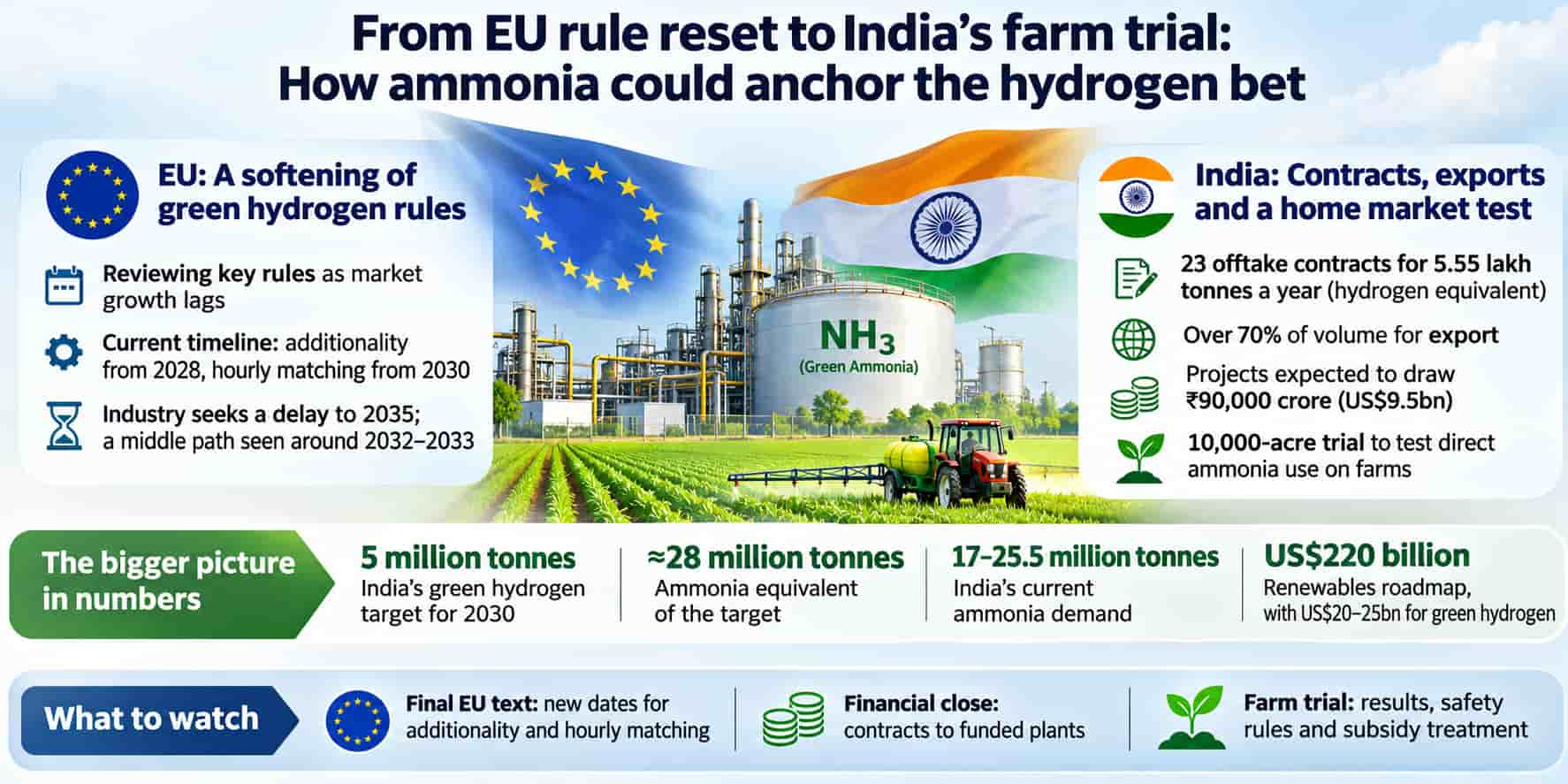
The rules matter because they drive cost. Under the current text, new projects must meet “additionality” from 2028, and hourly matching replaces monthly matching from 2030. Additionality means the electrolyser must run on electricity from newly built renewable capacity, subject to specified exemptions and transitional provisions. Hourly matching means the power must be generated in the same hour it is used. An earlier study found that hourly matching alone could raise green hydrogen costs by more than a quarter.
Industry wants more time. About two dozen associations have asked for both rules to be pushed to 2035. Some consultants expect a middle path, with new dates around 2032 or 2033. Nothing is final until the amended text is formally adopted. Environmental groups urge caution, arguing that grid decarbonisation alone does not remove the need for safeguards.
A policy adviser familiar with the discussions framed the stakes carefully. “The review is meant to rescue the European market first,” the adviser said. “Whether exporters gain depends on the fine print, especially the start dates and the protection for early projects.”
An order book that looks outward
India has, for its part, signed 23 offtake contracts covering about 5.55 lakh tonnes a year, in green hydrogen equivalent, according to the ministry. That is about 11% of the five-million-tonne mission target for 2030.
Eighteen of the deals were signed in 2026. More than 70% of the volume is earmarked for export, and the projects are expected to draw ₹90,000 crore (US$9.5bn) of investment. The investment figure represents expected investment associated with the projects, not capital already deployed.
The named buyers are largely foreign. ACME has agreed to supply 4.88 lakh tonnes of green ammonia a year to Japan’s IHI, while AM Green has deals with Germany’s Uniper and Japan’s JERA. Indoen has already noted that nearly 90% of the 2030 volume target is still uncontracted.
Timing is the quiet problem. India could start exporting green ammonia as early as 2028, with buyers in Europe and Japan in talks. That is the same year EU additionality requirements begin. The EU’s rules also apply equally to imported hydrogen. A delay therefore helps Indian suppliers seeking access to the European market.
It cuts the other way too. Softer rules also lower costs for European producers who can use their own grids. That may narrow the price gap India is counting on. Indoen has earlier examined how the EU’s carbon border levy shapes this demand. A softer rulebook may soften that pull as well.
 Counting in the right unit
The headline figure hides a unit problem. The ministry counts in hydrogen equivalent. The named deals are in ammonia and methanol tonnes. Ammonia is about 17.6% hydrogen by weight. In one earlier tender, 724,000 tonnes of ammonia translated into roughly 127,400 tonnes of hydrogen.
On that arithmetic, ACME’s 4.88 lakh tonnes of ammonia carries about 86,000 tonnes of hydrogen. That is around 15.5% of the national total. This is an Indoen calculation.
Run the same sum on the target. Five million tonnes of hydrogen equals roughly 28 million tonnes of ammonia. Estimates of India’s ammonia demand range from 17–19 million tonnes to 25.5 million tonnes. So the mission cannot be met through ammonia alone, even if every domestic tonne turned green. Steel, refining, chemicals and exports must carry the rest. That is why European rules matter to an Indian target.
A farm trial and a second buyer
In outlining India’s US$220bn renewables roadmap, the renewable energy secretary mentioned a trial on 10,000 acres across six states and ten crops. It injects ammonia directly into the soil instead of spraying urea. Early reports suggest the method could waste less fertiliser.
Ten thousand acres is about 4,000 hectares. It is a tiny pilot. But the idea could change who the buyer is. Today, green ammonia is meant to slot into existing fertiliser plants. About 6.7 lakh tonnes a year is contracted to 11 plants under the SIGHT programme.
Direct application, if proven commercially viable, would create another potential route for ammonia consumption. Against the higher demand estimate, the earlier 724,000-tonne tender covers approximately 2.8–4.3% of national demand, depending on which demand estimate is used. That shows how much domestic room is left.
The challenges are real. Ammonia is toxic and is stored under pressure. It needs trained handlers and special equipment, which smallholders may struggle to access. Direct soil injection would also require suitable machinery and safety procedures. Urea is sold at government-controlled prices, so any new route must fit the subsidy system.
A researcher at a New Delhi-based energy think tank saw the strategic value. “Export contracts show the world wants Indian molecules,” the researcher said. “A domestic farm market shows India can pay for them. A mature hydrogen economy needs both.”
A small slice of a large plan
On paper, the mission is modest. It has a public outlay of ₹19,744 crore (US$2.1bn) and aims to attract more than ₹8 lakh crore (US$85.2bn), according to official figures.
Yet the US$220bn renewables roadmap earmarks only US$20–25bn for green hydrogen, about a tenth. The scopes differ, because the mission figure includes the renewable capacity behind the hydrogen. Still, the gap shows how much of the hydrogen bill sits under solar, wind and transmission. Cheap, firm power may decide the outcome more than electrolysers.
What to watch
Three markers will show whether this bet pays off. The first is the EU text itself: the new additionality date, the hourly-matching date and the protection for early movers. The second is financial close. Indoen has argued that hydrogen’s pledges are not yet a market, and a signed contract is not a funded plant. The third is the farm trial. Results, safety rules and subsidy treatment will show whether India can build a home market that does not depend entirely on Brussels.
Europe has acknowledged that its rules may have run ahead of its market. India should avoid the same mistake with its contracts.
Follow us on : X | LinkedIn | Facebook | Bluesky