
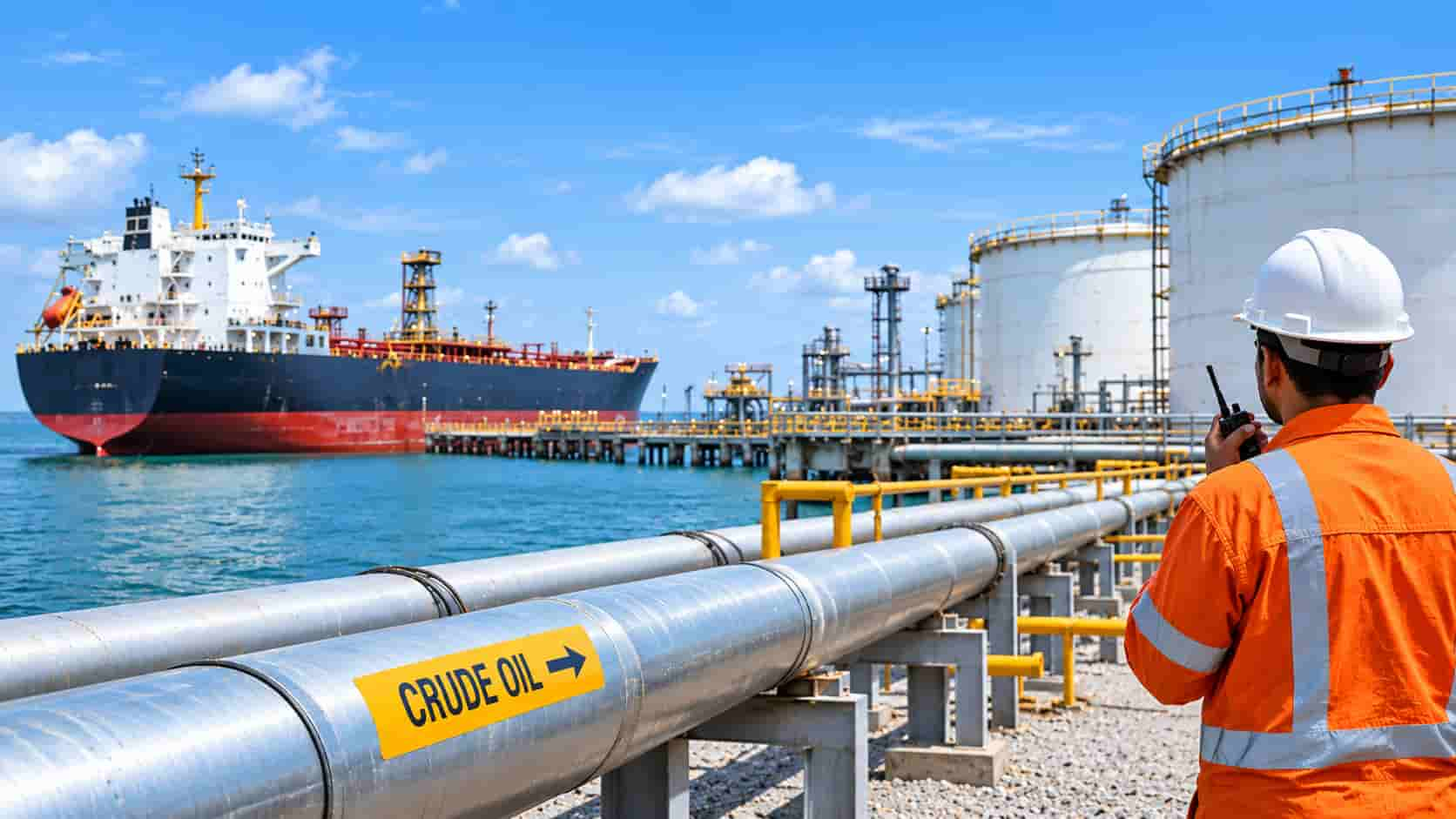
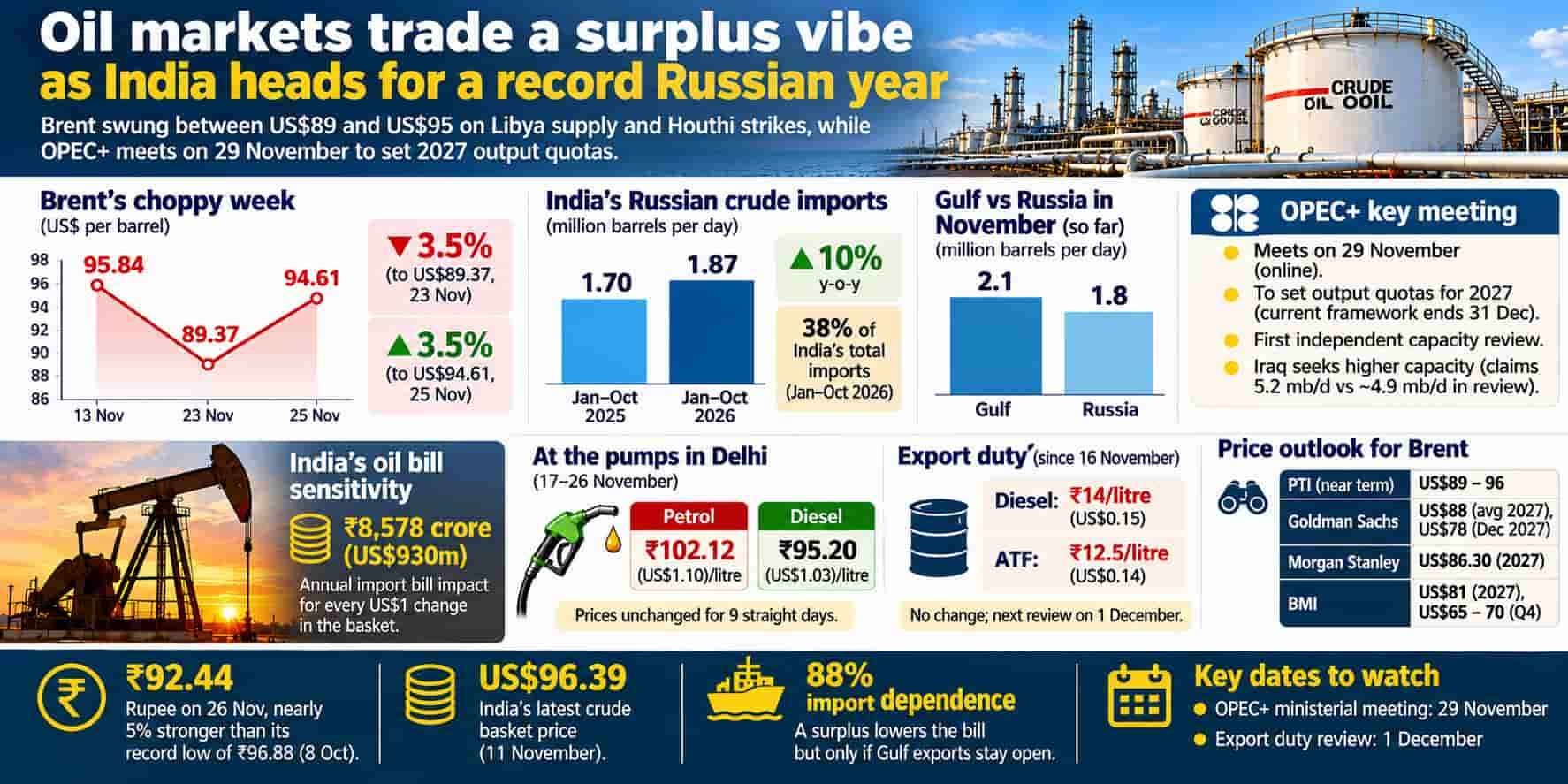
Brent (January contract) fell 3.5% to US$89.37 on Monday 23 November, its lowest close since August. Libya’s Sharara pipeline reopened, and Gulf exports kept rising. The fall came despite attacks on ships over the weekend of 21-22 November and a Houthi claim of a strike on Saudi Arabia’s Rabigh refinery on 22 November.
Brent rose more than 2% on 24 November. On 25 November it climbed 3.5% to US$94.61, after the Houthis said they had attacked Ras Tanura, Saudi Arabia’s largest refinery, and Riyadh’s financial district. On 26 November Iran said mines had struck ships near Hormuz, and prices eased early that day.
The moves show how the market is trading. A refinery strike added only a few dollars, because forecasts of a surplus dominate. “The market is pricing the surplus first and the attacks second,” said an analyst tracking global crude markets.
For India, each US$1 on the basket is worth about ₹8,578 crore (USUS$930m) a year. The latest verified basket reading is US$96.39 on 11 November, as per aggregated price data.
India’s record Russian year, and why it may not last
India took 1.87 million barrels a day of Russian crude in January-October, about 10% more than a year earlier and 38% of its imports, as per Kpler data. Through early November the figure was 1.99 million. China and India together bought more than 80% of Russia’s crude exports. US sanctions waivers helped, as did Ukrainian drone strikes on Russian refineries, which pushed more crude into exports.
This can look at odds with Gulf supply overtaking Russia’s in early November, at 2.1 million against 1.8 million barrels a day. Both are true. The year-to-date total reflects heavy buying earlier in the year, while November marks a turn. Analysts expect Russian purchases to ease in 2027 as Gulf supply recovers and Russian grades lose their price advantage.
“A record year does not set next year’s buying; we buy what is cheapest delivered, and that is now closer to home,” said an executive at a leading Indian refiner. A fresh Hormuz closure could still push refiners back to Russian barrels.
 OPEC+ meets on 29 November with 2027 quotas at stake
OPEC+ ministers meet online on Sunday 29 November, after this brief’s window, to set an output framework for 2027. The current one expires on 31 December. The meeting will use the first independent capacity review. Iraq is pressing for a higher estimate of its capacity, because capacity decides quota.
The review reportedly puts Iraq near 4.9 million barrels a day, close to the International Energy Agency’s (IEA) 4.87 million, while Baghdad claims 5.2 million. Kazakhstan also objects. Higher quotas would add barrels to a market the IEA already expects to be in surplus in 2027. For India, a surplus would lower the basket later, but only if Gulf exports stay open.
Pumps frozen, export duty unchanged, rupee firmer
Delhi petrol stayed at ₹102.12 (USUS$1.10) a litre and diesel at ₹95.20 (USUS$1.03) every day from 17 to 26 November. The export duty set on 16 November did not change: ₹14 (USUS$0.15) a litre on diesel and ₹12.5 (USUS$0.14) on aviation turbine fuel (ATF). The next fortnightly review is due on 1 December.
The rupee settled at ₹92.44 on 26 November, down 24 paise on the day on higher crude and US tariff worries. It is still nearly 5% above its record low of ₹96.88 on 8 October.
Where forecasters see prices heading
Near term, analysts surveyed by PTI expect Brent between US$89 and US$96 before the OPEC+ meeting. Beyond that, banks see lower prices. Goldman Sachs expects an average of US$88 in 2027, falling to US$78 by December 2027, and Morgan Stanley US$86.30 for 2027.
The OPEC+ decision could move the long-term path. BMI sees US$81 for 2027 and US$65-70 in the fourth quarter, rising to US$70-75 if OPEC+ restrains output and falling to US$60-65 if it does not. These forecasts assume a Gulf recovery. A wider Hormuz closure would break them.
What it means for energy security
With 88% import dependence, India is exposed to both a price fall and a rebound. The surplus helps the import bill only while Gulf exports stay open. The next checkpoints are the OPEC+ meeting on 29 November and the export duty review on 1 December.