
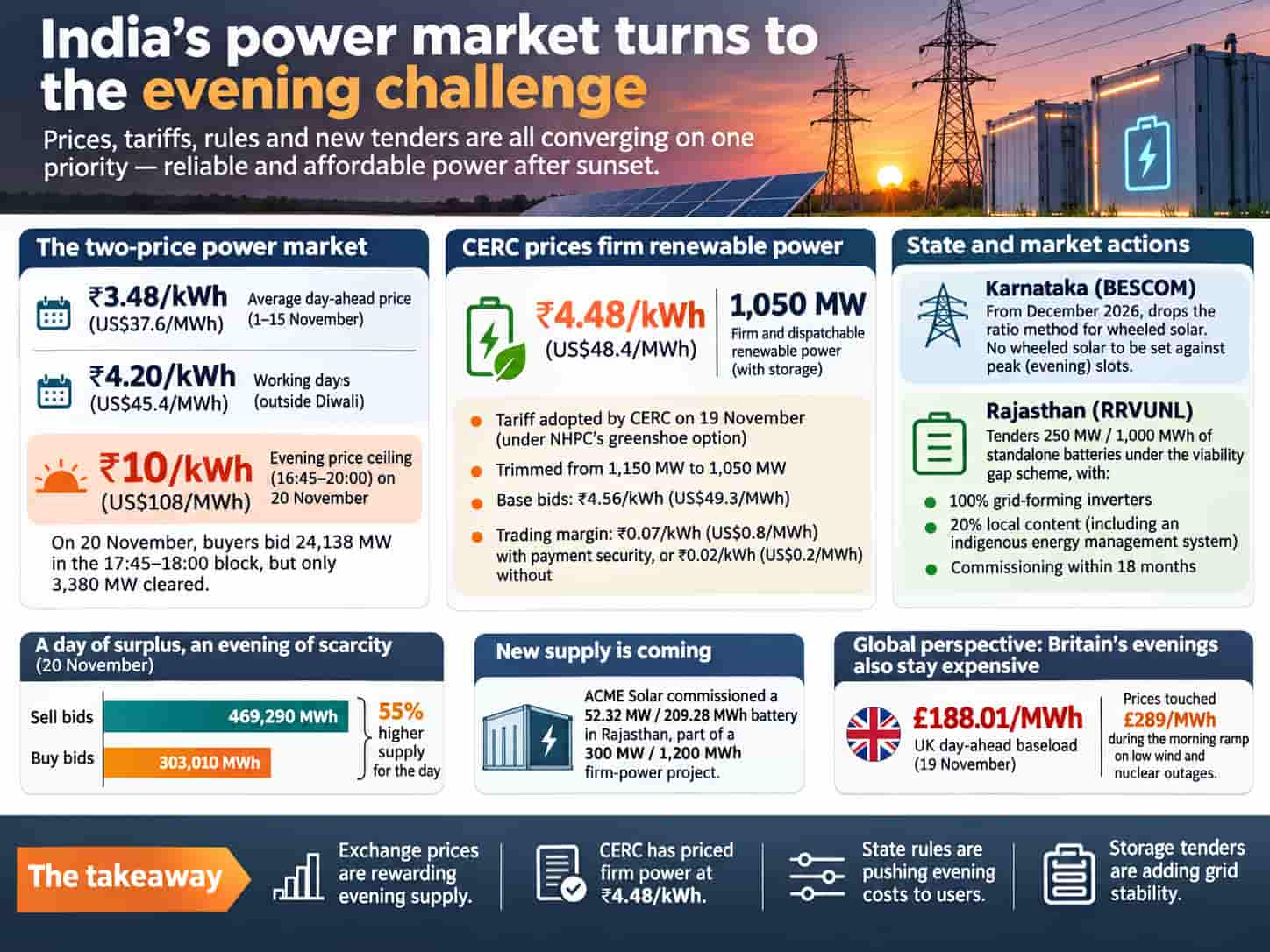
Day-ahead prices stayed soft in the first half of November. The market-clearing price averaged ₹3.48 per kWh (US$37.6 per MWh) over 1–15 November. Working days outside Diwali averaged ₹4.20 per kWh (US$45.4 per MWh). The softening came with lower national demand, reduced coal burn and recovering plant stocks, industry data shows. Indoen covered the supply side in its note on coal stocks recovering on lower burn.
The evening told a different story. On 20 November, the price sat at the ₹10 per kWh (US$108 per MWh) ceiling in every 15-minute block from 16:45 to 20:00, exchange data shows. In the 17:45–18:00 block, buyers bid 24,138 MW, sellers offered 3,586 MW and 3,380 MW cleared. By 23:15 the price had dropped to ₹3.28 per kWh (US$35.4 per MWh).
Over the full day, sell bids of 469,290 MWh exceeded purchase bids of 303,010 MWh by 55%. The market was oversupplied in total and short at dusk. Indoen described this pattern in its look at India’s grid strain.
“A market that clears every noon block and rations every dusk block is not short of energy. It is short of energy at the right hour,” said an analyst tracking India’s power markets.
Firm power gets a price
On 19 November, CERC adopted a tariff of ₹4.48 per kWh (US$48.4 per MWh) for firm and dispatchable renewable power with storage, under NHPC’s greenshoe option. It trimmed the request from 1,150 MW to 1,050 MW, citing fairness in competitive bidding. The base bidders had quoted ₹4.56 per kWh (US$49.3 per MWh). NHPC may add a trading margin of ₹0.07 per kWh (US$0.8 per MWh) if payment security is in place, and ₹0.02 per kWh (US$0.2 per MWh) otherwise, a trade report said.
The tariff sits in the gap. It is about 29% above the 1–15 November average, yet under half of the dusk ceiling. For a discom facing evening bids at ₹10 per kWh (US$108 per MWh), a contract near ₹4.48 per kWh (US$48.4 per MWh) is a hedge.
The supply is arriving. ACME Solar commissioned a 52.32 MW/209.28 MWh battery in Rajasthan, part of a 300 MW/1,200 MWh firm-power project, with operations set for 19 November, as per recent trade data.
“Firm renewable supply sits between the noon trough and the dusk cap, and that is exactly where discoms need long-term cover,” said a senior official at a central power sector agency.
There is a caution. CERC’s cut shows regulators are watching greenshoe allocations closely, and an adopted tariff still needs signed supply agreements with buyers.
 The rules catch up with the clock
On 19 November, Bangalore Electricity Supply Company Limited (BESCOM) revised time-of-day billing for high-tension consumers buying wheeled solar. From the December 2026 billing month, it drops the ratio method, which spread solar across all four slots in proportion to consumption. No wheeled solar will now be set against peak slots, a circular shows.
BESCOM’s own example explains why. Under the old method, 11,50,616 units of solar were adjusted against peak-slot consumption, and only 5,790 units were billed as utility supply. That is 99.5% of evening consumption netted off by midday solar. Open-access buyers will now pay for the evening they use.
Storage procurement is changing too. Rajasthan’s RRVUNL tendered 250 MW/1,000 MWh of standalone batteries under the viability gap scheme, with bids due on 21 December. It requires 100% grid-forming inverters, 20% local content including an indigenous energy management system, and commissioning within 18 months, according to a media report.
Grid-forming inverters answer the low-frequency concern Grid-India raised earlier this month. Indoen examined the local-content debate in how India’s storage rules differ from China’s.
Global: Britain’s evenings, set by gas and wind
UK day-ahead baseload settled at £188.01/MWh on 19 November. Wind was well below seasonal norms, and nuclear outages at Heysham 1 and 2 left gas plants to balance the system. Prices touched £289/MWh in the early hours as the morning ramp met light wind, an energy market report said.
For India, the lesson is structural. A grid with large renewable capacity prices its ramp hours, not its average hours, wherever it sits. Britain’s squeeze comes from fuel cost and weak wind. India’s comes from capacity after sunset. Both reward firm and fast-responding supply.
The transition test
Read the week as one chain. The exchange prices the dusk gap at ₹10 per kWh (US$108 per MWh). CERC prices firm power at ₹4.48 per kWh (US$48.4 per MWh). A state utility changes billing so the evening cost reaches the user. A state generator tenders batteries that stabilise frequency. Each link is small, but together they turn a scarcity into a market.
The unfinished part is delivery. Tariffs and tenders are not megawatt-hours. Until supply agreements are signed and batteries are commissioned, dusk will keep clearing at the ceiling.