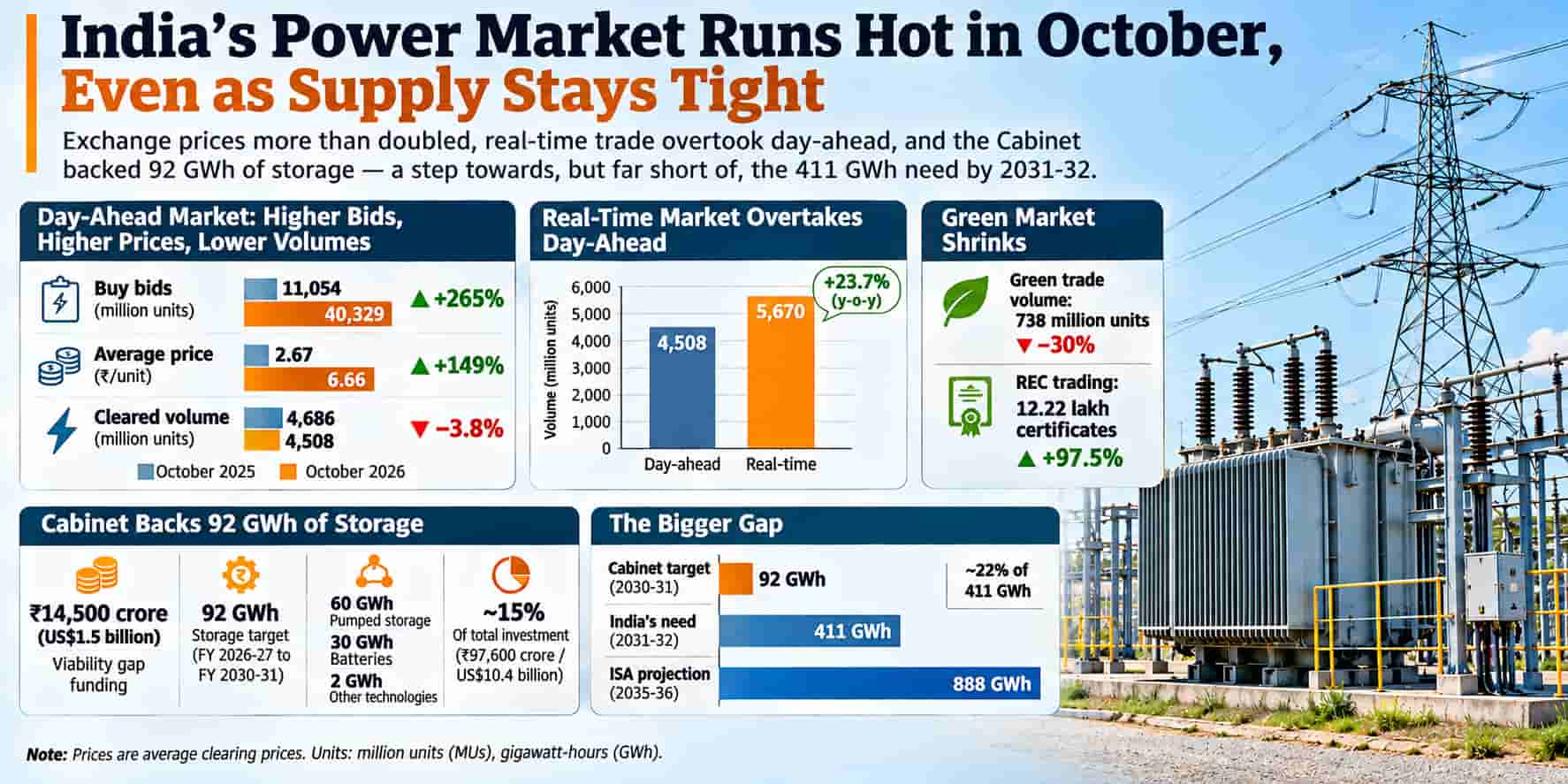
The exchange’s October data, released on 3 November, shows an odd pairing. Day-ahead buy bids rose 265% from a year earlier. The average clearing price rose 149% to ₹6.66 (US$0.071) a unit, from ₹2.67 (US$0.028). Yet cleared day-ahead volume fell 3.8% to 4,508 million units, as per recent trade data.
Buyers asked for far more and got slightly less. That points to a market short of sellers, not buyers. There is a caveat. The exchange itself says part of the jump reflects a low base, since demand in October 2025 was relatively weak. Even so, national consumption of 159.8 billion units was 21.9% higher.
“When buy bids rise by more than two and a half times and cleared volume still falls, the market is telling you it ran out of sellers, not buyers,” said an analyst tracking India’s power markets.
The monthly average also hides a swing. As Indoen reported on 2 November, the day-ahead price had eased to ₹3.65 (US$0.039) on 30 October, as spot power prices halved in weeks.
Real-time overtakes day-ahead, and green trade shrinks
Real-time market volume rose 23.7% to 5,670 million units, about a quarter larger than the day-ahead market. Its average price was ₹5.78 (US$0.062), up 112%, with near-zero prices in several blocks when demand was low. Term-ahead volume rose 138.8%.
Green trade moved the other way. The green market fell 30% to 738 million units, even as its day-ahead price rose 67% to ₹4.13 (US$0.044). Renewable energy certificate trading nearly doubled, up 97.5% to 12.22 lakh certificates, exchange data shows. Buyers may be turning to certificates when physical green power is scarce.
 States hedge with 25-year coal
Reported on 5 November, Adani Power signed a 25-year agreement to supply Uttarakhand 1,234 MW at a composite tariff of ₹5.746 (US$0.061) a unit. The tariff is subject to adoption by the state regulator. That is ₹0.91 (US$0.010) below October’s day-ahead average. The logic is plain: a state that paid spot prices in a weak-monsoon autumn wants a fixed price.
The counter-view is lock-in. A 25-year coal commitment can become a liability when noon prices collapse in spring.
“For a discom, a 25-year contract is insurance against a bad October and a burden in a good April,” said an executive at a leading Indian discom.
The regulator’s adoption order will show whether such cover is treated as prudent procurement.
A storage cheque for a 411 GWh problem
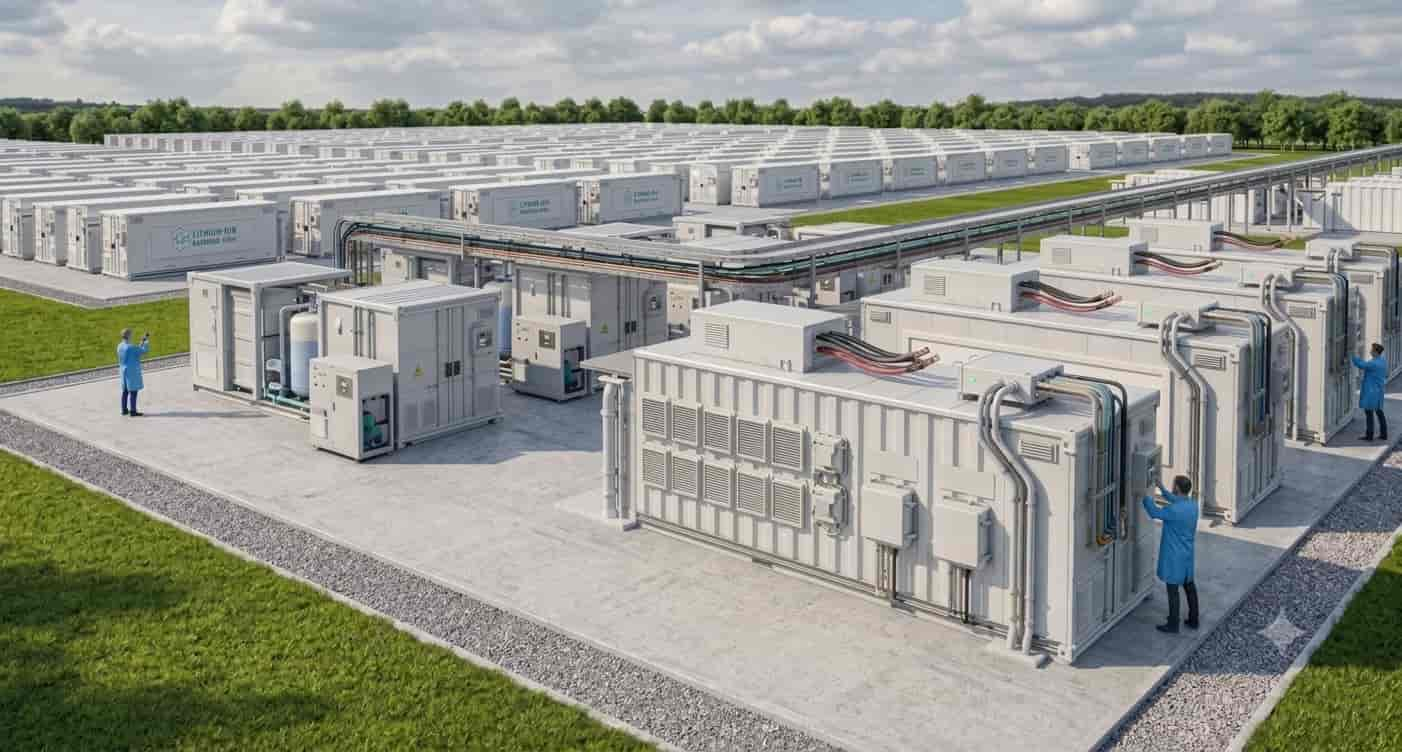
On 4 November, the Union Cabinet approved ₹14,500 crore (US$1.5 billion) of viability gap funding for about 92 GWh of grid-scale storage between FY 2026-27 and FY 2030-31. The target is 60 GWh of pumped storage, 30 GWh of batteries and 2 GWh of other technologies. Estimated investment is ₹97,600 crore (US$10.4 billion). Capacity will be allocated through competitive bidding, and batteries must meet 40% domestic content.
The arithmetic is instructive. Support covers about 15% of the investment. The 92 GWh is about 22% of the 411 GWh the government says will be needed by 2031-32. It is roughly 10% of the 888 GWh an International Solar Alliance report projects for 2035-36.
There are two caveats. Pumped storage is about 65% of the target and takes years to build, so it will not ease this winter’s evenings. And the domestic-content rule meets a battery market where, as Indoen has reported, prices have reversed after bids were won on 2025 cell costs.
Regional: Nepal’s window closes
Nepal’s annual 40 MW export window to Bangladesh through India’s grid runs from 15 June to 15 November, under the tripartite arrangement. It closes on 15 November. In winter, Nepal turns importer.
For India, that means more demand from a neighbour just as its own evenings stay tight. India has already approved exports of up to 654 MW to Nepal until 31 December.
The transition test
October’s numbers and the storage scheme describe the same gap from two sides. The market pays heavily for scarce hours, and the state is funding assets to fill them, but over five years. In between, discoms must choose between spot risk and long-term lock-in. How that choice is priced will shape grid modernisation as much as headline capacity. Indoen’s earlier look at why India’s power fix may lie in retail competition frames the same trade-off.
Follow us on : X | LinkedIn | Facebook | Bluesky