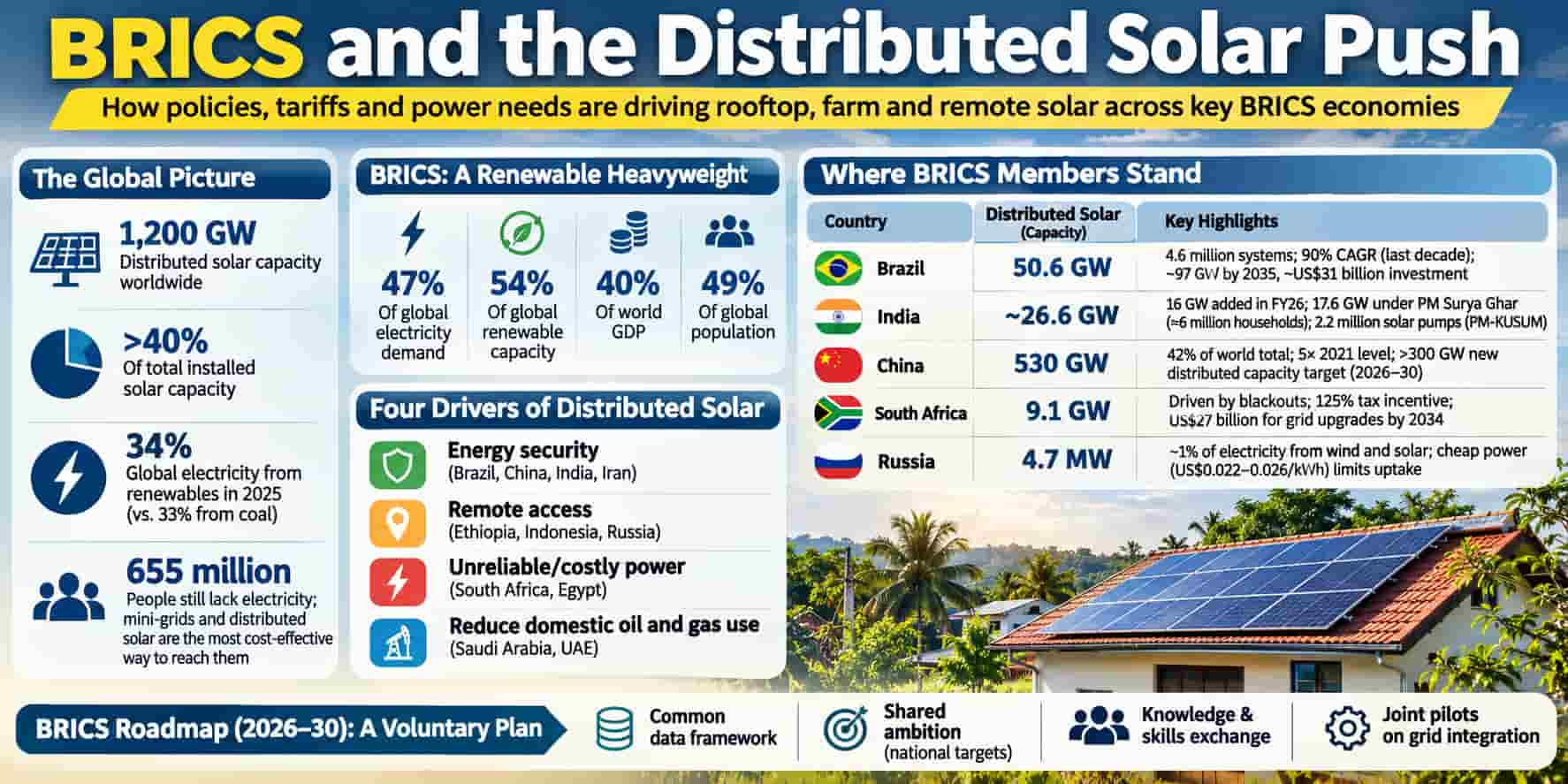
In 2025, renewables overtook coal in the global electricity mix, supplying about 34% of generation against coal’s 33%. Beneath that headline sits a quieter shift. Distributed solar, meaning panels on rooftops, farms and factories, has reached about 1,200 GW, more than 40% of all installed solar capacity. A new report from New Delhi’s Council on Energy, Environment and Water (CEEW) asks how the BRICS bloc scaled this segment, and what members can learn from one another.
The bloc carries weight. Its eleven members account for 47% of global electricity demand and 54% of renewable capacity, with 40% of world GDP and 49% of its population. Distributed renewables became an explicit BRICS energy priority only in May 2025, and a Digital Centre of Excellence for Smart Grids and Energy Storage followed in 2026. Yet just three members, Brazil, India and China, have mature markets.
Four motives, one common lever
The report finds four pathways. In Brazil, China, India and Iran, energy security came first: droughts in Brazil, coal dependence in China, rising demand and import dependence in India. Ethiopia, Indonesia and Russia needed to reach remote communities. South Africa and Egypt were driven by unreliable and costly power, while Saudi Arabia and the UAE want to burn less oil and gas at home.
The common lever is price. Where grid power is expensive, households and businesses move first. Where it is cheap, they stay put. That explains much of what follows, and it also frames the stakes: about 655 million people worldwide still lack electricity, and mini-grids and distributed solar are the most cost-effective way to reach them.
 Brazil: 90% growth and a bill for the grid
Brazil once drew about 80% of its power from hydropower, which left it exposed to droughts. Today 85% of its electricity is non-fossil, and distributed capacity has reached 50.6 GW, about 99% of it solar, across 4.6 million systems. Capacity has grown at a compound annual rate of 90% over the past decade, and homes account for 51.3% of it.
Policy got there by iteration. A 2012 net-metering rule stalled under taxes on exported power, and a 2015 revision exempted self-consumed electricity and stretched credit validity from 36 to 60 months. State schemes helped: a Santa Catarina utility’s 60% rooftop subsidy drew more than 10,000 registrations in 48 hours. In Paraná, farm loans of US$1.15 billion, backed by US$51 million in interest subsidies, lifted the number of systems from 5,558 to 25,684 between 2021 and 2023.
Success then created a problem. Rooftop owners stopped paying for the network they relied on. “What was envisioned to make consumers self-dependent started to erode the utilities’ revenue base,” says the CEEW report. A 2022 law introduced network charges, phased in from 15% in 2023 to 100% from 2029 for new consumers, while existing ones keep the old rules until 2045. Brazil expects nearly 97 GW by 2035, drawing roughly US$31 billion.
India: From village access to household mass market
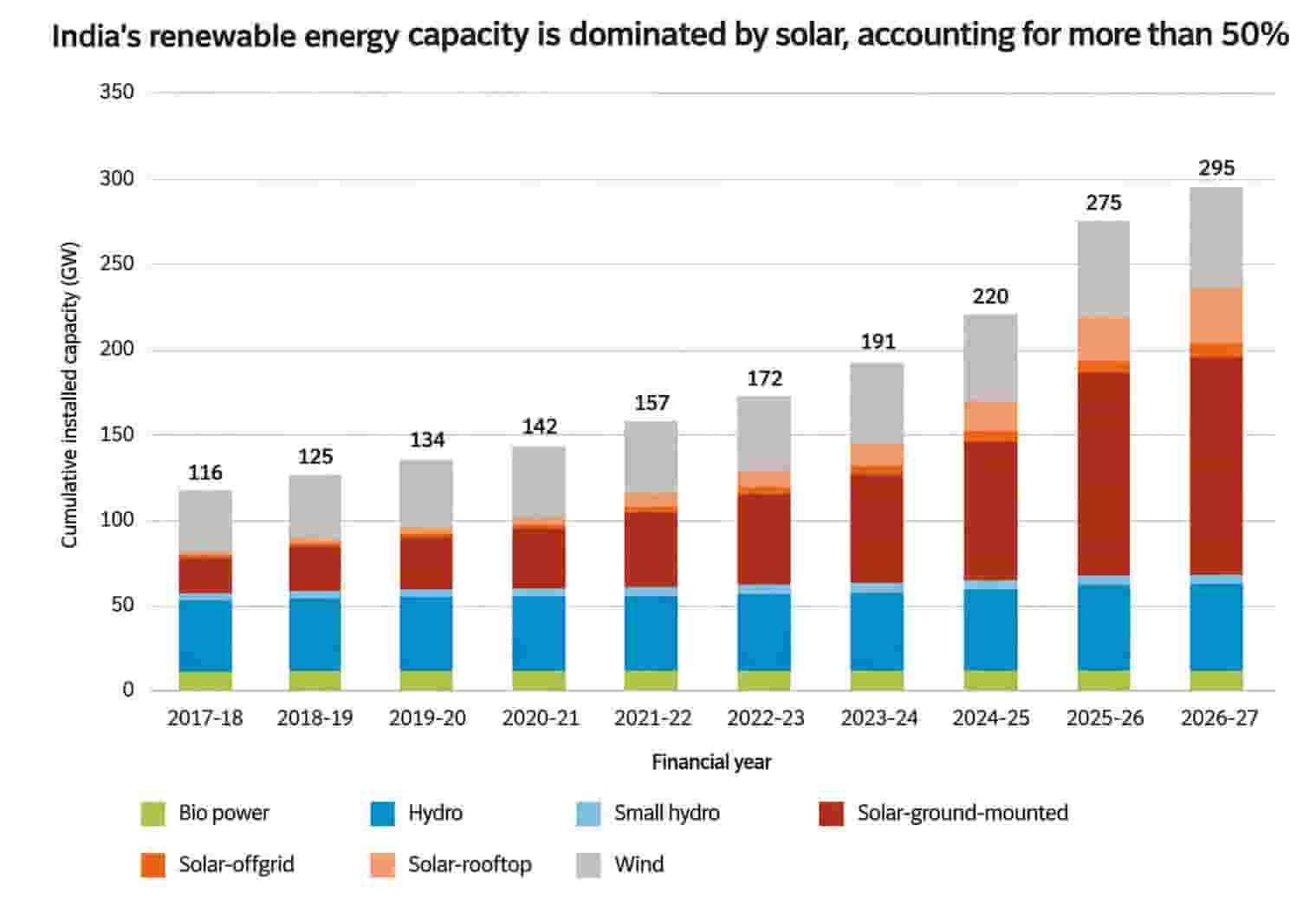
India’s journey began with rural access and now serves security. In FY26 alone it added 16 GW of distributed solar, 36% of all solar additions, and non-fossil sources supplied 29% of electricity. Early targets disappointed: a 2015 rooftop programme had installed only 1.9 GW by 2020, and its second phase was slowed by delays in processing applications and releasing incentives.
The 2024 PM Surya Ghar scheme changed that with subsidies, low-interest finance and a fully digital application. It has added 17.6 GW of residential rooftop capacity across nearly six million households, towards a goal of ten million by 2027. Installations averaged more than 3 lakh a month in FY 2026-27, roughly 10,000 a day. Indoen has examined how that rooftop boom is winning on numbers but not on share.
Farms matter too. PM-KUSUM has reached about 2.2 million farmers, with more than 10 GW and 2 million solar pumps, in a sector that takes about 15% of electricity on subsidised terms. Beyond solar, India counts 34,913 small biogas plants and over 5 GW of small hydro across 1,196 projects, against a potential above 21 GW.
The next phase mirrors Brazil’s: tariff design, energy accounting and storage. Indoen has also looked at how rules, not subsidies, may shape rooftop solar’s next phase.
China: Subsidies, a bill and a pivot
China holds 530 GW of distributed solar, 42% of the world’s total and five times its 2021 level. Coal’s share of its electricity fell from 77% in 2000 to 54% in 2025. The origin was industrial: after the 2008 crisis ended Europe’s demand for its modules, Beijing built a home market, starting with a 2009 scheme that subsidised 70% of off-grid and 50% of grid-connected capital costs.
Fixed 20-year tariffs then became a burden. Annual solar subsidies passed US$15 billion by 2017, prompting a 2018 cap of 10 GW a year on new distributed capacity, and guaranteed tariffs ended in 2025. A county-wide programme covering 676 counties and 140 million people showed that tendering one developer per county can trade precision for speed.
Commercial and industrial users still lead, with 61% of capacity, because cross-subsidies keep household tariffs low. The 15th Five-Year Plan targets over 300 GW of new distributed capacity in 2026–30 and grid capacity for 900 GW by 2030, plus 50 GW each of vehicle-to-grid and virtual power plants.
Russia and South Africa: Two ends of the tariff scale
Russia shows what cheap power does. Wind and solar supply about 1% of electricity, and 98% of capacity sits on the centralised grid. Microgeneration stood at just 4.7 MW at the start of 2024 against an estimated 15 GW potential, held back by low surplus prices of US$0.022–0.026 per kWh and a ban on serving apartments, where most Russians live. A 2026 law widens the rules. Meanwhile, hybrid solar-diesel systems in Yakutia saved 3,596 tonnes of diesel across twelve installations in 2021–24, with paybacks of seven to eight years.
South Africa sits at the other end. Load shedding hit 205 days in 2022 and 335 in 2023, Eskom’s availability fell from 77% to 56%, and inflation-adjusted tariffs rose about 28% between 2018 and 2024. At US$0.157 per kWh, its retail price is among the highest in the bloc. Distributed solar now stands at 9.1 GW, over half of renewable capacity, led by business users.
Policy followed the pain: tax incentives rose to 125%, licensing caps were lifted, and Cape Town pays households for exports. Yet integrating 56 GW of new renewables by 2034 needs 14,500 km of lines and about US$27 billion.
A roadmap, not a mandate
The report proposes four voluntary actions: a common data framework, a shared ambition built from national targets, a knowledge and skills exchange, and joint pilots on grid integration. Data would come first, and its logic is simple. “A target that cannot be measured cannot be meaningfully reviewed,” the authors argue. Brazil’s open data system could be the template, and progress would be reviewed every two years.
The limits are plain. The proposal avoids binding standards because tariffs and grid codes remain national, and it leaves trade measures to national and WTO processes, though China’s manufacturing scale is listed among the bloc’s strengths. The authors also concede that distributed renewables across BRICS have largely been a by-product of broader renewable policy, not a deliberate aim.
For India, the implication is clear.
Its rooftop push is entering the stage where Brazil found utilities losing revenue. Brazil’s choice to protect existing users until 2045 while phasing in charges for newcomers is one answer. Whether others will copy it is the real test of this roadmap.
Follow us on : X | LinkedIn | Facebook | Bluesky