On 4 November, the Union Cabinet cleared a scheme to set up domestic lithium and nickel processing plants. Support is capped at ₹500 crore (US$53 million) per lithium beneficiary and ₹900 crore (US$96 million) per nickel beneficiary, according to an official statement. The scheme runs from FY2026-27 to FY2030-31 and offers a 30% capital subsidy.
The logic is clear. India imports most of its refined battery inputs, and processing is where value and strategic risk sit. A similar mood ran through an industry expo in late October. Australia’s envoy said his country produces more than half of the world’s lithium and holds the second-largest cobalt reserves, as per recent reporting. The same report noted that no new investments or supply agreements were announced. It also cautioned that mineral supply does not by itself mean cheaper batteries.
Mines and refineries are only half the chain. The other half begins when a battery leaves the vehicle. That is where China has just changed course.
What China actually changed
China moved early on electric buses. By the end of 2025 it had 551,400 new-energy urban buses, or 87.5% of its fleet, according to a media analysis. Those buses are now producing retired packs at a scale few countries have seen.
In 2021, Beijing encouraged firms to give such batteries a second life in storage, backup power and charging. Rules effective April 2026 repealed that framework. A 30 July notice withdrew special recognition for these firms and told industry bodies to stop promoting the category.
It is not a ban. Qualified reuse is still allowed where products meet standards. Reuse in electric bicycles and other restricted uses is prohibited. The stated worry is safety: packs reassembled without proper testing, with uneven capacity and cell condition. The shift is from encouragement to examination.
 The sums that did the damage
New batteries got cheap. BloombergNEF’s annual survey found stationary-storage packs at US$70 per kWh in 2025, down 45% in a year. A turnkey storage system averaged US$117 per kWh. An old pack must beat that after testing, repackaging, new controls, certification and warranties.
A recent policy brief from a Delhi-based energy research institute puts a number on it. Stakeholders it consulted expect repurposed systems to need a 30–50% price advantage over new ones. Against US$117 per kWh, that means landing a system at roughly US$59 to US$82 per kWh. These are Indoen’s illustrative sums, since $117 is a global average and Indian tender prices differ. Even so, the target is steep. The brief itself warns the gap could narrow if new cells keep getting cheaper.
“Used packs are not free packs,” says a researcher at a New Delhi-based energy think tank. “Once you add testing, a new management system and a warranty, you are racing a new LFP cell that gets cheaper every year.”
India’s retirement wave is a ripple
India has crossed 10 million registered EVs. Sales grew 29.7% to 26.59 lakh units in 2025-26, according to reports cited by a news agency. Most of these are two- and three-wheelers with small packs, and most are still young.
Try a rough sum. Assume an average of 5 kWh a vehicle, which is loose because cars carry far bigger packs than scooters. Ten million vehicles then hold about 50 GWh. India may need 236 GWh of battery storage by FY32, costing US$36.1 billion. So even if every EV on the road retired tomorrow, old packs would cover about a fifth of that need. They will not retire tomorrow.
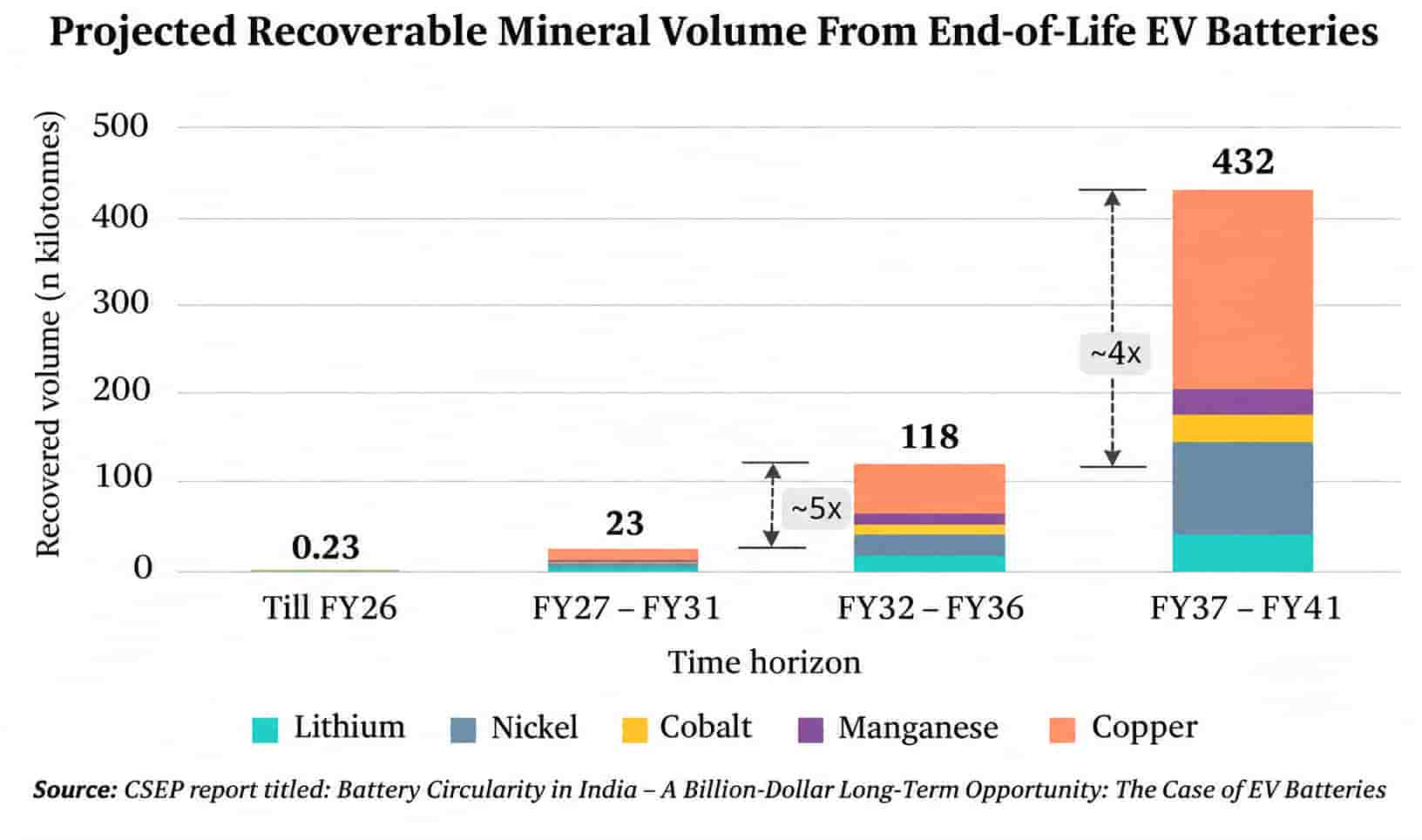
The institute’s brief proposes a three-year pilot of just 100 to 150 MWh. That is under 0.1% of 236 GWh. Its long-run estimate is larger: 0.9 to 1.4 TWh of cumulative repurposing potential by 2050. The prize is real, but it comes late. The brief also admits it has not assessed supply by vehicle segment. It notes that two- and three-wheeler batteries retire earlier and differ in chemistry and format from car packs.
India’s first reuse market is therefore likely to be small, local and uneven in quality.
 Rules before reuse
India’s Battery Waste Management Rules place collection and recycling duties on producers. The brief calls one gap a precondition for scale: the rules must say who is liable once a pack passes from its first owner to a refurbisher. Without that, warranties and take-back duties have no clear party to enforce them against.
A second tension pulls the other way. One think tank has argued that producer-responsibility timelines rest on conservative battery-life assumptions and may force early retirement. Packs could be pulled out before reuse economics are ready.
“The dull rule matters most,” says an executive at a battery recycling company. “Until the law says who owns the risk after a pack leaves the vehicle, insurers and lenders will stay away.”
There is a quiet upside. The independent health checks that reuse needs are the same data lenders lack when they price used EVs. Indoen has reported that EV financing is running into a resale-value problem. A trusted battery health record could serve both markets.
Recycling may be the stronger bet
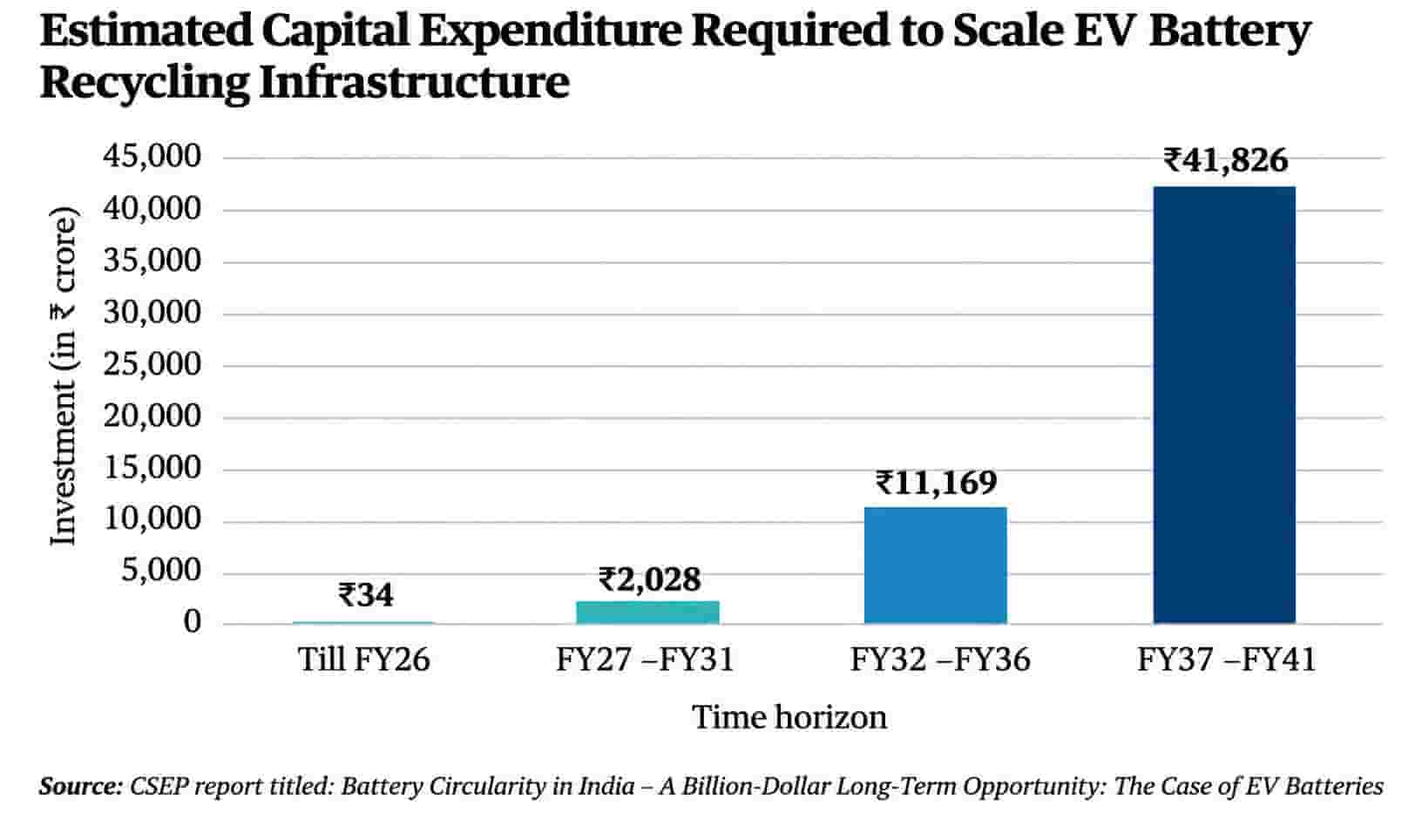
For a country spending ₹2,814 crore (US$300 million) on lithium and nickel processing, recovered material from retired packs is a second feedstock, mined at home. That makes recycling closer to the Cabinet’s logic than reuse is. Reuse still has niches where duty is light and benefits are clear. The brief points to rural livelihoods, schools, telecom backup and solar-linked bus depots, such as a 224-kWh pilot in Surat.
The lesson from China is not that reuse is wrong. It is that reuse needs evidence, standards and a price edge before it needs promotion.
What to watch
Four things will show whether India learns early. First, whether the battery waste rules clarify liability for repurposed packs. Second, whether a supply study by vehicle segment follows. Third, what operating data the first pilots publish. Fourth, how bidders respond to the processing scheme, whose beneficiaries will be chosen in two stages.
India is right to build from the mine. It should plan for the afterlife before the first big batch arrives.
Follow us on : X | LinkedIn | Facebook | Bluesky