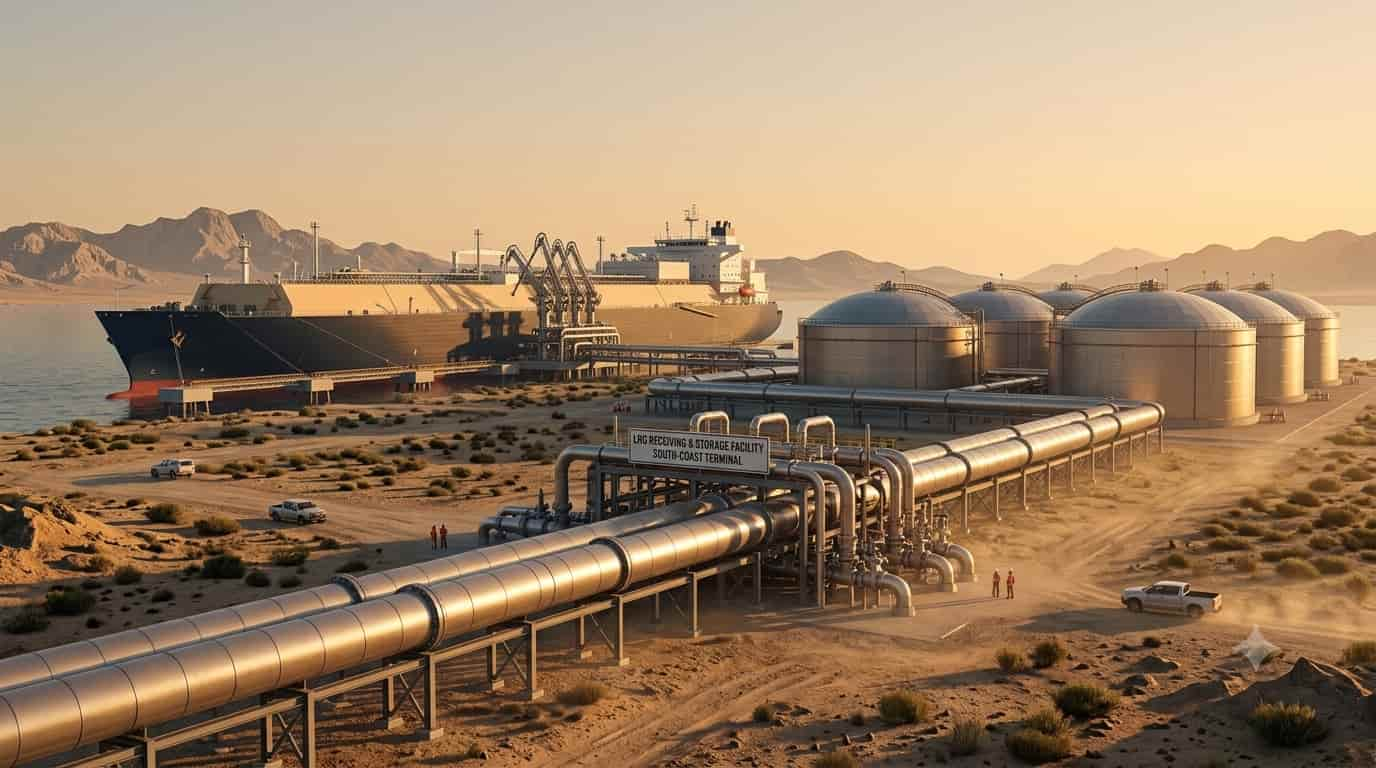
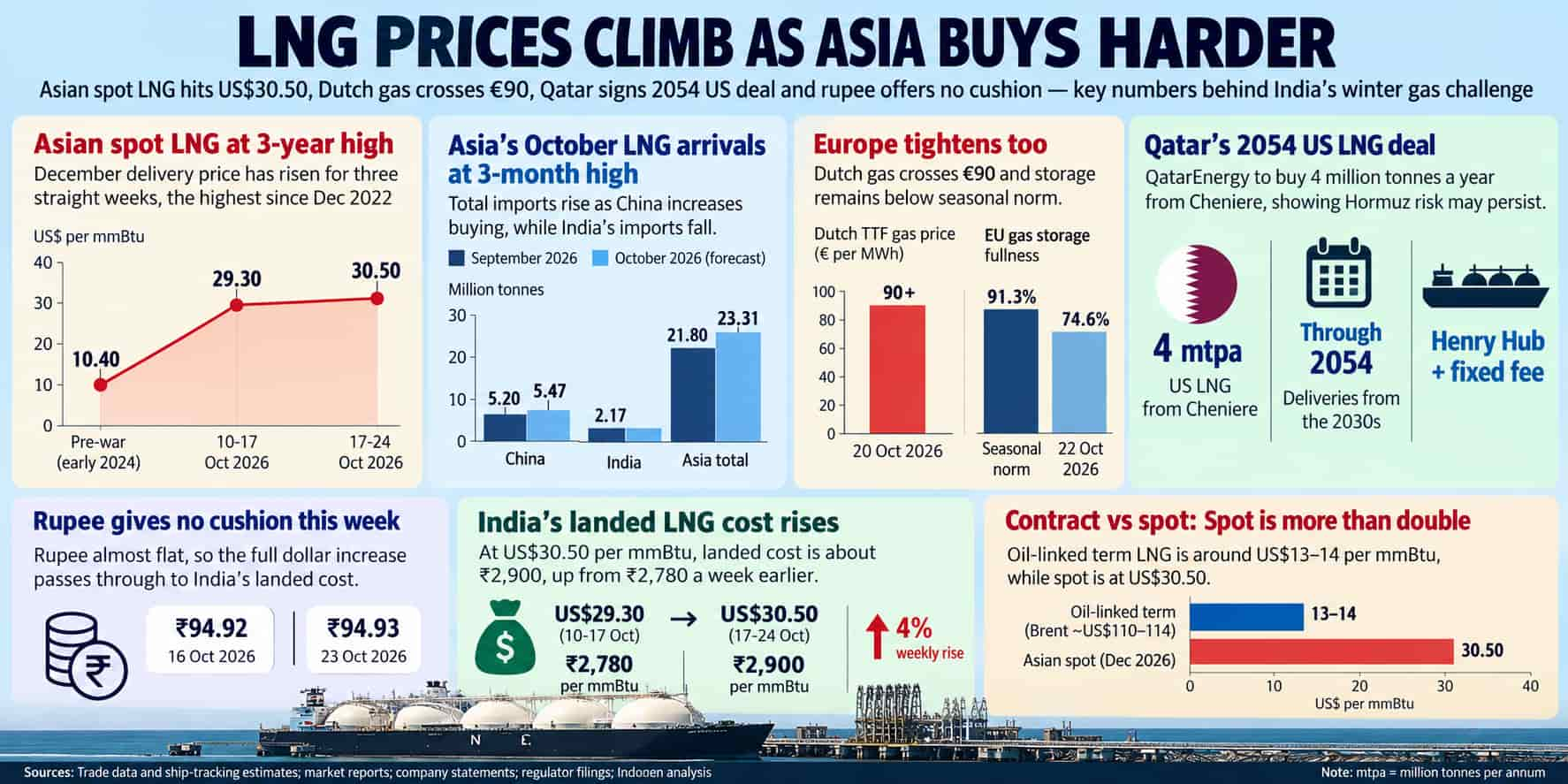
Asian spot LNG for December delivery averaged US$30.50 per mmBtu this week, up from US$29.30. It was the third weekly rise and the highest since December 2022, as per recent trade data. Last week, Europe led the story. This week, Asia did. A major Chinese buyer took at least 11 cargoes for November–December. South Korea’s Kogas also sought supply. Colder forecasts and a reported tanker strike off Yemen added to the premium.
Asia’s October arrivals are forecast at 23.31 million tonnes, a three-month high, as per ship-tracking data. China alone is expected at 5.47 million tonnes, up from 5.20 million in September. India went the other way. Its September imports fell 14% to 2.17 million tonnes. A price-sensitive buyer loses first when richer rivals bid.
An analyst tracking global LNG markets said: “Asia is not backing down. When one Chinese buyer takes at least eleven cargoes in a week, price-sensitive buyers like India are pushed to the margins.”
Europe is not far behind. Dutch gas crossed €90 per MWh on 20 October, the first time since December 2022. EU storage was 74.6% full on 22 October, about 17 points below the seasonal norm, and one bank says it may have peaked. Europe will soon start drawing gas just as Asia buys harder. For India, the Atlantic cargoes that served it in summer are now the most contested ones.
Qatar’s pivot and what it means for India
The week’s biggest signal came from Qatar itself. QatarEnergy agreed to buy 4 million tonnes a year of US LNG from Cheniere through 2054. The price is Henry Hub plus a fixed fee. Deliveries start in the 2030s. The world’s second-largest exporter is buying from its main rival. That suggests Doha expects Hormuz risk to last.
India’s own Qatari contract was signed in 2024. Petronet is due 7.5 million tonnes a year from May 2028, delivered ex-ship. A question follows that neither side has answered: will those volumes always come from Ras Laffan?
An executive at a leading Indian gas utility put it this way: “A term contract is only as good as the route it travels. After this year, buyers will ask where the molecules come from, not just what the slope is.”
There is a counterpoint. The deal is under 1% of global LNG trade. Qatar also says it can restart within weeks once passage reopens.
 Landed cost: No cushion this week
Last week, a rising rupee absorbed part of the jump. This week it did not. The rupee closed at ₹94.93 on 23 October, almost flat on ₹94.92 a week earlier. So the 4% dollar rise passed straight through. Spot LNG of US$30.50 is about ₹2,900 per mmBtu (US$30.50). A week ago it was ₹2,780 (US$29.30). Regasification and pipeline charges come on top. Before the war, spot was US$10.40, so the price has nearly tripled.
The gap with contracts is the sharper story. With Brent near US$110–114 and a slope near 12%, oil-linked term LNG works out near US$13–14 per mmBtu, on Indoen’s estimate. Spot is more than double that. Last week’s Indoen analysis showed how a stronger rupee hid some of it. This week there was no such help.
Gas-fired power feels the squeeze. At US$30.50, fuel alone for a plant with a heat rate near 7,500 Btu per kWh costs about ₹22 per kWh (US$0.23), on Indoen’s estimate. That is below the evening spike of US$0.39 a unit that Indoen reported from Tamil Nadu. It is far above what the exchange pays in most hours. Gas units fit only the evening peak, and only if gas is available.
Retail prices and domestic gas
Distributors are not moving together. Delhi CNG stayed at ₹86.98 per kg (US$0.92). Mumbai CNG is ₹89 (US$0.94), up ₹1 (US$0.01). Chennai is ₹99.50 (US$1.05), up ₹2 (US$0.02) from ₹97.50 (US$1.03) on 1 October. Mumbai PNG held at ₹52 per SCM (US$0.55), as per latest city listings.
The domestic price tells a different story. The administered price for legacy ONGC and Oil India gas is capped at US$7 per mmBtu, though the formula gave US$11.22 for October. With crude above US$110, November’s formula price will rise again. The cap shields distributors. It also widens the gap for producers. The November notification is due within days.
Regulation: Small steps, no relief
PNGRB approved a platform on the Indian Gas Exchange to list and book unused regasification capacity. It is voluntary. It aims at underused terminals, which can offer cheaper slots. Petronet’s Dahej ran at about 66 % in April–June because Qatari cargoes went missing. Cheaper slots may draw cargoes to terminals far from consumers.
The regulator also proposed putting 12 pipelines outside the national grid under the unified tariff. Comments closed on 23 October. Remote networks may gain. Others on the grid may pay more. The final order will show who bears the difference.
The energy-security question
India wants gas at 15% of its primary energy mix by 2030. The share was 7.2% in FY2025. This week’s numbers show the difficulty. Domestic output covers about half of demand. The rest is bought at the margin, against Chinese and European buyers, at roughly twice the term price.
Prices could still ease. A mild winter would cool Asian buying. Qatari restarts take weeks, though, and one analyst expects prices to rise further next week. Watch Qatar’s next force majeure notice, Petronet’s results on 2 November and the November APM price.