
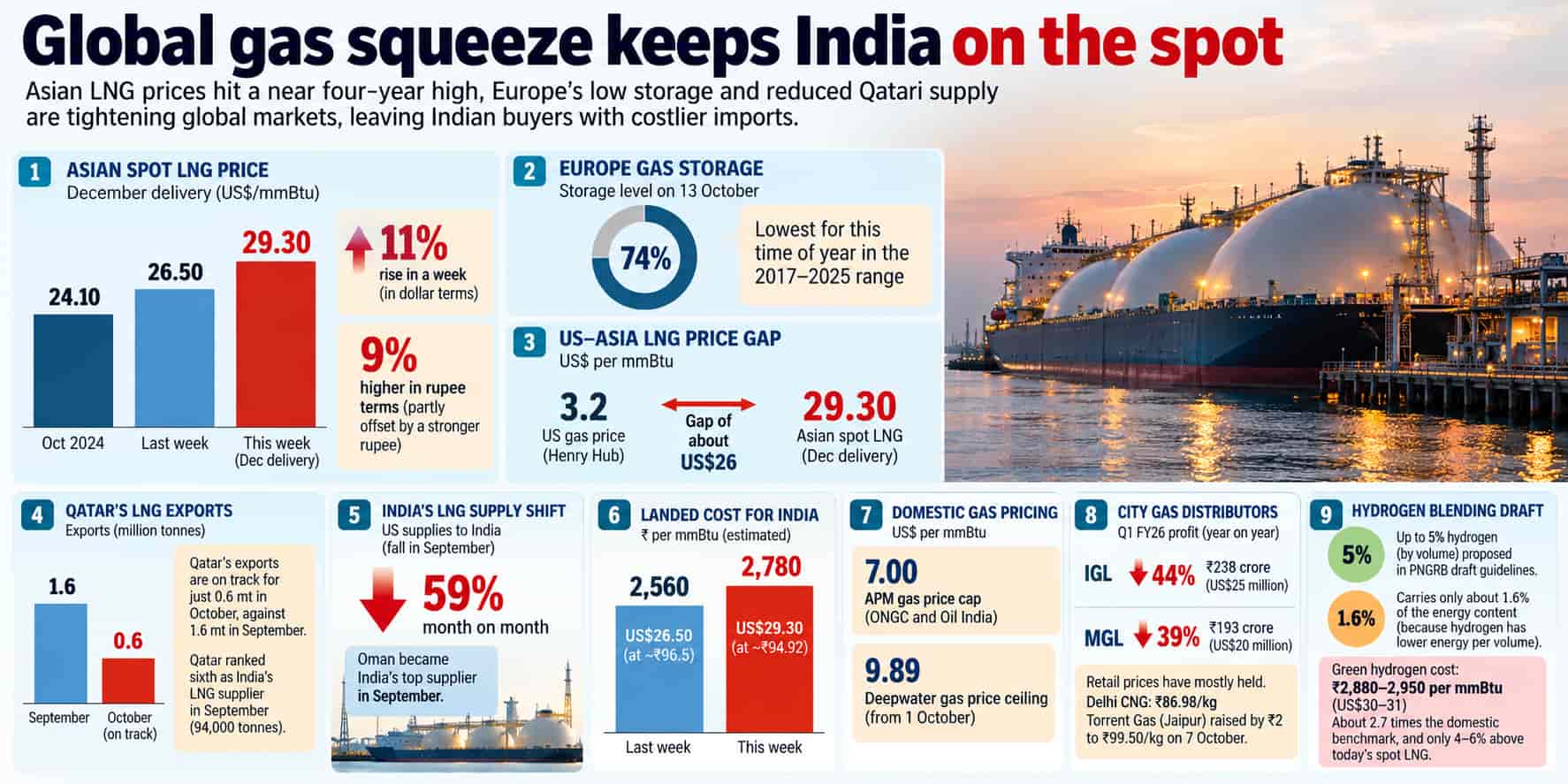
Asian spot LNG for December delivery rose to US$29.30 per mmBtu this week, from US$26.50 a week earlier, as per recent trade data. Attacks on ships near the Strait of Hormuz kept a risk premium in the price. Chinese and South Korean buyers also returned to the spot market. One global bank has raised its winter Dutch gas forecast to €90 per MWh and sees €135 in a stress case.
Europe is the second force. EU storage stood at about 74% on 13 October, the lowest for this time of year in the 2017–2025 range, as per EU storage data. Europe is paying up for Atlantic cargoes. US gas trades near US$3.2 per mmBtu, so the spread to Asian spot is about US$26. India felt this in September, when US supplies fell 59% month on month and Oman became its top supplier, as per ship-tracking data. Indoen’s earlier analysis looked at how that supply chain was rebuilt.
Qatar is the third force. Its October LNG exports are on track for just 0.6 million tonnes, against 1.6 million in September, even though Gulf oil flows have largely recovered. Oil and LNG have parted ways. Qatar once supplied India around 45% of its LNG. In September it ranked sixth, at 94,000 tonnes.
An analyst tracking global LNG markets put the risk plainly: “Even if Hormuz reopens tomorrow, Qatari LNG will not return tomorrow. Restart takes weeks, and shipowners will want proof of safe passage first.”
What it means for landed cost
The dollar price is only half the story for Indian buyers. The rupee rose for a sixth straight session to ₹94.92 on 16 October, helped by RBI intervention. A week earlier it was near ₹96.5. At those rates, last week’s US$26.50 meant about ₹2,560 per mmBtu. This week’s US$29.30 means about ₹2,780. The price rose about 11% in dollars but about 9% in rupees. The cushion is real, but it depends on RBI support and a softer dollar.
Contract pricing shows the bigger gap. With Brent near US$106, oil-linked term cargoes price at roughly US$13–15 per mmBtu by one estimate. Spot is about double. As Indoen reported, India’s cheapest LNG is the cargo that has not arrived. Buyers must fill the hole at spot.
Gas-fired power takes the hit. At US$29.30, fuel alone for a plant with a heat rate near 7,500 Btu per kWh costs about ₹21 per kWh (US$0.22), on Indoen’s estimate. Such units stay at the bottom of the merit order. They will run on directions or for the evening peak, not on price.
 Domestic gas and city gas
Domestic prices live in another world. The administered price for legacy ONGC and Oil India gas is capped at US$7 per mmBtu, although the formula gave US$11.22 for October. The ceiling for deepwater gas rose to US$9.89 from 1 October, as notified earlier this month.
The cap protects distributors only on the volumes they get. The marginal supply is imported. A media report puts IGL’s April–June profit down 44% at ₹238 crore (US$25 million). MGL’s fell 39% to ₹193 crore (US$20 million). Retail prices have mostly held. Delhi CNG stayed at ₹86.98 per kg (US$0.92) in recent listings. But Torrent Gas raised Jaipur CNG by ₹2 to ₹99.50 (US$1.05) on 7 October.
An executive at a leading Indian gas utility described the squeeze: “We can absorb some of this cost for a few months. We cannot absorb it for a whole winter without losing either margin or customers.”
Policy: A hydrogen draft that tests the arithmetic
The week’s main regulatory move was on hydrogen. The Petroleum and Natural Gas Regulatory Board (PNGRB) published draft guidelines for blending up to 5% hydrogen, by volume, into household piped gas. This followed its conference at IIT Ropar on 9–10 October. The draft is open for public comments. It says clearly that it does not, by itself, allow commercial blending.
The numbers are striking. Green hydrogen discovered in government-backed tenders at ₹387–397 per kg (US$4.1–4.2) works out at ₹2,880–2,950 per mmBtu (US$30–31) on an energy basis, as per analysts cited in a trade report. That is about 2.7 times the domestic benchmark. But it is only 4–6 % above today’s spot LNG.
The limits are equally clear. A 5% blend by volume carries only about 1.6% of the energy, on Indoen’s calculation, because hydrogen holds about a third of methane’s energy per cubic metre. Networks need upgrades. Distributors must absorb the extra cost or pass it on. The draft lays a foundation for future rules. It is not a fix for this winter.
On domestic supply, Essar Oil & Gas won five new coal bed methane blocks in the government’s special bid rounds. The volumes are small. But they are home-grown molecules.
The energy-security question
The week shows why India’s gas ambitions are fragile. The government wants gas at 15% of the primary energy mix by 2030. The share was 7.2% in FY2025. Domestic output covers only about half of demand, so the swing supply is imported at spot. Every Hormuz headline therefore reaches the CNG pump and the fertiliser plant.
Not every forecast is bleak. Europe’s gas network operators say average-winter demand can be met from current storage. One bank still sees Dutch gas at €56 in the fourth quarter. A quick Hormuz reopening would cool prices. But Qatari restart takes weeks, and a cold January would test everyone. Watch the next Qatari force majeure notice and the first cold snap in North Asia.