Three reports published between 6 and 10 November 2026 look unrelated. One covers a trade arrangement in Brussels. One counts the world’s emissions. One counts carbon capture plants. Read together, they show that carbon is now judged in three ways: what it costs, how much of it is emitted, and where it is buried. India faces all three tests with an uneven hand.
A dip that policy did not deliver
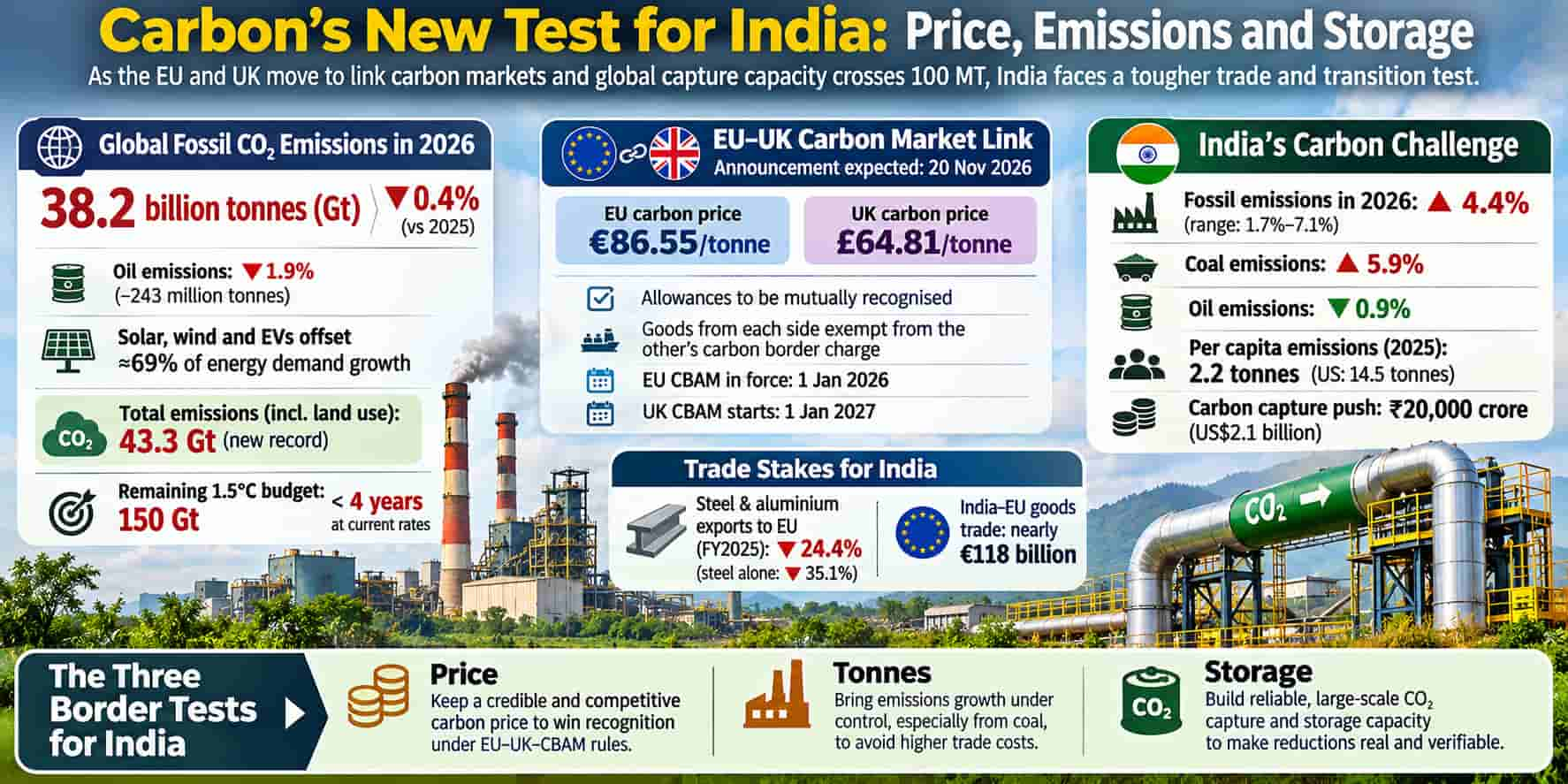
The Global Carbon Project released its 2026 budget on 10 November. It projects global fossil CO₂ emissions at 38.2 billion tonnes, down about 0.4%. The range is wide, from a fall of 1.5% to a rise of 0.6%. A small increase cannot be ruled out.
The cause matters. Oil emissions fall 1.9%, or 243 million tonnes, after the Iran conflict closed the Strait of Hormuz and pushed up fuel prices. Solar, wind and electric vehicles offset about 69% of the growth in energy demand. High prices explain most of the rest. The authors of the report say the dip does not show that emissions have peaked.
Add land-use emissions and the total reaches a record 43.3 billion tonnes. The remaining budget for 1.5°C is 150 billion tonnes, less than four years of current emissions. Indoen has already looked at why overshoot is now certain.
India sits on the wrong side of the chart. Its fossil emissions are projected to rise 4.4%, within a range of 1.7% to 7.1%. China, the US and the EU are expected to fall by 0.9%, 1.3% and 1.5%. Coal drives India’s rise, up 5.9%. Oil emissions fall slightly, by 0.9%.
That 4.4% compares with a rise of just 1.4% projected for 2025 in last year’s edition. The context cuts both ways. India’s per capita emissions were 2.2 tonnes in 2025, against 14.5 tonnes in the US. That argument will be heard in every carbon border dispute.
 Two clubs, one outsider
On 6 November 2026, a draft post-Brexit carbon deal document seen by a media outlet showed the EU and UK ready to conclude talks on linking their emissions trading systems. Allowances would be mutually recognised.
Goods from each side would be exempt from the other’s carbon border charge. The announcement is expected at a summit in Brussels on 20 November 2026.
The timing is tight. The EU’s border mechanism became definitive on 1 January 2026. Britain’s starts on 1 January 2027. Without a link, exporters could pay carbon costs twice.
The link has a price. On 6 November 2026, UK allowances closed at £64.81 a tonne. EU allowances stood at €86.55, as per recent reporting. Analysts expect the gap to narrow, which means British firms would pay more. A British MP from an industrial constituency has warned that this could push production abroad while global emissions stay unchanged. One market analysis expects 2027 to be a transition year, not a full link.
“A link is not only about avoiding border charges,” said a policy adviser familiar with the negotiations. “It also means keeping your carbon price in step with a bigger partner, and that carries a political cost.”
India stands outside this club, but not without options. In September 2026, the UK listed India’s Carbon Credit Trading Scheme (CCTS) as a qualifying carbon pricing mechanism. Relief will equal the carbon price already paid at home. Talks with the EU were still open in July 2026, with no recognition announced.
The stakes are real. India’s steel and aluminium exports to the EU fell 24.4% in FY2025, steel alone by 35.1%, before any border payment began. The EU is India’s third-largest trading partner, with goods trade of nearly €118 billion. One estimate says the border burden on India could fall 42%, to €480 million, if India’s carbon price reached a quarter of the EU level.
Indoen has looked at how EU carbon rules weigh on India’s green hydrogen plans. It has also asked who pays for net zero when India has no carbon price on households.
The third test is burial
The Global CCS Institute counts 113 commercial capture facilities with combined capacity of 68 million tonnes a year. Plants under construction would add 56 million tonnes, lifting capacity by 82% to above 100 million tonnes. More than 400 million tonnes have been stored since 1996.
Put that beside the other numbers. The whole fleet captures 68 million tonnes a year. The fall in oil emissions in 2026 is 243 million tonnes. One year of costly fuel did more than three and a half times what all 113 plants capture in a year.
India’s arithmetic is starker. A 4.4% rise on a base of about 3.2 billion tonnes is roughly 140 million tonnes. That is Indoen’s own estimate. It is about twice the world’s current capture capacity, added in a single year.
The pipeline leans towards gas. Natural gas processing and LNG hold 42 million tonnes of operating capacity. Across all projects, hydrogen, ammonia and fertiliser could capture 103 million tonnes a year, and cement and lime 42 million. These are broadly the sectors the border levies target. Power and heat could reach 160 million tonnes, but the report ties this to gas-fired plants.
Europe shows the limits. Its injection capacity is expected to reach 33 million tonnes by 2030, short of the EU’s 50 million tonne goal. In the Middle East, the report notes, projects often chase near-term returns from using CO₂ rather than storing it permanently.
India’s response is a start. The Union Budget of 1 February 2026 set out ₹20,000 crore (US$2.1 billion) over five years for capture across power, steel, cement, refineries and chemicals. Only ₹500 crore (US$53 million) is set aside for FY2026-27. One analysis from an Indian research institute finds that about 56% of emissions from existing steel and cement capacity can only be abated through capture. So the technology is not optional for exporters. But first-year money is pilot-sized.
Where the three tests meet
The first surprise is in the pipeline. The world is building capture for gas, not coal. India’s growth this year is coal. Nothing in the figures reviewed points to capture on coal at scale.
The second is definitional. A tonne captured and used is not always a tonne stored. India’s scheme covers both use and storage. Border officials may not treat them alike.
The third is price visibility. If the link lifts British prices towards EU levels, the reference price for any Indian deduction rises. But a deduction is only worth what Indian firms actually pay. The CCTS sets intensity targets, not an absolute cap, and exchange trading was expected from around October 2026. Legal commentators have also asked whether credits count as a carbon price under EU rules.
“Recognition at the border will depend on what Indian firms actually pay, not on how many certificates exist,” said a researcher at a New Delhi-based energy think tank. “A market without a visible price earns little credit.”
Two dates frame the next seven weeks. The EU–UK summit is on 20 November 2026, and Britain’s border levy starts on 1 January 2027.
The question for Indian industry is not whether carbon will be priced, counted and buried. It is whether it can show all three, on paper, in time.
Follow us on : X | LinkedIn | Facebook | Bluesky