Day-ahead prices rose through the first week of November. Purchase bids exceeded sell bids every day from 2 to 6 November, and daily averages ran from ₹4.87 (US$0.052) to ₹5.22 (US$0.055) a unit. That followed the ₹3.65 (US$0.039) seen on 30 October, as Indoen reported in its look at prices that rose 149% while volumes fell.
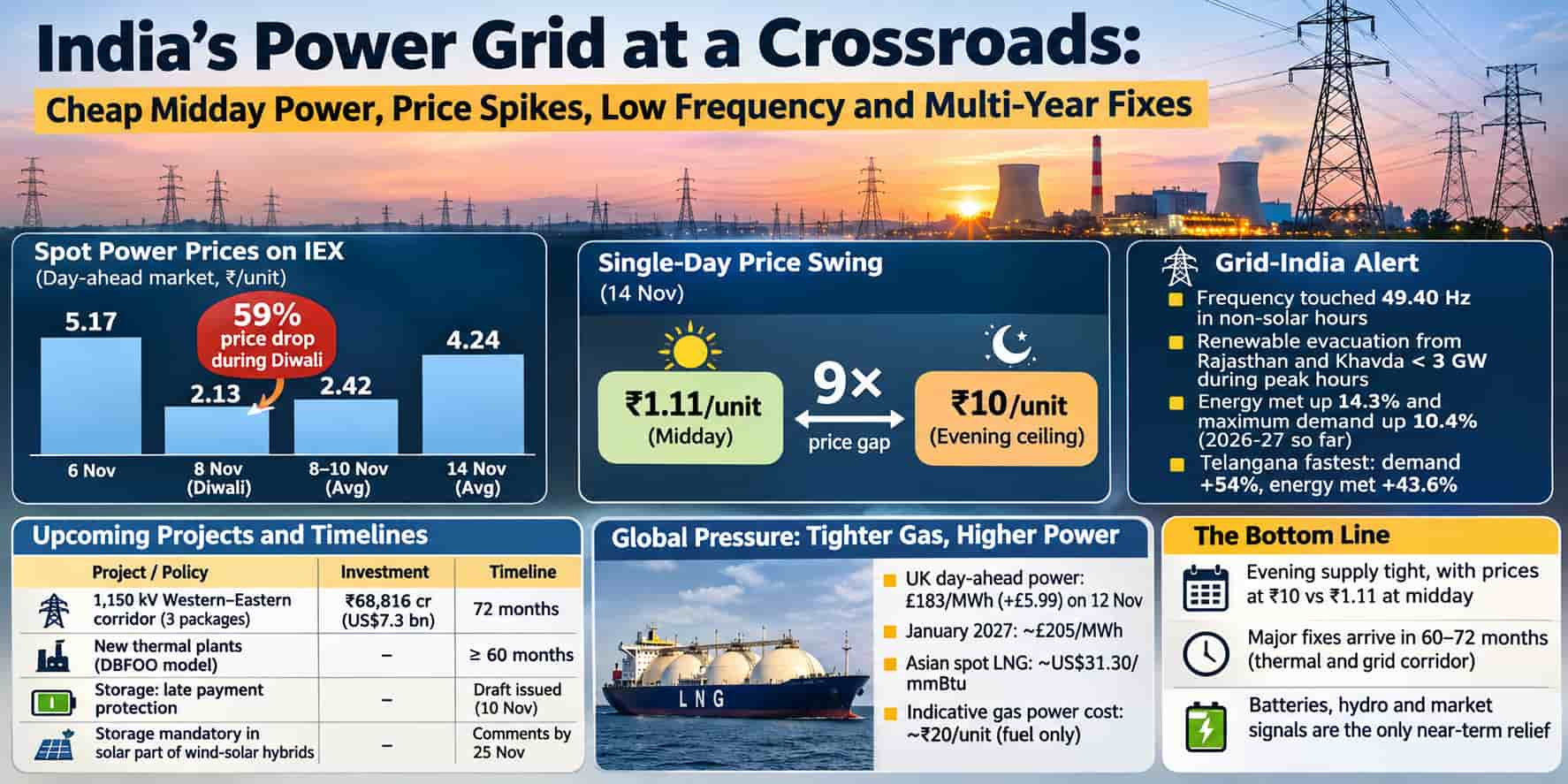
Then the festival cut demand. On 8 November, during the Diwali break, the clearing price fell to ₹2.13 (US$0.023) from ₹5.17 (US$0.055) on 6 November, a drop of 59%. Purchase bids on 8 November were 137,154 MWh, under a third of the 6 November level. The average for 8–10 November was ₹2.42 (US$0.026), exactly half the ₹4.84 (US$0.051) of 1–7 November, as per recent trade data.
The recovery was quick. Prices were ₹2.44 (US$0.026) on 9 November and ₹2.70 (US$0.029) on 10 November. By 14 November the day’s average was about ₹4.24 (US$0.045), with sell bids of 509,161 MWh against purchase bids of 331,277 MWh, exchange data shows.
That same day, prices ran from ₹1.11 (US$0.012) at midday to the ₹10 (US$0.11) ceiling, a gap of about nine times. Power is cheap while the sun shines and dear after dark.
“The Diwali dip shows how much cheap supply the system holds when factories pause. The test is whether it is still there when industry restarts and the sun goes down,” said an analyst tracking India's power markets.
Grid-India flags frequency and evacuation limits
Grid-India reported that all-India energy met rose 14.3% and maximum demand 10.4% in 2026-27 so far, against the same period of 2025-26. Telangana grew fastest in October up to 22 October, with maximum demand up 54% and energy met up 43.6%, followed by Karnataka. The summary named no driver.
The report also flagged frequency touching 49.40 Hz in non-solar hours on certain days, with significant overdrawal by several states. Transmission constraints limit combined renewable evacuation from Rajasthan and Khavda/Lakadia to less than 3 GW during peak hours, according to a media report.
This is a grid-security signal, not only a price signal. States drawing more than their schedule at night push frequency down, while renewable power sits stranded in the west. Indoen has tracked this squeeze in how India's grid has become a queue.
 Corridors on a 72-month clock
On 12 November, the National Committee on Transmission recommended a 1,150 kV ultra-high-capacity corridor linking the Western and Eastern regions at ₹68,816 crore (US$7.3 billion). It has three parts, at ₹18,000 crore (US$1.9 billion), ₹17,000 crore (US$1.8 billion) and ₹33,816 crore (US$3.6 billion), all to be bid together.
The scheme includes new substations in Chhattisgarh, Odisha and West Bengal and a 6,000 MW ±800 kV HVDC link between Bhadla-IV and Raigarh Kotra-III. Completion is set at 72 months from allocation, as per recent trade data.
The same committee backed ₹2,389.5 crore (US$255 million) of 1,200 kV testing facilities, over dissent from two expert members, one of whom wanted a government grant instead. Delhi’s rising load also drew a ₹286.55 crore (US$30 million) transformer upgrade at Bhiwani and Jhatikara, due in 30 months.
“A corridor is only as useful as the generation, storage and demand it connects, and 72 months is what it costs to get all three right,” said a senior official at a central power sector agency.
Storage gets payment security, thermal gets a 60-month clock
On 10 November, the Power Ministry proposed extending late payment protection to independent storage developers, with 30 days for comments. Standalone storage companies would be treated like generators and transmission licensees, a trade report noted. That matters because discom payment risk is the main worry for lenders to merchant storage.
The ministry also advised states that new thermal plants bid under the DBFOO model should take preferably not less than 60 months to commission, citing equipment lead times for boilers, turbines and generators, as per recent trade data. The advisory is realistic, and it ends hopes of new coal easing the evening gap before about 2031. A separate draft, dated 10 November, would make storage mandatory in the solar part of wind-solar hybrid bids, with comments due by 25 November.
Global: Europe’s winter squeeze reaches India’s evening
UK day-ahead baseload power rose £5.99 to £183.00/MWh on 12 November, with January 2027 near £205/MWh. Unplanned Norwegian gas outages, low wind and hardening Iran rhetoric pushed gas and power up 6 to 8%, an energy market report said.
For India, the link is spot LNG. Tight Atlantic gas keeps Asian LNG near US$31.30 per mmBtu, and at that price fuel alone for a gas plant costs about ₹20 (US$0.21) a unit on an indicative estimate. Gas cannot be the evening fix. Batteries and hydro must be.
The transition test
Set the dates side by side. Evening prices reach ₹10 (US$0.11) while midday clears near ₹1.11 (US$0.012). Frequency dips below 50 Hz after sunset. The fixes on offer arrive in 60 months for coal, 72 months for the 1,150 kV corridor and years for pumped storage.
Only market signals and batteries move faster. That is why storage payment security and hybrid mandates matter more than their size suggests, and why the Diwali dip should not be read as relief. When industry restarts, the evening is still the constraint.