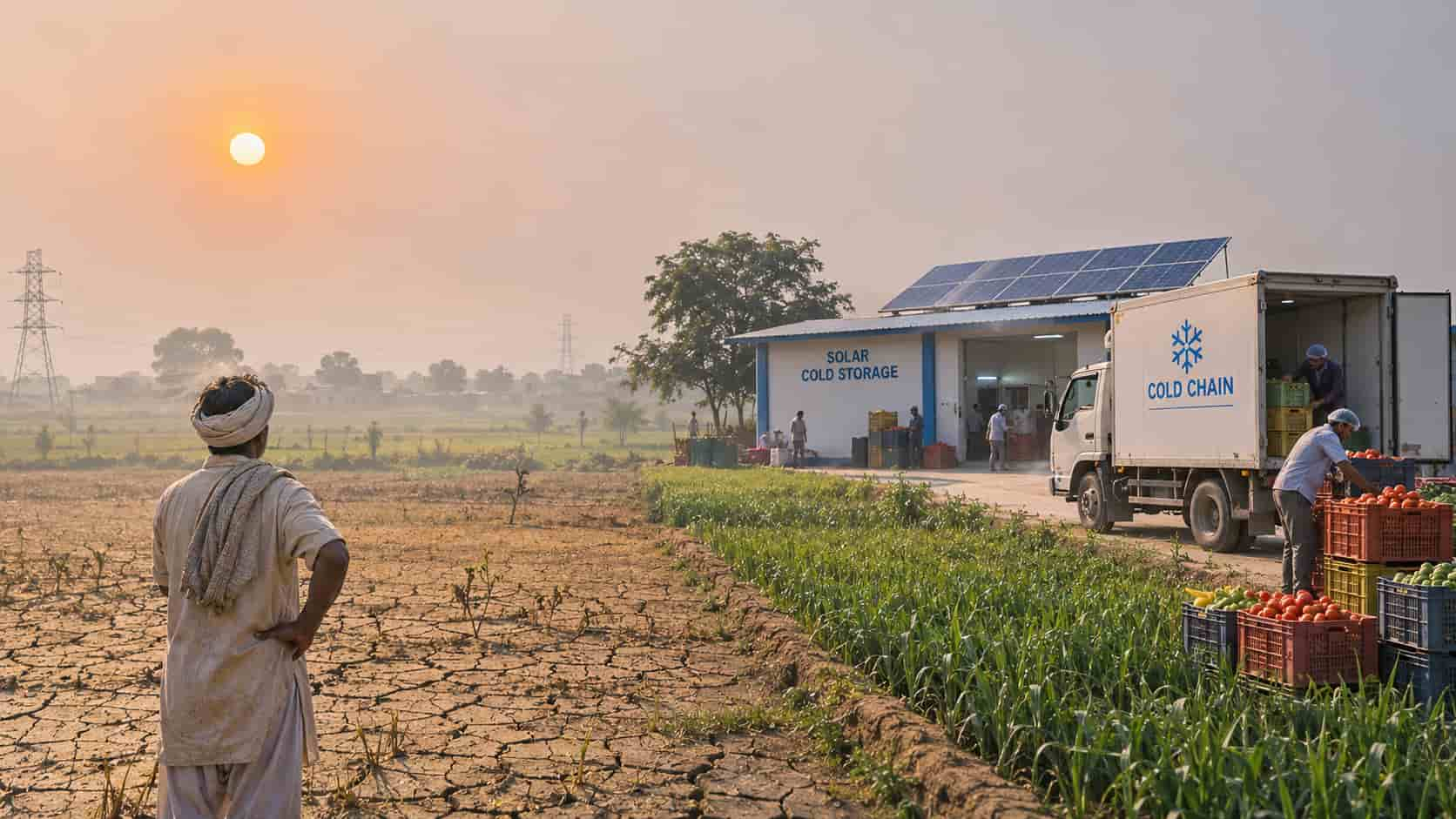
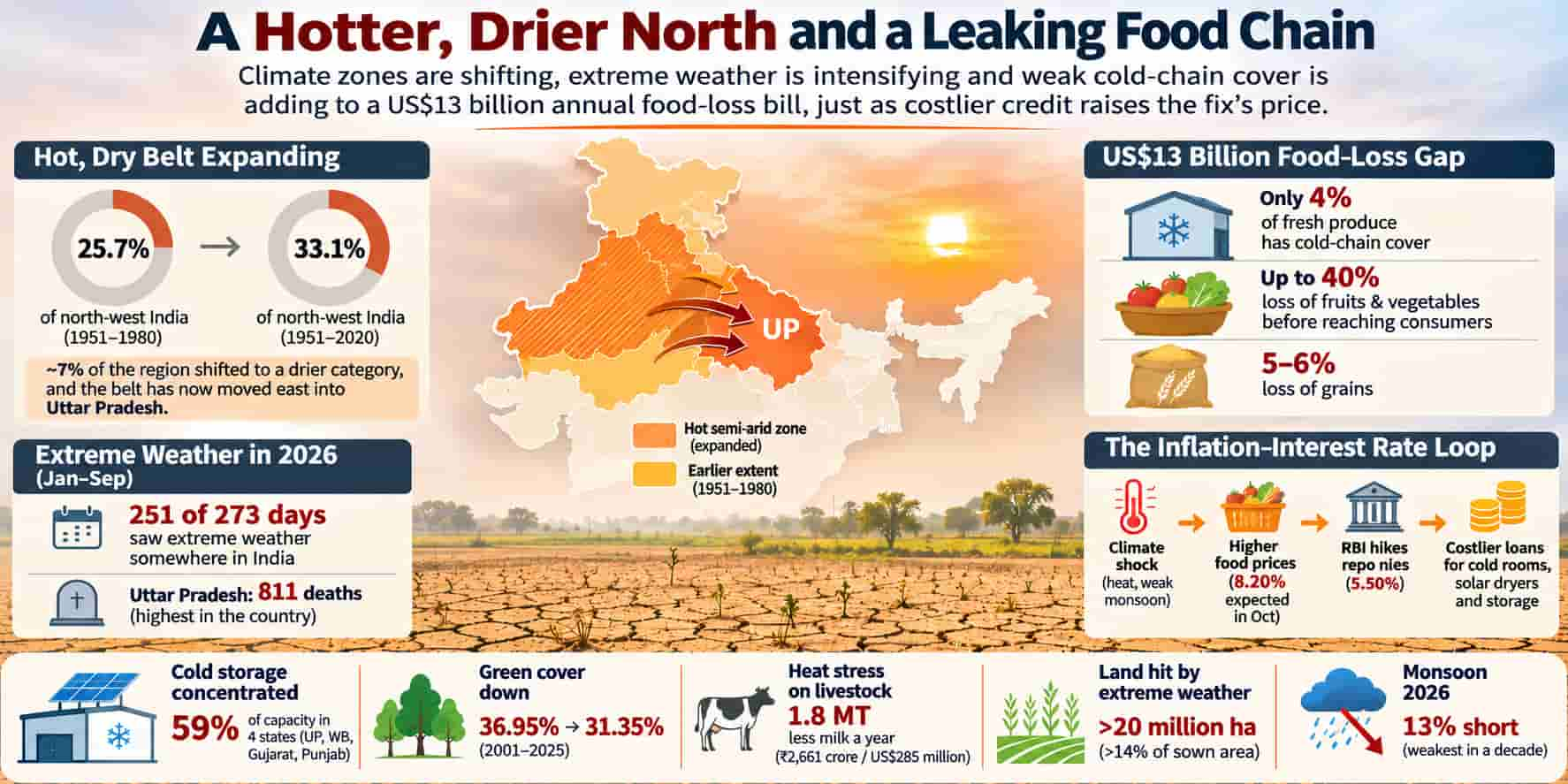
India’s climate map has shifted. A study in the India Meteorological Department’s own journal compared 30-year periods, from 1951–1980 to 1991–2020. It found that the hot semi-arid zone grew from 25.7% to 33.1% of north-western India’s area.
Roughly 7% of the region slipped into a drier category. The belt also moved east into Uttar Pradesh, which lay outside it earlier.
The south tells the opposite story. Much of peninsular India turned wetter, and tropical savannah now covers about three-quarters of it. So the finding is not that India is simply drying. It is that the weather farms were planned around has moved.
Uttar Pradesh sits where this shift meets the shocks. Between January and September 2026, India’s most populous state saw extreme weather on nearly 64% of the 273 days, the highest share in the country along with Himachal Pradesh. It also recorded 811 deaths in that period, ahead of Maharashtra’s 286 and Bihar’s 245, according to a national extreme-weather assessment released on 4 November.
Heat deaths are likely undercounted. A researcher involved in the assessment noted that each one must be officially certified before it is blamed on a heatwave.
There is a caveat. The zone study tracks long-term climate classes. It does not pin the shift on one cause, and one academic quoted in coverage said links to ocean patterns need more work.
Still, the planning gap is plain. “Crop calendars and advisories in parts of the Gangetic plain were written for a climate that has already moved,” said a researcher at a New Delhi-based climate think tank. “Planning now has to catch up with the map.”
Losses that start after harvest
Farm losses draw the headlines. A quieter leak sits after harvest. A recent white paper from a climate research group estimates that India loses US$13 billion worth of food each year because cold-chain cover is thin. Only 4% of fresh produce passes through it. Up to 40% of fruit and vegetables, and 5–6% of grains, are lost before they reach consumers.
Estimates differ, so treat them as a range. A government-backed technology note puts post-harvest losses at ₹92,000 crore (US$9.8 billion) a year. A donor-funded cold-room project cites US$18.5 billion. The methods vary. The direction does not.
Heat adds to the bill. More than 20 million hectares, over 14% of India’s sown area, have been hit by extreme weather. Heat stress is also estimated to cut milk output by 1.8 million tonnes a year, a loss of ₹2,661 crore (US$285 million). Around 40% of livestock is exposed.
 The inflation loop
Food makes up nearly 40% of the consumer price index. A poll of economists expects food inflation to hit 8.20% in October, up from 7.74% in September. Onion prices have nearly doubled since January. The 2026 monsoon ended 13% short, the weakest in a decade.
Not all of this is climate. Costlier imported edible oil and volatile crude play a part. Even so, the RBI cited the weak monsoon and El Niño when it raised the repo rate by 25 basis points to 5.50% on 7 October. That was its first hike since February 2023. Economists expect another 25 basis points in December.
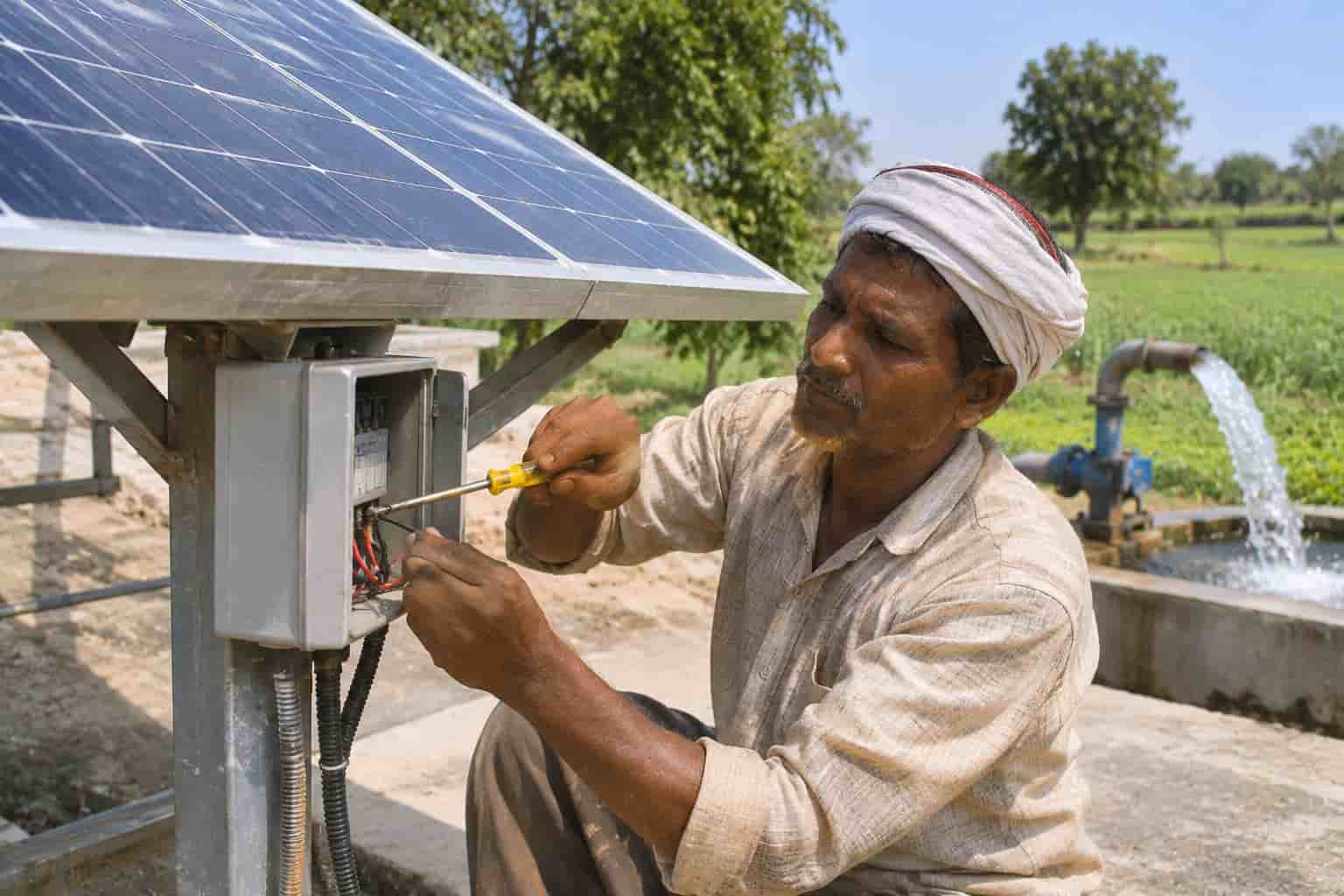
Here is the loop to watch. A climate shock lifts food prices. The central bank tightens. Higher rates make loans for cold rooms, solar dryers and storage dearer, just as those assets could blunt the next shock. Indoen has reported that solar-powered livelihood tools show strong returns, yet adoption stays under 3% because credit is scarce. A rate cycle driven partly by weather makes that gap harder to close.
Cold storage built in the wrong shape
India does not lack cold storage everywhere. Four states, Uttar Pradesh, West Bengal, Gujarat and Punjab, hold about 59% of capacity, roughly 21 million tonnes. But industry commentary suggests more than 70% of national capacity serves potatoes. So the state at the edge of the shifting dry belt has many chambers, but they are built largely for one crop. Fruit, vegetables and milk, the items heat spoils fastest, need smaller stores closer to farms.
Power is the second gap. Large stores need steady grid supply, and rural feeders are thin. Solar cold rooms offer a way through. In Bihar, 15 solar-powered units set up with UN and Japanese support charged a small user fee and lifted self-help-group revenues by 62%.
“Running a cold room on rooftop solar is cheap,” said an executive at a developer of solar cold-storage units. “The expensive part is the loan to build it, and that bill has just gone up.”
For power planners, this is a new kind of load. It is small, scattered and daytime-heavy, which suits solar. It also lands on distribution companies that are already stretched, as Indoen has shown in its look at how heat, EVs and AI are outrunning the US$34.7 billion distribution revamp.
Trees as an unbooked asset
A Climate Trends study of land cover and summer temperatures between 2001 and 2025 adds a lever that few budgets count. India’s green cover fell from 36.95% of land in 2001 to 31.35% in 2025. In summer, non-green land ran 1°C to 2.5°C hotter than green land. Areas that lost cover warmed by 0.26°C on average.
The authors of the study are careful. Even areas that stayed green warmed, so wider climate change is at work. Restoration alone cannot offset it.
Still, the finding opens a question planners rarely ask. If shade and soil moisture take a degree off local summer heat, they may also trim cooling demand and spoilage. Neither shows up in any power planner’s ledger. That is an inference, not a finding. It is worth testing in state heat action plans.
Why the window is short
Mitigation will not rescue this decade. A UN synthesis report says that if current national pledges are delivered, global emissions fall only 6% below 2019 levels by 2035. The figure is 9% if conditional elements come through. Best-estimate warming is 1.7–2.3°C by 2100. A global health assessment released ahead of COP31 found that annual heat-related deaths rose nearly 36% after the Paris Agreement. Indoen has already shown how India’s US$89.5 billion heat budget misses children. The food system needs the same scrutiny.
The calendar adds pressure. El Niño is expected to persist through February 2027, and a former IMD chief has said summer may arrive as early as February. Live storage in 178 reservoirs stood at 78.71% of last year’s level in early October.
So the next decisions are modest ones. States could update crop advisories to the new zones. Banks and development lenders could price cold-chain loans for farmers, not for large operators. The RBI’s December meeting will show how far tightening runs.
India’s adaptation test will be won in dull places: a refrigerated truck, a feeder line, a loan sanctioned at a sensible rate.
Follow us on : X | LinkedIn | Facebook | Bluesky