July gave India’s power sector two records at once. Coal plants generated more electricity than in any earlier July. Renewables also had their best month ever.
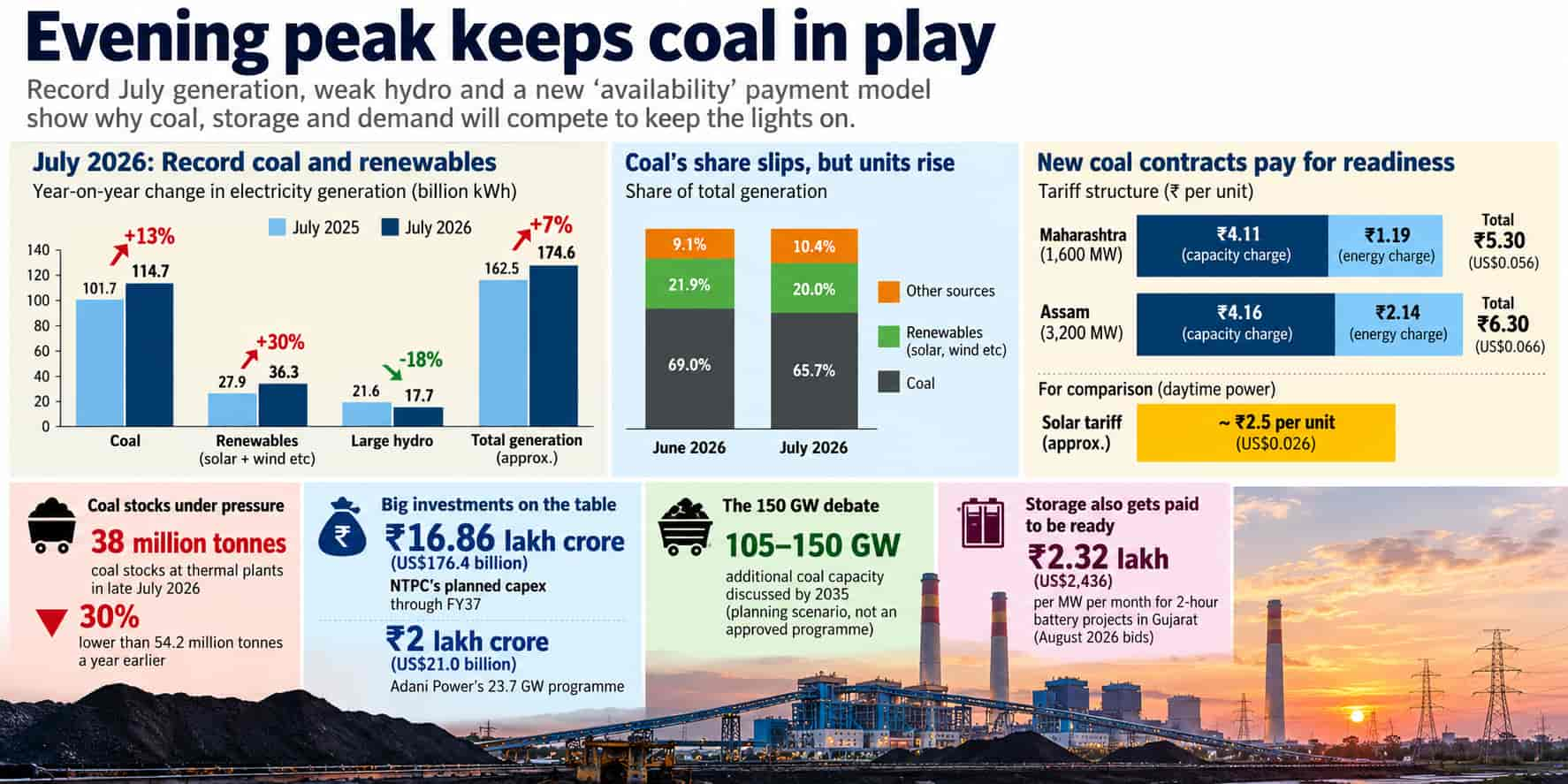
Coal-fired generation rose 13% on the year to 114.7 TWh, as per industry data. Renewable output rose 30% to 36.25 billion kWh, and coal’s share of the mix slipped to 65.7% from 69% in June. A second dataset puts coal output closer to 119.4 billion kWh. The gap comes from source and coverage. Both show growth of about 13%.
A smaller share, a bigger burn
A share is only a ratio. The grid runs on units and hours. Working back from the reported growth rates, coal added about 13 TWh year-on-year. Renewables added between 5 and 8 TWh, depending on the dataset. On either count, coal added more new electricity than renewables did.
Weak rain explains much of it. Large hydropower fell 18% to 17.7 TWh as reservoirs got less inflow. That left coal plants to meet the evening peak, when solar generation drops away. One wind turbine maker’s management gave a simple example. During a 270 GW daytime peak, solar met 22% of demand and wind 5%. At a 250 GW evening peak, solar met nothing and wind met 21%.
The next few months may repeat the pattern. The India Meteorological Department expects rainfall at 90% of the long-period average, and a developing El Niño may keep rain low. An energy research group has warned of a generation gap of nearly 18 billion kWh, as per recent reporting. In effect, India’s coal fleet also works as a hedge against bad rain. Planners rarely describe it that way.
What the grid is really buying
Newer coal contracts show where the money is heading. Adani Power, India’s largest private thermal generator, describes its new plants as balancing units. Its focus is uptime, not maximum output. In April to June, its plants were available 96% of the time but ran at a 78% load factor.
The new contracts have two parts. A capacity charge pays for keeping the plant ready. An energy charge is added when power is supplied. Fuel cost passes through to the buyer by formula.
The 1,600 MW Maharashtra contract carries ₹5.30 (US$0.056) a unit, of which ₹4.11 (US$0.043) is the capacity charge. In the 3,200 MW Assam contract, ₹4.16 (US$0.044) of a ₹6.30 (US$0.066) tariff is fixed. Solar tariffs hover near ₹2.5 (US$0.026) a unit. But solar sells daytime energy, while these contracts sell evening assurance. They are not like-for-like.
“Buyers are no longer paying only for units. They are paying for the assurance that a plant will be there at seven in the evening in a bad monsoon,” said an executive at one of India’s largest private thermal generators.
 The 150 GW question
The wider question is how much of this readiness India needs. The Central Electricity Authority’s March plan sees about 1,121 GW of installed capacity by FY36. Coal reaches 315 GW. Solar reaches 509 GW and wind 155 GW. Storage adds up to 174 GW (888 GWh), split between batteries and pumped hydro. Non-fossil sources would hold about 70% of installed capacity. That is a share of capacity, not of every hour’s supply.
Separate discussions point to 105–150 GW of additional coal by 2035, against an earlier benchmark of 97 GW. The same report cautions that this is not an approved programme. It should not be added to the plan’s coal figure. Indoen’s earlier analysis noted that the estimate leans on a year of weak hydropower.
“The 150 GW figure is a planning scenario, not a construction order. Demand, storage costs and discom finances will decide how much of it is ever built,” said a researcher at a New Delhi-based energy think tank.
Money is not waiting for that clarity. NTPC alone has outlined ₹16.86 lakh crore (US$176.4 billion) of capex through FY37, as Indoen reported. So the 150 GW debate is really about readiness. If storage, pumped hydro and demand management supply it more cheaply, some of that coal will never be needed.
Insurance needs fuel
A plant paid to stand by must have coal in its yard. Stocks at thermal plants fell to 38 million tonnes in late July, nearly 30% below the 54.2 million tonnes of a year earlier, as per the same data. By 19 October, 96 of 191 plants were rated critical, even as dispatch hit a record 2.6 million tonnes a day, as Indoen reported.
Thermal coal imports likely fell for a seventh straight month in July, so the system leans on domestic mines. On paper, price risk sits with the buyer and readiness risk with the generator. A rail jam or a mine disruption would test that split.
Who else gets paid to wait?
China shows where this can go. It has paid coal plants a standby fee since 2024. From 2026 the payment covers at least half of their fixed costs. In January 2026, Beijing extended the same capacity price to standalone storage, tied to coal benchmarks.
India already pays batteries on this logic. Two-hour battery projects in Gujarat closed near ₹2.32 lakh (US$2,436) per megawatt a month in August. Soon coal and batteries will be compared on one yardstick: the cost of being ready.
That is the risk for new coal. Adani’s programme is 23.7 GW at about ₹2 lakh crore (US$21.0 billion). Just 56% of the new capacity was tied up under long-term contracts by June, the company said. Net debt stood at ₹47,643 crore (US$5.0 billion). One wind maker’s management argues that 16-hour batteries are not yet viable. Prices can fall.
There is a second test. Readiness also means ramping quickly. Indoen’s earlier analysis found that only 1.9 GW across the fleet had shown it can run at 40% minimum load. A plant that cannot flex is ready on paper only.
What to watch
India does not face a simple choice between coal and clean power. It faces a pricing question: who is paid to be ready, and for how many hours? Three signals will answer it this winter. The first is the rain. The second is coal stocks before the cold sets in. The third is how many of the untied contracts get signed.
Follow us on : X | LinkedIn | Facebook | Bluesky