

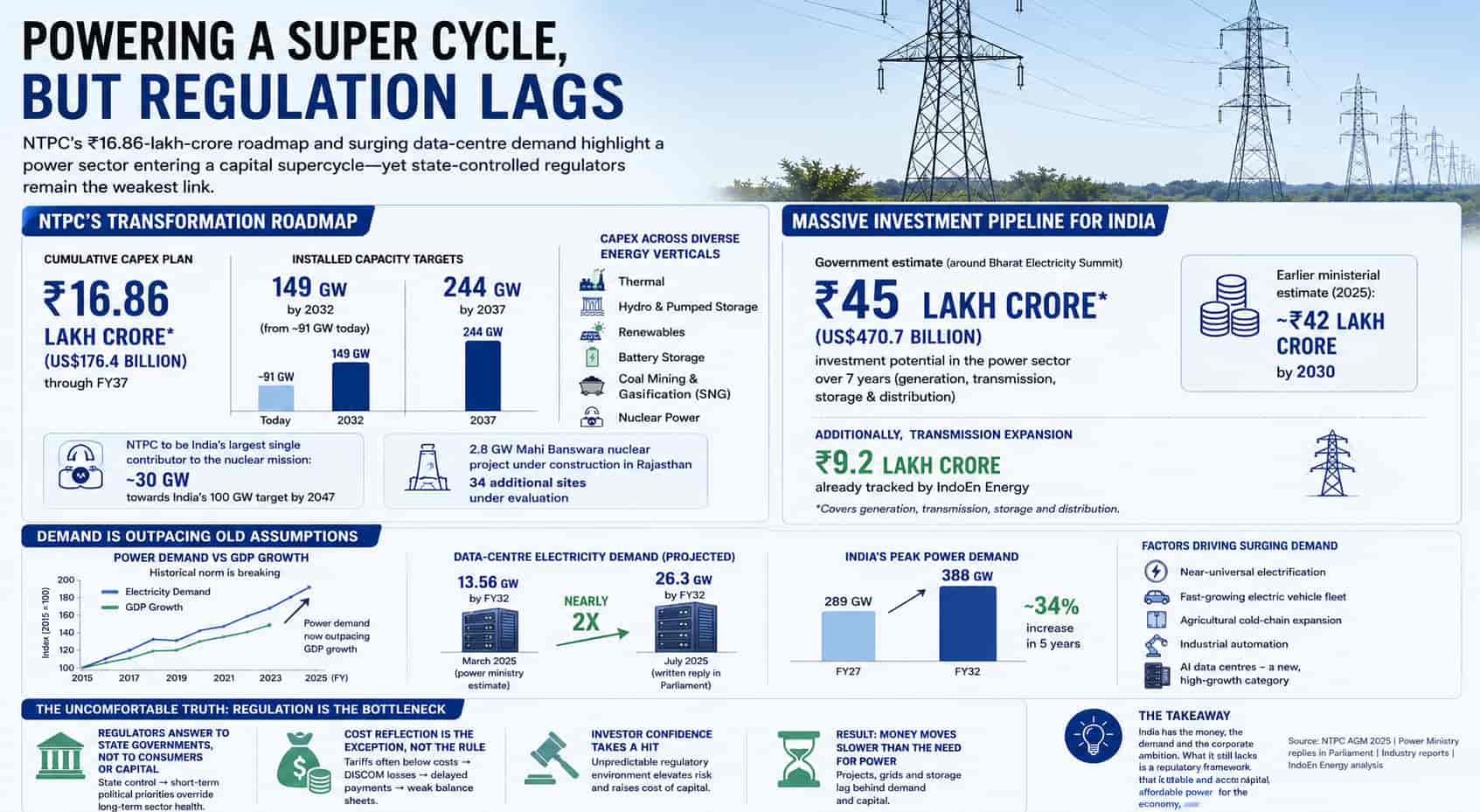
At its 50th annual general meeting on 27 August, NTPC’s chairman and managing director, Gurdeep Singh, told shareholders the company was raising its ambitions considerably. NTPC now targets 149 GW of installed capacity by 2032, up from around 91 GW today, and 244 GW by 2037. Backing this is a cumulative capital expenditure plan of roughly ₹16.86 lakh crore (US$176.4 billion) spread across thermal, hydro, pumped storage, renewables, battery storage, coal mining and nuclear power, according to a media report.
The composition matters more than the headline number. Of the 149GW planned by 2032, 60GW is meant to be renewable. NTPC is also positioning itself as India’s largest single contributor to the country’s nuclear ambitions, aiming for around 30GW towards the national target of 100GW by 2047, alongside its 2.8GW Mahi Banswara project already under construction in Rajasthan and 34 additional sites under evaluation.
A coal-gasification unit producing synthetic natural gas is meant to substitute imported gas. This is not a company hedging its coal exposure; it is a company trying to become a diversified energy conglomerate inside seven years.
This roadmap sits alongside a government estimate, repeated most recently around the Bharat Electricity Summit, that India’s power sector as a whole carries an investment potential of ₹45 lakh crore (US$470.7 billion) over the next seven years, covering generation, transmission, storage and distribution, industry reports suggest. That figure has been in circulation, in varying forms, since around January, and a separate ministerial estimate earlier this year put the number closer to ₹42 lakh crore by 2030.
The exact figure keeps moving. What has not moved is the underlying claim: this is meant to be one of the largest infrastructure build-outs in Indian corporate history, on top of the ₹9.2 lakh crore transmission expansion Indoen Energy has previously tracked.
Demand nobody modelled a year ago
Part of the reason capital is being committed at this pace is that India’s demand curve has changed shape. Electricity consumption has historically tracked GDP growth roughly one-for-one. That relationship is now breaking, with power demand expected to outrun economic growth, largely because of near-universal electrification, a fast-growing electric vehicle fleet, rising agricultural cold-chain needs, industrial automation, and one entirely new category: AI data centres, as per recent reporting.
That last category is the sharpest illustration of how quickly the ground has shifted. In March, the power ministry estimated data-centre electricity demand would reach 13.56 GW by FY32. By July, in a written reply to Parliament, the same ministry had nearly doubled that figure to 26.3 GW, according to a media report.
India’s overall peak power demand is now projected to reach 388 GW by FY32, up from 289 GW in FY27. Indoen Energy has already flagged how this demand-led phase, rather than policy alone, is reshaping the solar build-out; the same forces now sit underneath NTPC’s revised targets and the sector-wide investment figures being quoted at industry summits.
 The uncomfortable part: Money was never the constraint
Here is where the coherent, if less comfortable, story begins. A recent newspaper column has argued that India’s real power-sector problem was never a shortage of capital, it is regulatory design. Discoms across most states post large losses year after year, and their accumulated debt, run into many trillions of rupees, has been written off by the central government more than once.
When poor financials show up almost everywhere rather than in a handful of badly run utilities, that pattern points to something systemic rather than local mismanagement.
State electricity regulators are meant to prevent exactly this, using cost-plus pricing that should, in principle, let discoms recover their costs. The column’s argument is that regulators are not doing so because they are not genuinely independent of the state governments that appoint and oversee them, and state governments have strong short-term political reasons to keep tariffs low.
“Regulatory independence is the entire point of setting up an independent regulator in the first place,” said a policy adviser at a New Delhi-based energy think tank. “When the appointing authority and the entity being regulated both answer, directly or indirectly, to the same state government, you should expect exactly the pattern we see: chronic under-recovery, chronic losses, and periodic bailouts that reset the clock without fixing the mechanism.”
Three fixes have been proposed: moving the selection of state regulatory commissioners to a central authority, giving discoms greater pricing agency within a more sophisticated regulatory framework, or reverting to a centralised regulator, which would likely require difficult legal and possibly constitutional change.
Privatisation, on its own, does not solve the problem either, since private operators would still need pricing certainty that slow-moving courts and politically influenced regulators cannot reliably guarantee.
This is not an abstract concern for a sector planning ₹16.86 lakh crore (US$176.4 billion) in new capex. Discoms are the buyers at the end of NTPC’s supply chain. If their finances remain fragile and their regulators remain politically constrained, the risk is not that India lacks investment appetite, but that the money committed upstream cannot be fully absorbed downstream.
Indoen Energy has already tracked one version of this mismatch, in the ageing power purchase agreements now colliding with a solar-heavy grid, and in the regulatory friction slowing India’s nuclear ambitions, a sector NTPC itself is now betting heavily on.
A governance fix that costs almost nothing
If structural regulatory reform is a multi-year, politically difficult project, there is a smaller, more immediate lever on the table: how discoms are actually rated. Every March, the Power Finance Corporation publishes its Annual Integrated Rating of power distribution utilities, the benchmark assessment used across the sector.
On its 100-point scale, 75 points go to financial metrics and only 25 to operational indicators such as losses and collection efficiency. Initiatives that do not show up on a balance sheet, from 24x7 consumer helplines in Bengaluru to employing tribal women as meter readers in rural Chhattisgarh, go largely unrecognised, according to an expert opinion piece.
The suggested fix is to fold environmental, social and governance disclosure into discom ratings, aligning them with the framework SEBI already mandates for India’s top 1,000 listed companies. The Gujarat Electricity Regulatory Commission has already directed state discoms to begin ESG reporting, and several listed power companies already publish sustainability reports voluntarily.
“Lenders and rating agencies are no longer looking at a discom’s books in isolation,” said an executive at one of India’s leading renewable energy developers. “Green bonds, sustainability-linked loans and transition finance now carry ESG conditions attached, so a discom that cannot demonstrate credible non-financial performance is quietly shutting itself out of some of the cheapest capital available to it.”
Unlike constitutional reform of state regulators, this is something that could plausibly move within a rating cycle or two. It will not fix the political-economy problem at the heart of discom losses, but it addresses a narrower, real gap: discoms doing genuinely useful transition-linked work today have no formal channel to be rewarded for it, and financiers increasingly want to see exactly that kind of evidence before committing capital.
The bigger, global backdrop
None of this is happening in isolation. Morgan Stanley Research recently projected that Asian governments and corporates could commit close to US$5.5 trillion to energy investment as AI-linked and security-driven demand reshapes the region, a trend Indoen Energy has tracked separately.
India’s own ₹45 lakh crore (US$470.7 billion) ambition sits inside that wider Asian pattern, not apart from it. What distinguishes India is not the scale of capital chasing the sector, but the specific, decades-old institutional design that decides whether that capital reaches the consumer as reliable, affordably priced power, or gets stranded somewhere between a generator’s balance sheet and a loss-making discom.
That is the real test facing NTPC’s ₹16.86-lakh-crore (US$470.7 billion) roadmap, and the ₹45-lakh-crore (US$470.7 billion) ambition sitting above it. The generation and storage targets are, on paper, achievable; Indian utilities have hit aggressive capacity goals before.
Whether the demand materialises as planned, whether discoms can pay for the power NTPC is building, and whether the regulators standing between the two are allowed to do their job independently, will decide whether this becomes India’s best-executed energy transformation or its most expensive stranded-asset lesson.
Follow us on : X | LinkedIn | Facebook | Bluesky