
India's energy story is often presented as a choice between the old and the new. Coal versus solar. Fossil fuels versus clean energy. Energy security versus climate goals.
The latest investment trends suggest something quite different.
Rather than choosing one path, India appears to be pursuing all of them simultaneously.
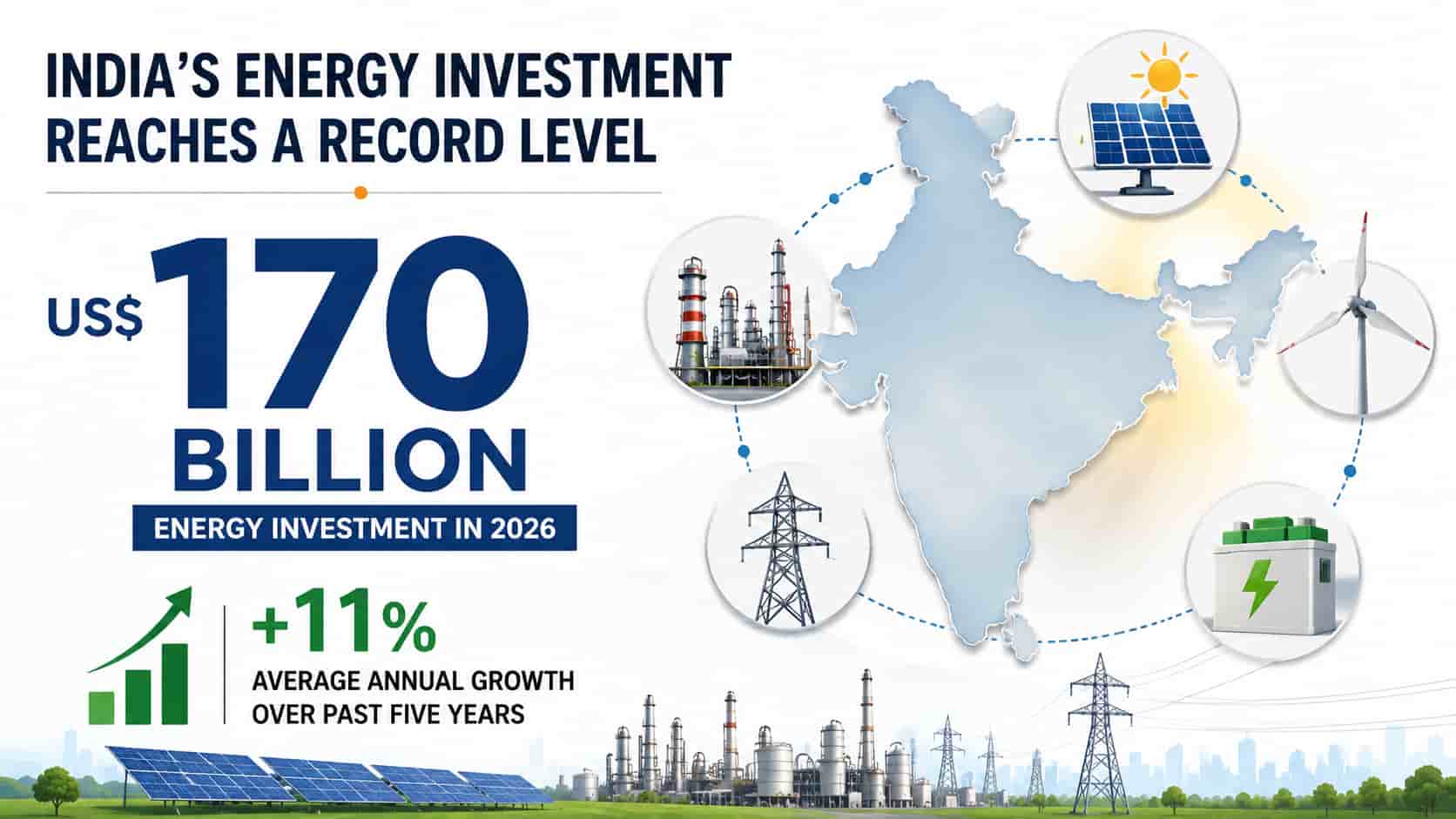
The country is on course to attract around US$170 billion in energy investment in 2026, capping five years of average annual growth of 11%. Behind that headline figure lies a remarkable reshaping of capital flows across the energy sector.
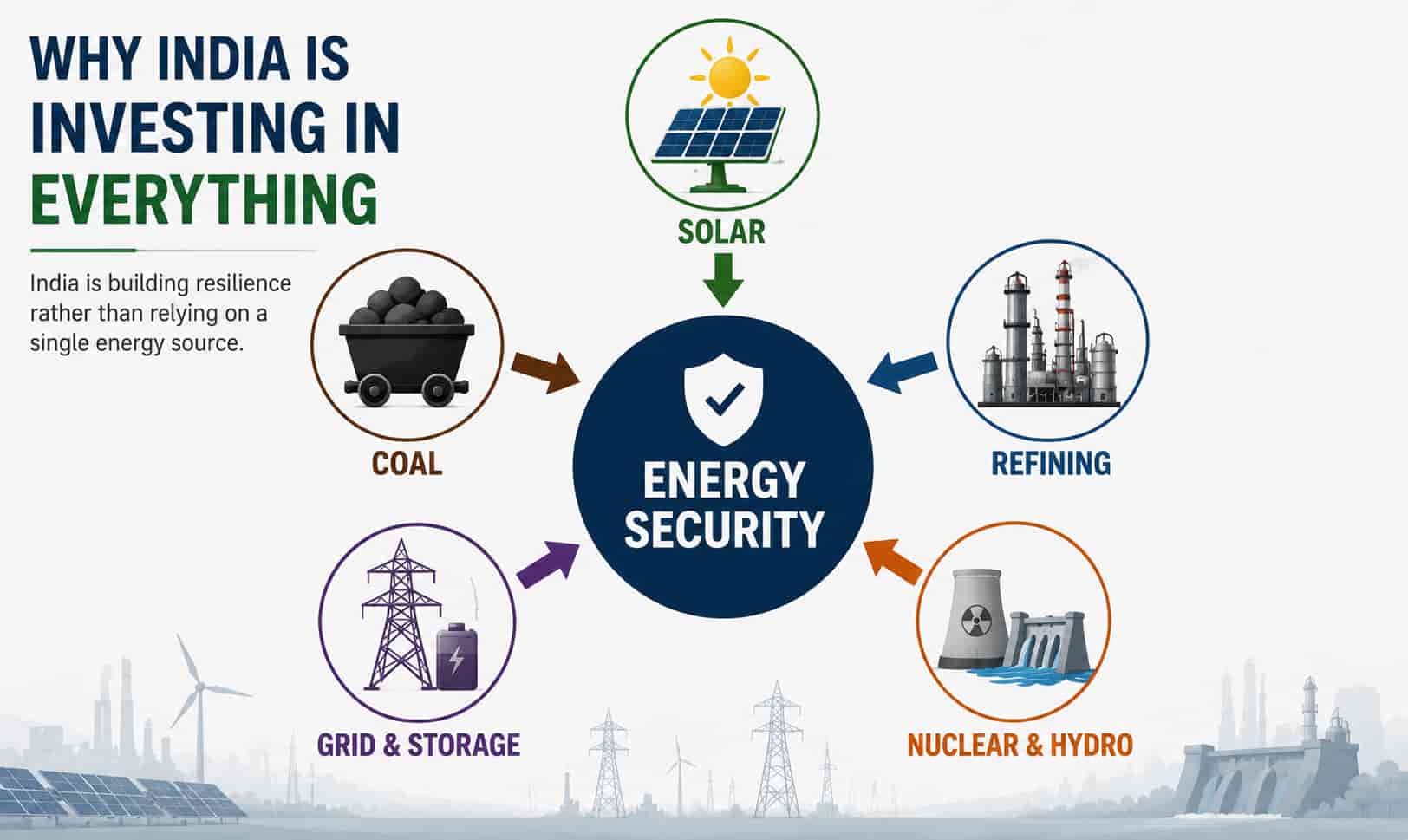
Solar power is booming. Refining capacity is expanding rapidly. Coal production is being pushed higher. Nuclear and hydropower investments are rising. Grid infrastructure is growing. Efficiency spending continues to increase.
At first glance, the combination may appear contradictory. Yet the pattern reveals something important about the next phase of India's energy development. The country's investment strategy is increasingly being organised around energy security rather than around any single technology or fuel.
That shift is taking place at a time when global energy markets are experiencing renewed uncertainty. Disruptions linked to the Middle East have highlighted the vulnerabilities of fuel-importing nations, particularly in Asia. For India, which imports the vast majority of its crude oil requirements, the message is difficult to ignore.
The rise of a diversified energy strategy
One of the most striking findings is that India is no longer concentrating its energy future in any one area.
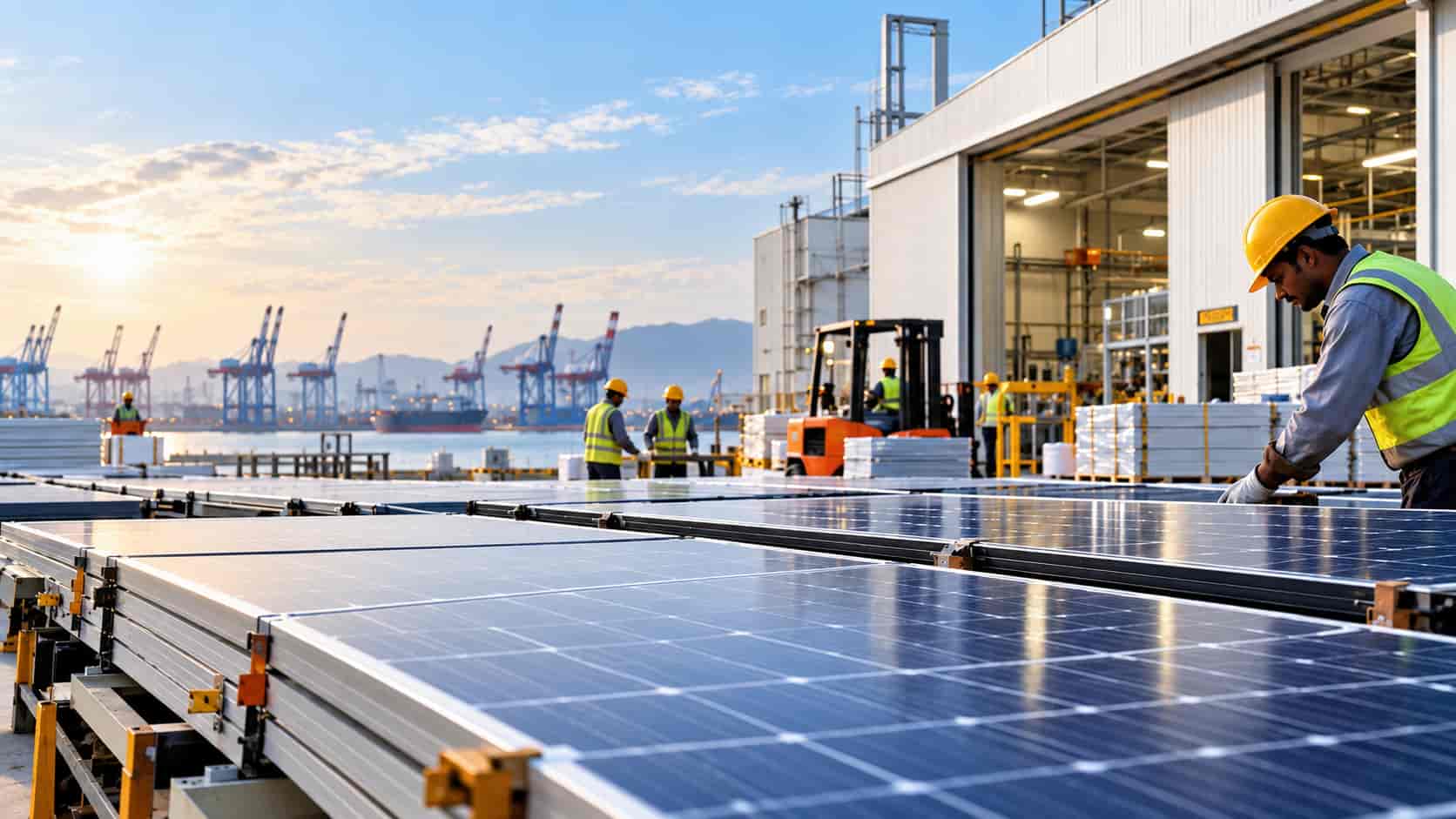
Solar photovoltaic investment has been growing by around 25% annually over the past five years. Refining investment has expanded at an equally impressive pace, growing by 23% annually. Together, these two sectors have accounted for roughly one-fourth of India's energy investment growth during the period.
This combination offers an important clue about how policymakers and investors increasingly view the country's energy future.
Solar investments help reduce dependence on imported fuels over the long term. Refining investments, meanwhile, strengthen India's position within global petroleum markets while improving domestic fuel security.
Rather than replacing one with the other, both are being pursued simultaneously.
The result is a more diversified energy portfolio capable of responding to multiple risks at once.
 Solar emerges as a strategic asset
India's clean-energy progress has been significant.
The country achieved its Nationally Determined Contribution target of obtaining 50% of installed power generation capacity from non-fossil sources five years ahead of schedule. A major contributor was the surge in solar investment, which reached US$20 billion in 2025.
The achievement reflects a broader transformation taking place globally.
According to the study, solar has become one of the world's dominant energy investments. Worldwide spending on solar projects now stands at approximately US$365 billion annually, equivalent to roughly US$1 billion every day.
Even more remarkable is the decline in costs.
A decade ago, adding one gigawatt of solar capacity required around US$3 billion in investment. Today, that figure has fallen to around US$700 million. Solar costs have declined by approximately 80% over the past decade.
For India, these falling costs are not merely an environmental opportunity. They represent a strategic economic advantage.
Every additional solar project potentially reduces future exposure to imported fuels and international price shocks.
The significance of these developments extends beyond renewable energy alone. Falling technology costs, concerns over fuel-import dependence, rising electricity demand and growing geopolitical uncertainty are reshaping investment decisions across India's entire energy system.
A recent assessment in the International Energy Agency's World Energy Investment 2026 report suggests that India’s energy investment is on course to reach around US$170 billion in 2026 after expanding at an average annual rate of 11% over the past five years. More importantly, the pattern of spending reveals a country pursuing multiple objectives at once.
Rather than making a straightforward shift from conventional fuels to clean energy, India appears to be building a broader energy-security portfolio that combines renewables, conventional fuels, grid infrastructure, storage and efficiency measures in a single long-term strategy.
The coal paradox
Yet while renewable energy grabs most headlines, coal remains deeply embedded within India's development strategy.
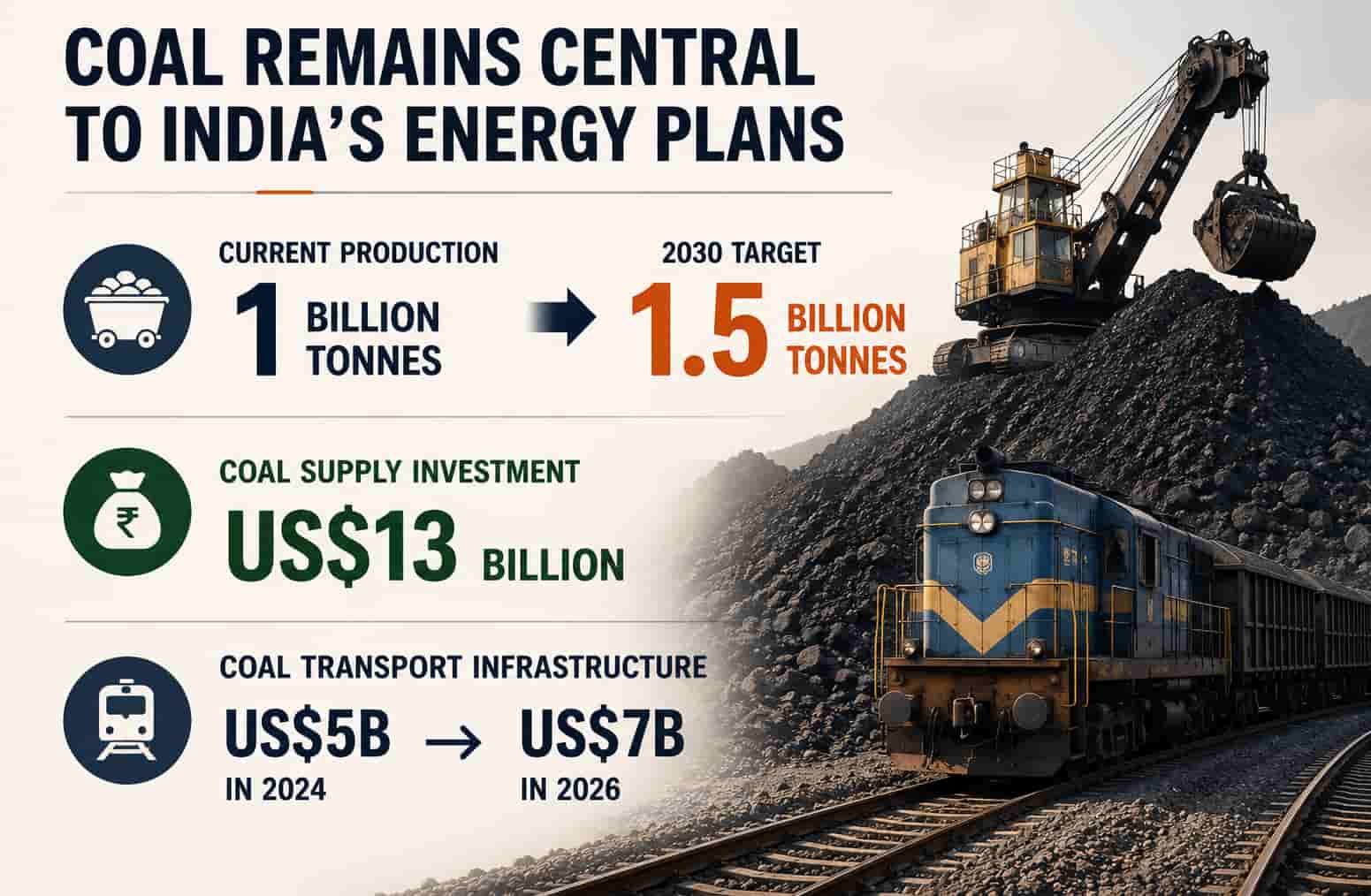
Investment in coal supply is expected to reach approximately US$13 billion in 2026.
The goal is ambitious. India aims to raise coal production from around 1 billion tonnes today to 1.5 billion tonnes by 2030.
Coal transport infrastructure is also receiving substantial investment. Spending is expected to increase from US$5 billion to US$7 billion as the country expands logistical capacity and improves coal movement across regions.
Critics may view such investments as incompatible with climate objectives.
Supporters argue that they reflect economic realities.
Coal continues to underpin a large share of India's electricity generation and industrial activity. Steel, cement, manufacturing and power generation remain heavily dependent on reliable coal supplies. For a rapidly growing economy, ensuring fuel availability remains a critical priority.
The report suggests that energy security concerns triggered by recent global disruptions may further reinforce this logic.
Rather than reducing coal investments immediately, many countries are seeking to secure domestic resources while simultaneously accelerating cleaner alternatives.
India appears to be following that path.
 Refining quietly becomes a growth story
Perhaps the most underappreciated development in India's energy sector is the expansion of refining.
While public attention frequently focuses on renewables, refining investment has emerged as one of the fastest-growing segments of the energy economy.
Current investment trends are expected to place India on track for nearly a 15% increase in refining capacity by 2030.
This development has strategic significance.
India remains heavily dependent on imported crude oil. However, it has increasingly established itself as a major exporter of refined petroleum products.
Additional refining capacity strengthens the country's role within regional and global fuel markets while helping capture more value from imported crude.
At a time when geopolitical uncertainty continues to affect global oil flows, refining infrastructure may become an increasingly important economic asset.
A shift in power sector economics
Power sector investment now accounts for roughly half of India's total energy spending.
What is particularly noteworthy is the changing balance within that investment.
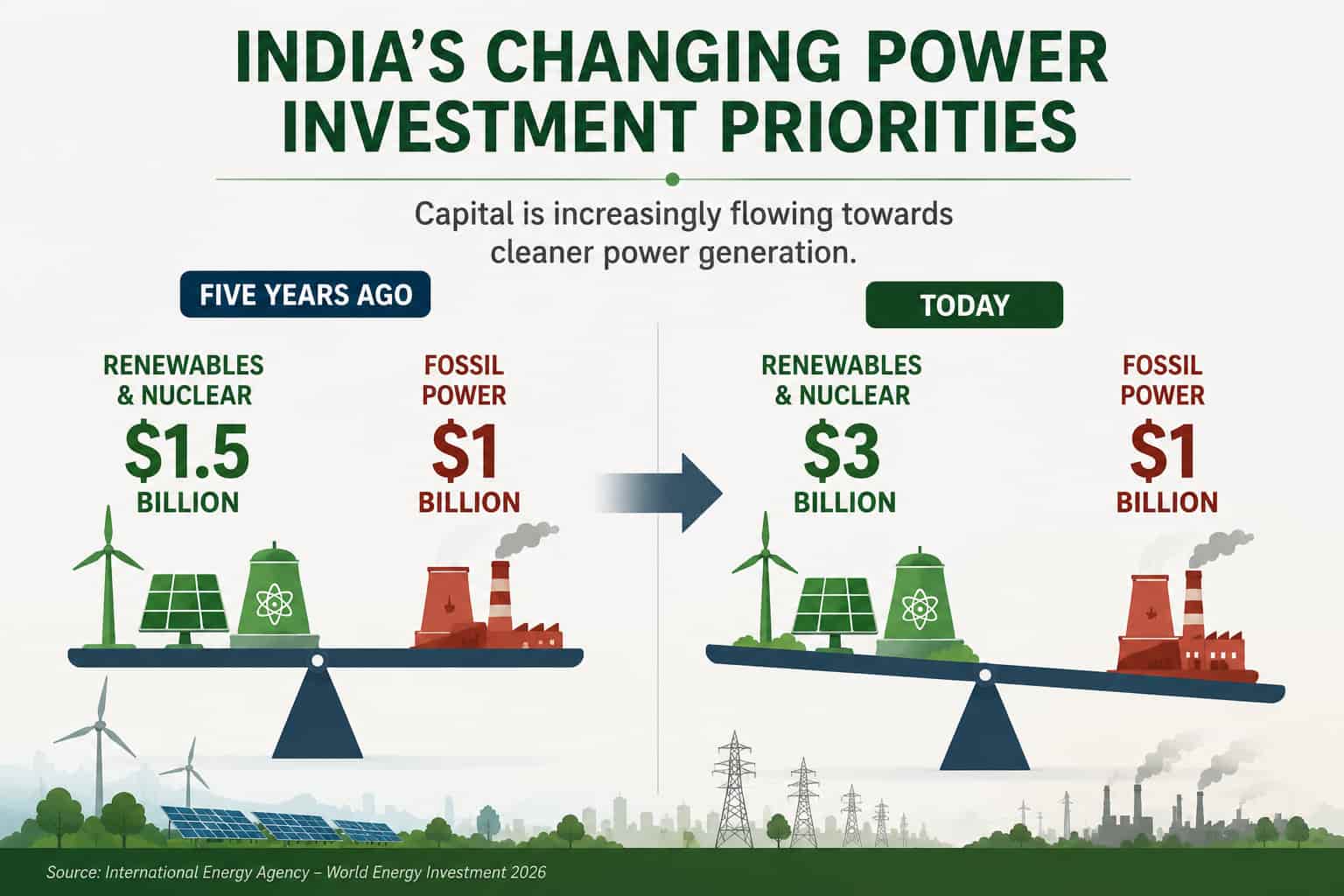
Today, India invests approximately three dollars in renewables and nuclear power for every dollar invested in fossil-fuel-based power generation.
Only five years ago, that ratio stood at roughly 1.5 to one.
The change illustrates how rapidly capital allocation is evolving.
However, renewable expansion is creating new challenges.
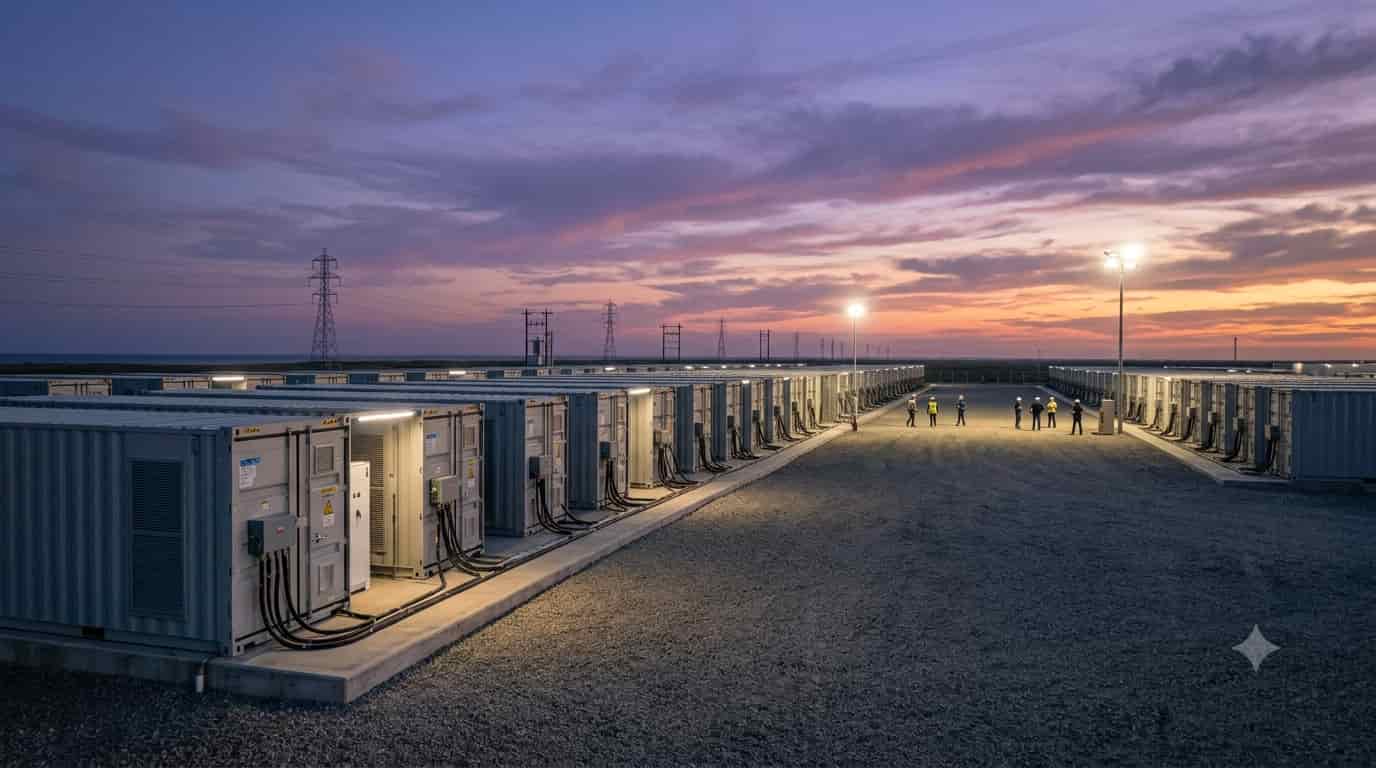
Solar and wind generation require complementary investments in transmission systems, storage technologies and dispatchable generation sources.
Recognising this reality, India has expanded hybrid renewable tenders and storage-linked projects.
Investment in nuclear and hydropower has also surged. Spending on both technologies reportedly tripled between 2021 and 2025.
This trend is important because it reflects a shift away from viewing renewables solely as generation assets. Increasingly, attention is moving towards system reliability and grid stability.
The hidden role of efficiency
Energy transitions are often associated with new power plants and large infrastructure projects.
Yet some of the most important gains come from using energy more efficiently.
Investment in efficiency improvements has been growing by more than 10% annually over the past five years and has reached approximately US$18 billion.
Efficiency rarely attracts the same attention as solar parks or nuclear reactors.
Nevertheless, it remains one of the cheapest methods of strengthening energy security.
Every unit of energy saved reduces the need for future generation, transmission and fuel imports.
The broader study estimates that clean-energy investments, electrification and efficiency measures helped major importing regions avoid around US$260 billion in fossil-fuel import costs during 2025.
For countries such as India, these savings are becoming increasingly relevant as global energy markets grow more volatile.
Consumers begin to reshape the transition
Some of the most fascinating signals in the report emerge not from boardrooms or government ministries but from households.
During recent LPG supply disruptions, India reportedly experienced a surge in induction cookstove sales ranging between ten and fifteen times normal levels.
The episode offers a glimpse into how consumers respond when traditional fuel systems face uncertainty.
Energy transitions are often discussed in terms of policy and investment.
However, behavioural shifts can be equally powerful.
Electric mobility presents another example.
Investment in electric vehicles remains relatively modest at around US$2 billion and EVs account for only around 5% of vehicle sales. Yet adoption continues to grow from a low base.
If electricity becomes increasingly affordable and reliable, consumer electrification could accelerate far more rapidly than current projections suggest.
What India's investment strategy reveals
The most important conclusion may be that India is entering a new phase of energy development.
For years, discussions often framed energy policy as a choice between economic growth and sustainability.
The investment data suggest a more nuanced reality. India is expanding solar power while increasing coal production. It is building refineries while strengthening renewable energy. It is investing in nuclear, hydro, storage and transmission simultaneously.
Rather than choosing between energy security and energy transition, the country appears to be pursuing both. There are risks.
Managing such a broad investment agenda will require substantial capital, policy consistency and infrastructure planning. Some observers may question whether continued coal investments could complicate long-term decarbonisation goals.
Yet there are also opportunities.
A diversified energy system may prove more resilient in a world characterised by geopolitical uncertainty, volatile fuel markets and rapidly changing technologies.
The most revealing lesson from India's US$170 billion energy investment story may therefore be this: the country's energy future is not being built around a single fuel or technology. It is being built around resilience.
And in an increasingly uncertain world, resilience may become one of the most valuable energy assets of all.