
Hyundai Motor Group commits $15.5bn to India through 2032
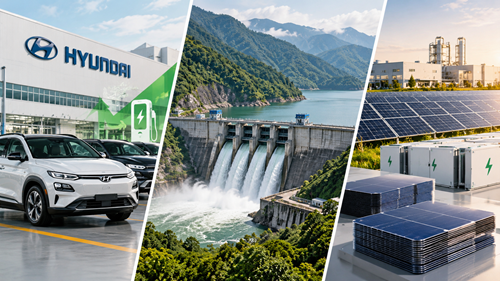
Hyundai Motor Group has committed $15.5bn to India over 2026–2032, announced after Executive Chair Euisun Chung met Prime Minister Narendra Modi on 13 October. The money is meant for manufacturing, supplier localisation, mobility businesses and R&D. The R&D share is about $700m, including a vehicle testing track. A dedicated Indian investment entity will coordinate the funding and look for local partners. The announcement does not split the sum between Hyundai and Kia, and it sets no final capacity target.
The programme builds on a large base. The group already has 14.25 lakh units of annual capacity: 8.24 lakh at Chennai, 1.70 lakh at Pune and 4.31 lakh at Kia’s Anantapur plant. The Maharashtra piece is the most detailed so far. Hyundai will invest an additional ₹4,000 crore ($420m) in the state by 2030 to raise Pune's output from 1.7 lakh to 3.2 lakh units a year. That takes Hyundai Motor India to nearly 1.14 million units by 2030. Its direct investment in the state stands at ₹7,000 crore ($735m), and suppliers have put in ₹4,600 crore ($485m).
The structural interest lies in what the capital is buying. Hyundai is targeting about 90 per cent localisation by 2030. Its Pune announcement raised the target to 92 per cent from 83 per cent, with battery-pack localisation underway. It plans four EVs by 2029. Kia has eight electrified models, including a small electric SUV built locally by 2029. The programme also covers charging infrastructure and vehicle recycling. Pune’s flexible lines will build both petrol and hybrid vehicles, so this is a staged transition rather than an all-EV bet.
The timing also reflects competition. Hyundai Motor India slipped from second to fourth in domestic sales last fiscal year, which suggests the capacity is partly defensive. For India’s energy transition, localisation of batteries, power electronics, and charging will shape demand on the EV and storage supply chain.
Arunachal clears $5.5bn hydropower pipeline as Subansiri remains half-commissioned
Arunachal Pradesh’s cabinet has approved more than ₹52,000 crore ($5.5bn) for five new hydropower projects with a combined capacity of nearly 4,000 MW. The state’s release does not name the projects, developers, river basins or schedules. As the report itself notes, approval of investment does not mean construction has begun or that capacity is available.
The benchmark is NHPC’s Subansiri Lower project on the Assam–Arunachal border. It is a 2,000 MW plant costing ₹30,071 crore ($3.2bn). Four of its eight 250 MW units are commissioned, and the fourth entered commercial operation on 8 May 2026. The report gives no date for the remaining four. On our arithmetic, the new pipeline works out at no less than about $1.4m per MW, against roughly $1.6m for Subansiri Lower.
The reason this matters is firming. The Ministry of Power has identified Subansiri’s potential to balance intermittent solar and wind and supply peaking power. As variable renewables grow in the grid, flexible hydro with storage-like behaviour becomes more valuable. The open questions are execution risk and project identity. The unnamed projects, the unfinished half of Subansiri and the environmental, dam-safety and community concerns the report flags will decide whether this pipeline becomes capacity.
Jupiter targets mid-2027 IPO to fund solar and storage expansion, eyes $685m revenue
Jupiter International, the solar cell maker, is targeting a listing by mid-2027. It is in talks with merchant bankers and expects to settle its IPO strategy in about a month. Issue size and valuation are undisclosed. The proceeds are meant to fund expansion over FY28–FY29, strengthen cell manufacturing and take the company into upstream components and battery storage.
The revenue trajectory is steep. The company expects ₹3,000–3,200 crore ($315–335m) this year, against ₹950 crore ($100m) last year, and ₹6,500 crore ($685m) in FY28. Cell capacity of 5.4 GW is set to reach 7.5 GW once a 3 GW Nagpur plant comes online. A 2 GW ingot-and-wafer unit is planned there, with a later expansion towards 10 GW. A 5 GW battery storage plant is due in July 2027. An earlier report put the overall expansion programme at ₹3,000 crore ($315m), though the October report gives no capex figure.
The business model shows where the constraint sits. Jupiter makes cells, not modules, and supplies Waaree, Premier and Adani group companies under multi-year agreements. India’s module capacity is about 250 GW against cell capacity of 37 GW, so cells are the scarce link in domestic solar manufacturing. Government quality-control standards for wafers and ingots are expected from 2028. A listed, cell-focused supplier moving upstream and into storage is a bet that this segment gets the structural support.
IREDA extends $307m loan for 969 MW Maharashtra solar portfolio spread across 152 sites
NOPL Solar Projects, a wholly owned subsidiary of Vikran Engineering, has signed a rupee term loan of up to $307.2m with IREDA. It will fund a 969 MWac (1.16 GWp) solar project across 152 sites in Maharashtra under the Mukhyamantri Saur Krishi Vahini Yojana 2.0. The estimated project cost is ₹4,201 crore ($440m). The loan covers about 70 per cent, with the balance of roughly ₹1,260 crore ($130m) coming from promoter contributions and other sources.
The structure ties the borrower closely to its parent. NOPL has awarded Vikran an EPC contract worth ₹3,517 crore ($370m). Under the facility agreement the parent carries no direct liability. It is expected to give a corporate guarantee through a separate instrument, and IREDA gets no board seat or control rights.
The portfolio averages about 6.4 MWac per site, which makes it distributed solar rather than a utility-scale park. That fits the scheme’s apparent purpose of supplying daytime power close to agricultural demand. For India’s financing landscape, it shows IREDA lending to decentralised, state-programme-linked capacity, a segment that does not usually attract large international project finance.
ADB and Japan back renewable power shift at 1.1 million tonne ammonia plant
The Asian Development Bank and the Government of Japan have signed financing agreements with AM Green Ammonia (India). It includes a $100m loan from the Leading Asia’s Private Infrastructure Fund 2, financed by JICA and administered by ADB. The money converts a former natural-gas-fuelled ammonia and urea facility to renewable power, giving a plant of around 1.1 million tonnes of ammonia a year. The location, total project cost and offtake terms are not disclosed. JBIC is named as a cooperating institution, but no amount is given.
This is the first investment under ACCEL, the Action for Creating Energy Security for Long-term Resilience initiative launched by ADB and Japan in May 2026. ACCEL has two priorities: short-term liquidity support for businesses, especially SMEs, and a medium- to long-term shift to more diversified, sustainable energy systems.
The structural point is brownfield conversion. Switching an existing gas-based ammonia site to renewable power reuses existing ammonia infrastructure and removes gas as the feedstock. The project aims to cut emissions and create an export industry.
The loan is small against a plant of this size, so the rest of the capital stack matters. Its significance lies in the signal that Japan-linked multilateral money is targeting energy-security-driven industrial conversion.
FMO’s $100m rupee loan to ReNew backs long-term clean energy finance
The Dutch development bank FMO has provided a $100m, rupee-denominated, 10-year corporate debt facility to ReNew Solar Power, a wholly owned subsidiary of ReNew Energy Global. FMO calls it its largest investment in India’s energy sector. It funds solar and hybrid projects under construction, but names no specific projects. FMO classifies all of it as green, and the deal also qualifies under the 2X Challenge for women’s economic opportunities.
The currency structure is what stands out. A long-tenor rupee loan from a foreign development lender removes the exchange-rate mismatch that dollar borrowing creates for developers who earn in rupees. ReNew’s CFO said it diversifies funding sources. The sum is modest against a portfolio of 20.5 GW of clean energy and 1.7 GW/6.2 GWh of storage, plus manufacturing of 6.4 GW of modules and 2.5 GW of cells, with 4 GW of further cell capacity planned by December 2026.
The loan sits alongside a $138m FMO commitment to a Copenhagen Infrastructure Partners vehicle, matched by CIP to $276m, for renewables in India and other emerging markets. Together they suggest European development finance is moving from project-level support to platform-level and local-currency instruments.