
India solved its power shortage problem. It has not solved its power-sharing problem.
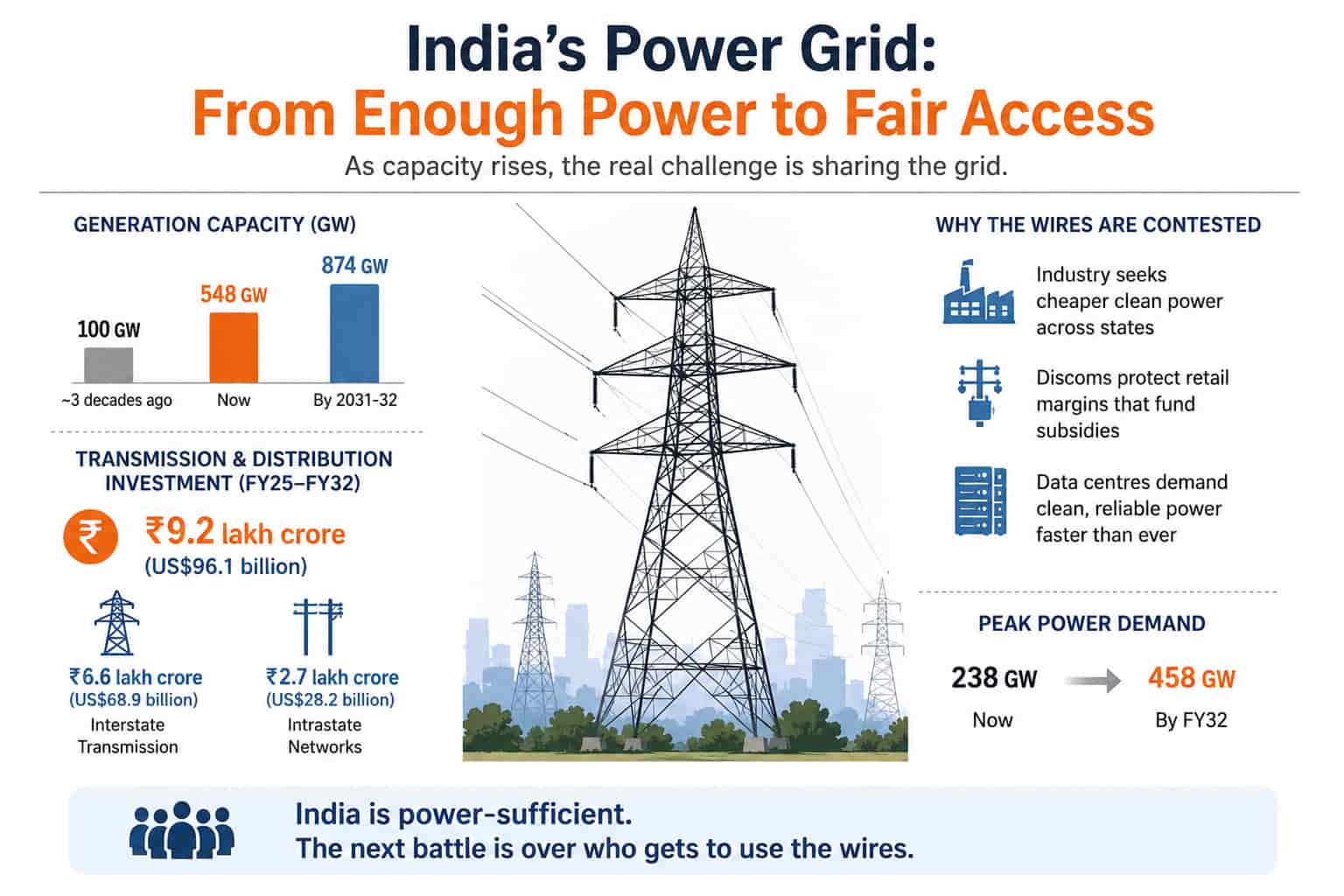
For three decades, the country’s electricity story was about scarcity. Generation capacity has now crossed 548 GW, up from roughly 100 GW three decades ago, and the government expects it to reach 874 GW by 2031-32. Blackouts have all but disappeared outside local faults. India is, by most measures, power-sufficient.
But sufficiency at the generation level has exposed a newer, messier problem downstream. Everyone now wants a share of the same wires, at the same time, for different reasons.
Industrial consumers want cheap renewable power routed from another state. Discoms want to protect the retail margins that fund rural subsidies. And a fast-growing category of consumer, the data centre, wants electricity that is clean, uninterrupted and available faster than any grid has ever been asked to expand.
The ₹9.2 lakh crore bet on wires, not power plants
The next phase of India’s power capex cycle looks nothing like the last one. Between FY25 and FY32, India is expected to invest roughly ₹9.2 lakh crore (US$96.1 billion) in transmission and distribution infrastructure, according to the National Electricity Plan, referenced in a recent brokerage note. Of that, ₹6.6 lakh crore (US$68.9 billion) is earmarked for interstate transmission and ₹2.7 lakh crore (US$28.2 billion) for intrastate networks.
The reasoning is straightforward. Peak power demand is projected to nearly double, from around 238 GW to roughly 458 GW by FY32. Most of the new capacity being added is renewable, and renewable generation tends to sit far from where people actually consume power. None of that electricity is useful without wires strong enough to move it to a factory in Haryana or a data centre in Mumbai.
Power Grid Corporation, which owns roughly 84% of India’s interstate transmission network, sits at the centre of this build-out, alongside private developers and equipment manufacturers who now find themselves in the middle of the country’s biggest infrastructure story.
 Why the wires themselves are becoming contested territory
A dispute in Haryana shows what happens when demand for grid space outpaces the space itself. Jindal Stainless runs a steel plant in Hisar. It wanted to import 100 MW of wind and solar power from projects it had developed in Gujarat and Madhya Pradesh, wheeled across the national grid.
Haryana refused, citing a practical concern: the state’s entitlement to draw power from the interstate grid sits at 6,913 MW, while the physical lines running into the state can carry closer to 10,000 MW. That spare capacity is exactly what Haryana leans on during summer, when demand climbs and the state buys short-term power on the exchanges.
Jindal argued it was not asking for anything extra. It was already buying roughly 104 MW from the local discom, and every unit sourced from its own renewable projects would simply replace that. On 23 June 2026, the Haryana Electricity Regulatory Commission agreed, ruling that a state cannot deny long-term open access purely to preserve corridor capacity for its own short-term summer purchases.
Eighteen months after Jindal’s first letter, the permission was finally granted.
The case matters because it is not really about one steel plant. It is about what happens when a discom’s two businesses — running the wires and selling the electricity — start pulling in opposite directions.
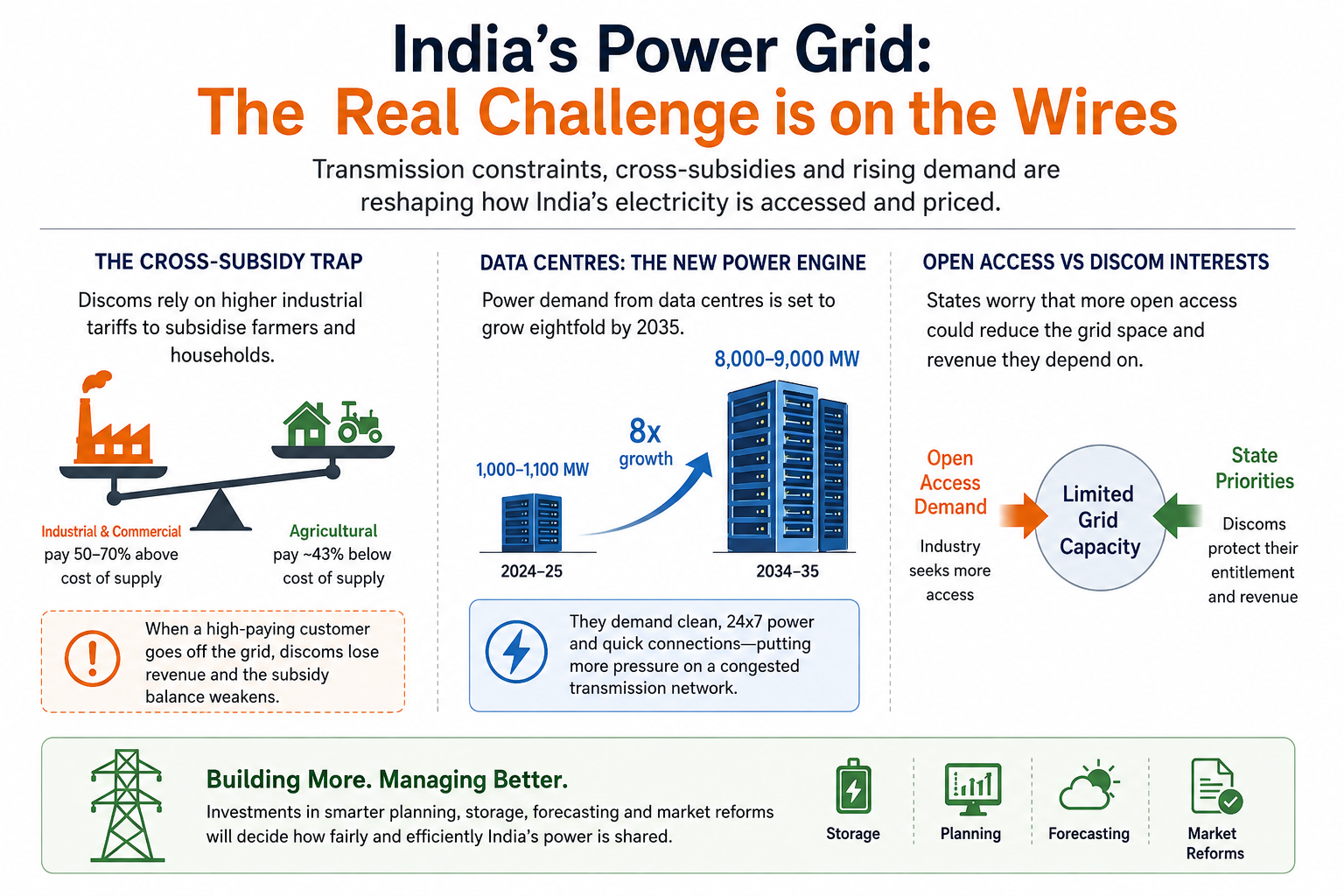
Industrial and commercial consumers are deliberately charged more than the cost of serving them, and that surplus subsidises farmers and households who pay less than cost. In Maharashtra, commercial consumers pay 50 to 70% above the average cost of supply, while agricultural consumers pay roughly 43% below it.
When a profitable industrial customer switches to open access, a discom does not just lose that customer’s bill. It loses the cross-subsidy that quietly funds everyone else’s cheap power.
Haryana’s own numbers show how quickly this is scaling. Contracted power left unused by discoms because consumers shifted to open access rose from 8.6 crore units in the first half of FY25 to 14.5 crore units in the second half, pushing the additional surcharge on open-access consumers from ₹1.15 to ₹1.37 (US$12.02–14.32 per MWh) per unit within a year.
"The tension is structural, not incidental," said an executive at one of India’s leading renewable energy developers. "Every large industrial consumer that wins open access is a template for the next hundred who will ask for the same thing. Discoms are going to spend the next decade renegotiating what fairness on a shared grid actually looks like."
 A new kind of customer that does not wait for infrastructure
Layered on top of that contest is a category of demand India’s grid planners barely accounted for five years ago.
India’s data centre capacity has quadrupled over the past six years to 1.7 GW, making the country the largest data centre market in the Asia-Pacific region outside China, according to a BloombergNEF report.
The pipeline is larger still, with 1.3 GW under construction and another 3.2 GW that has already secured land, power and permits. BloombergNEF expects India’s data centre electricity demand to rise more than eightfold, from 11 terawatt-hours in 2025 to 91 terawatt-hours by 2035.
That is a demand curve grid planners have never had to serve before, not because of its size, but because of its character. Data centres need power that is close to constantly available and ready on a timeline that has nothing to do with how long it takes to build a transmission line. The World Economic Forum’s Innovation Playbook for Future Power Systems frames this bluntly: AI-driven demand is arriving in months, while new transmission capacity still takes years to permit, finance and build.
Whether India’s own grid can absorb that kind of demand fast enough remains one of the more consequential open questions in the sector, one Indoen Energy has examined in the context of Delhi’s own import-dependent grid.
The unglamorous fix: Better meters, not just bigger wires
If the demand side of India’s grid is becoming more complicated, the supply side is leaning on a surprisingly unglamorous fix: knowing, in far greater detail, where electricity is actually going.
Under the Revamped Distribution Sector Scheme, India has committed roughly ₹3 lakh crore (US$31.3 billion) to a smart metering rollout targeting 25 crore meters, a base larger than the installed meter fleet of the US and EU combined, according to industry estimates.
More than 5 crore meters are already in place. The scheme has separately sanctioned ₹1.53 lakh crore (US$16.0 billion) of loss-reduction works and ₹1.31 lakh crore (US$13.7 billion) of smart-metering works specifically.
The payoff is already visible in the numbers. National aggregate technical and commercial losses, the standard measure of how much power discoms lose to theft, faulty billing and technical leakage, fell from 21.91% in FY21 to 15.04% in FY25. Rural households now receive an average of 22.6 hours of daily supply, up from 12.5 hours in FY14.
"Smart meters were sold as a billing fix, but their real value is intelligence," said a researcher at a New Delhi-based energy think tank. "A meter that reports consumption every fifteen minutes generates thousands of data points a year, and that is what lets a discom spot a bypassed connection or a demand spike before it becomes a financial or a grid problem."
A global pattern, with an Indian twist
India is not alone in discovering that a power-sufficient grid still has to be managed, priced and shared carefully. In the United States, a similar reckoning is under way for different reasons. American utilities are entering what analysts call an investment super-cycle, expected to exceed US$1 trillion in grid upgrades by 2030, and have requested US$18.6 billion in rate increases in just the first half of 2026 alone, according to a recent policy explainer.
The lesson from that experience is a useful one for India: a high electricity rate and a high electricity bill are not the same thing, and policymakers who conflate the two tend to design the wrong fix.
India’s version of that lesson may be arriving through its discoms rather than its consumers. The reform journey since the Electricity Act of 2003, which first forced state boards to share spare transmission capacity with outside buyers, has taken generation and trading further than it has taken distribution, where cross-subsidies and delayed payments continue to complicate a clean financial turnaround.
None of this changes the basic arithmetic. India’s grid now has more generation than it knows what to do with in the middle of a sunny afternoon, and not nearly enough flexibility to move that power to where and when it is actually needed.
The ₹9.2 lakh crore (US$96.1 billion)being poured into wires over the next seven years is as much a bet on solving that mismatch as it is on adding new capacity. Whether discoms, regulators and a new generation of power-hungry data centres can share the same grid without one of them losing out is likely to be the defining power-sector story of the decade.
Follow us on : X | LinkedIn | Facebook | Bluesky