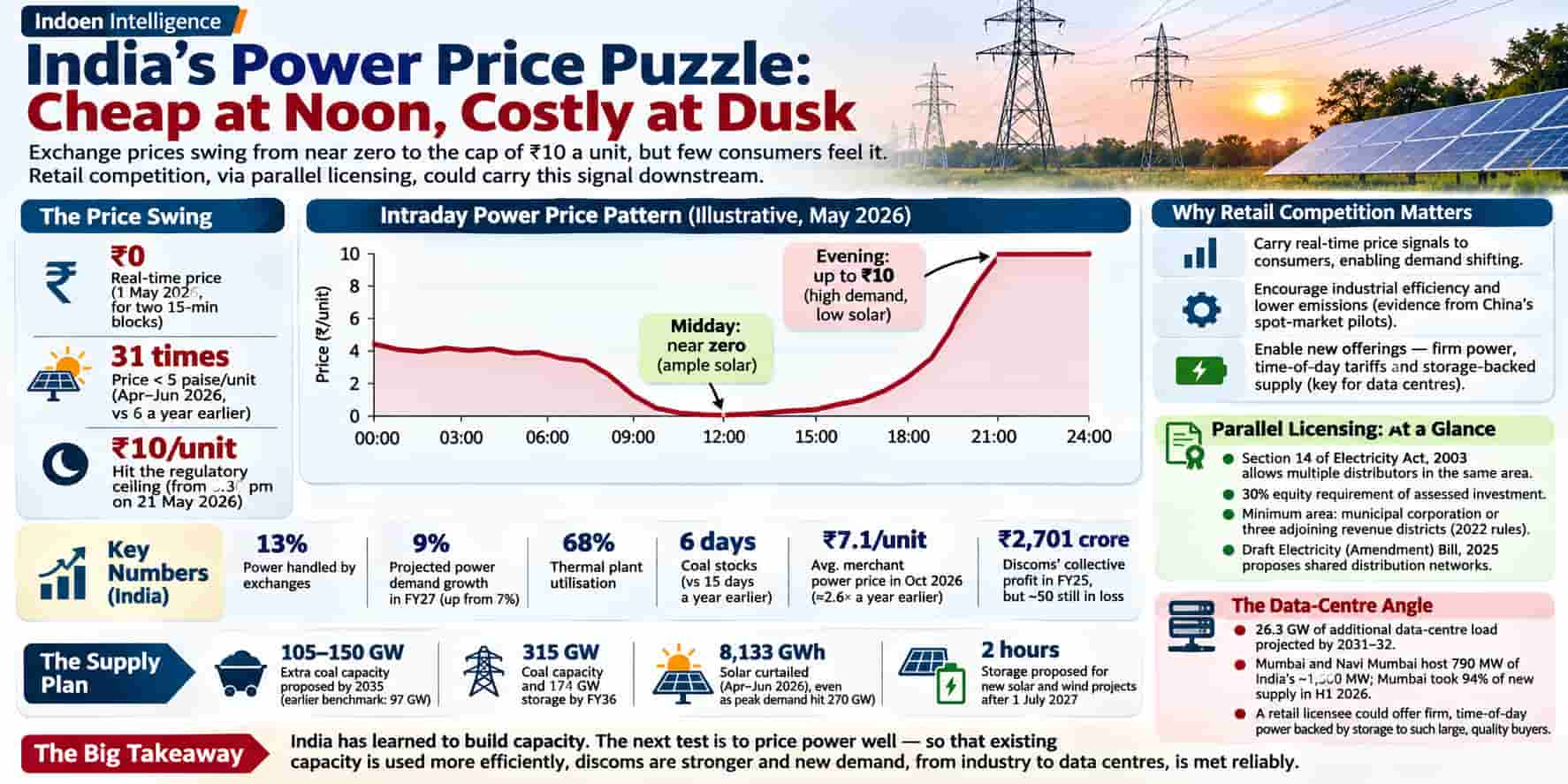
On 1 May this year, the real-time price on India’s power exchange fell to zero for two 15-minute blocks. Between April and June, prices dipped below five paise (US$0.0005) a unit 31 times, against six a year earlier. After sunset, they can touch the regulator’s ceiling of ₹10 (US$0.11) a unit, as they did from 6.30 pm on 21 May. Cheap at lunch, dear at dinner.
Yet the swing seldom reaches a farmer’s pump, a cold store or a factory floor. Exchanges handle only about 13% of India’s power. Long-term contracts and administered retail tariffs cover the rest. The cost of expensive evening power lands on distribution companies instead. As per ministry figures, discoms made a collective profit of ₹2,701 crore (US$285m) in FY25, yet around 50 still ran at a loss.
Pressure is building. A brokerage note raised its FY27 demand growth forecast to 9% from 7%, with October generation up 24% year on year. Thermal plants ran at 68% utilisation. Coal stocks fell to six days of consumption, against 15 a year earlier. Merchant power averaged ₹7.1 (US$0.075) a unit in October so far, about 2.6 times the level a year ago. Prices have since eased with the rains, as Indoen reported earlier, but the thin buffer remains.
Supply fixes, slow clocks
Most proposed answers are physical. Recent planning discussions have floated 105 GW to 150 GW of extra coal by 2035, above an earlier 97 GW benchmark. The same report cautions that this is not an approved programme. The Central Electricity Authority’s longer plan counts 315 GW of coal and 174 GW of storage by FY36.
The grid has its own problems. India curtailed 8,133 GWh of solar between April and June, even as peak demand touched 270 GW. About 21 GW of renewable capacity was running on temporary connections. Forecasting tools, STATCOMs and batteries will help.
But each of these fixes has a long lead time. A coal unit takes years. A transmission line fights land disputes and forest clearances. A price signal can change behaviour within a season. That is why the retail end deserves more attention than it gets.
 What China’s spot markets suggest
A peer-reviewed study of listed Chinese firms from 2012 to 2020 treated China’s spot-market pilots as a natural experiment. It found that spot trading improved the ESG performance of energy-intensive companies. The channels were better resource allocation, steadier operations and stronger employee governance.
It also found lower carbon intensity, which eases fears of greenwashing. The effect was stronger in more market-oriented regions and where suppliers faced competition. China has since moved fast, and spot markets now cover nearly all its provinces.
This is an underexplored lesson for India’s coal debate. Emissions are usually framed as a supply question: how much coal, how much solar. The Chinese evidence suggests that how electricity is priced can also change how heavy industry behaves. The caveats are real. The data end in 2020 and cover listed firms only. India’s industrial users sit inside a very different tariff regime. Still, the direction is hard to ignore.
“We can build a solar plant in 18 months,” said an executive at one of India’s leading renewable energy developers. “Building a price signal that reaches a household takes far longer. Noon power is nearly free, and nobody downstream is rewarded for using it.”
Why parallel licensing is back
That is where parallel licensing enters. Section 14 of the Electricity Act, 2003 lets more than one distributor serve the same area. Applicants must show equity equal to 30% of the assessed investment. The 2022 rules set the minimum area at a municipal corporation or three adjoining revenue districts. Today, each licensee must build its own wires. Where two licensees operate, regulators may fix only a ceiling on retail tariffs, which leaves room for competitive pricing.
The government wants to remove the wires problem. The draft Electricity (Amendment) Bill, 2025 proposes shared distribution networks, so entrants need not duplicate poles and substations. A power engineers’ federation says this paves the way for privatisation. A former power secretary has flagged two harder questions: legacy power contracts, and the cross-subsidy gap that arises because a new entrant’s customers differ from the incumbent’s.
“Shared networks solve duplication,” said a policy adviser familiar with the discussions on the draft Bill. “They do not solve who carries the old contracts. Until that is settled, entrants will pick the best customers first.”
Mumbai is the only real laboratory. Tata Power holds a licence running to 2039 and reports over 8 lakh distribution consumers across 485 sq km. Mumbai’s framework separates changeover, where a customer switches supplier on the incumbent’s wires, from switchover, where the customer moves to the other utility’s network. It is a live test of retail choice.
The data-centre test
Data centres could be the first big proving ground. The Power Ministry has projected 26.3 GW of added AI data-centre load by 2031–32. A NITI Aayog proposal would make developers show that local grids and water can support their projects. The load is concentrated. Mumbai and Navi Mumbai host 790 MW of India’s roughly 1,500 MW, and Mumbai took 94% of new supply in the first half of 2026.
Here is a twist. Mumbai has the multi-utility model, yet the cluster sits largely in Navi Mumbai. That area does not appear in the licence areas Tata Power lists. A market research preview says the state utility, MSEDCL, has allocated about 6 GW of grid capacity there. The city with choice and the cluster with the load are different places.
Yet these buyers are well placed to pay for quality. Tier IV facilities made up 43% of first-half supply, according to the same industry report. And poor power quality can hurt data centres and sensitive electronics. A retail licensee offering firm, time-of-day contracts backed by batteries could find willing customers. As Indoen has argued, onsite power may ease grid stress more than flexible demand. A competing supplier could offer both.
This reframes the usual worry. Data centres add to the strain on a distribution revamp already struggling to plan ahead. But they are also the customers whose willingness to pay could help finance storage.
Risks, and the clock
None of this is easy. Cherry-picking is the obvious danger. Entrants chase industrial and data-centre load, while the incumbent keeps farmers and households. The Ministry of Power has clarified that states can keep subsidising domestic and agricultural users under Section 65. The 30% equity rule and large minimum areas may also deter all but the biggest players. And a retail price signal works only if regulators let it pass through rather than smoothing it away.
Time is the harder constraint. Draft rules would require two hours of storage for new solar and wind projects commissioned after 1 July 2027. A winter with a six-day coal buffer arrives first.
India has learned to build capacity. Whether it can price power well will decide how much of that capacity is used. The coal debate asks what to add. The retail question asks what to do with what already exists.