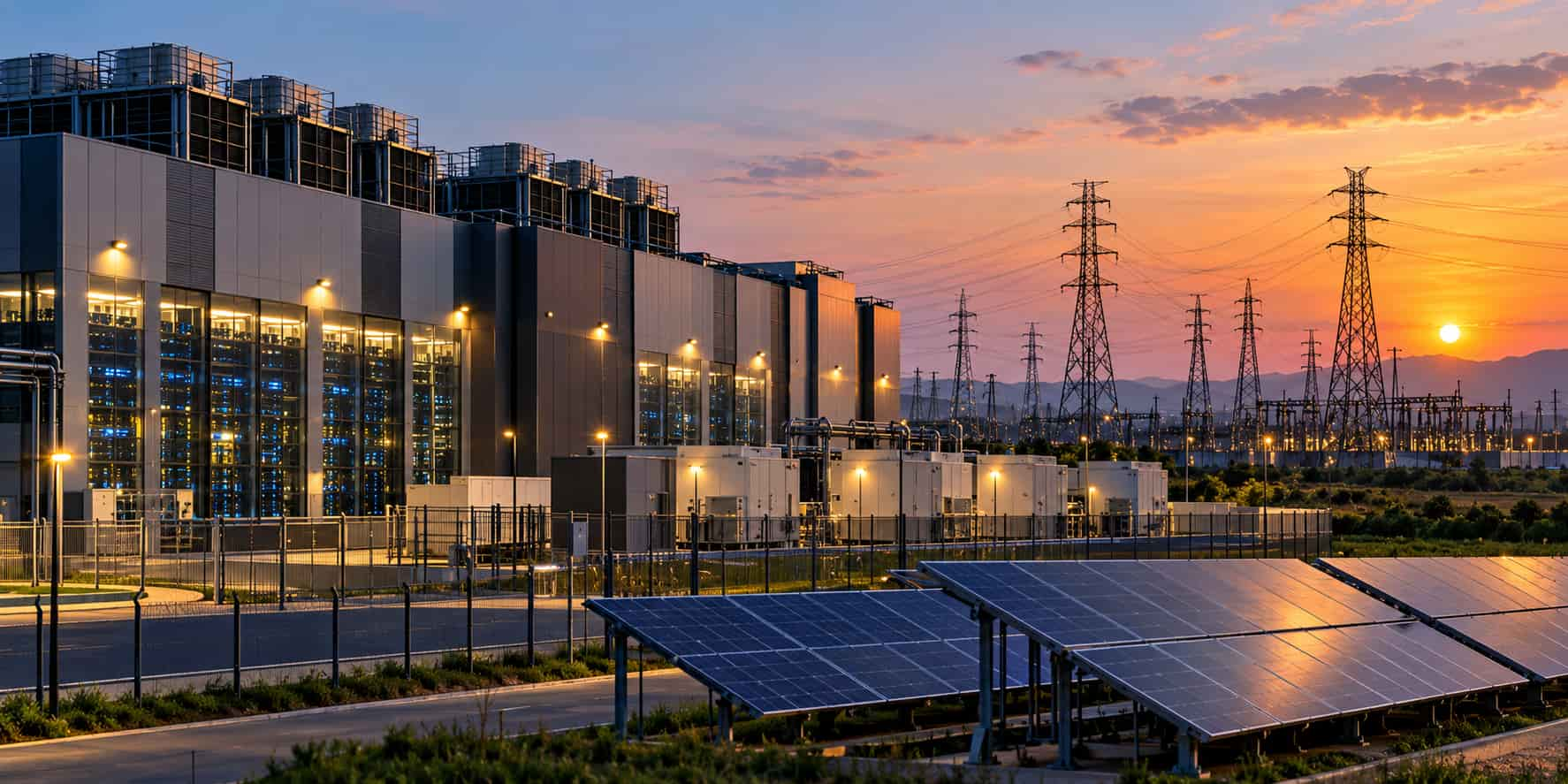
Data centres are being built faster than the grids that must serve them. A large facility typically draws 200–500 MW from the grid. That is equal to the needs of 200,000 to 500,000 households.
A new data centre can be ready in 18 to 24 months. Traditional grid expansion takes 4 to 10 years. This mismatch can worsen grid constraints and force costly upgrades, especially because data centres tend to cluster in a few regions.
A new report from Ember asks a practical question. How much can data centres themselves reduce stress on the grid at peak hours? It tests two routes, shifting consumption to other hours or locations, and switching to their own onsite supply.
Why peak hour matters
Data centre capacity is set to at least double in most regions between 2025 and 2030. But grids are built to handle their single highest-demand hour, not the average one. So the real question is how much of this new load lands on that peak.
The study looks at nine markets: Texas, California and New York in the US; Ireland, the UK and Germany in Europe; and Malaysia, the Philippines and Singapore in ASEAN. It assumes data centres run as an inflexible load, which sets a baseline.
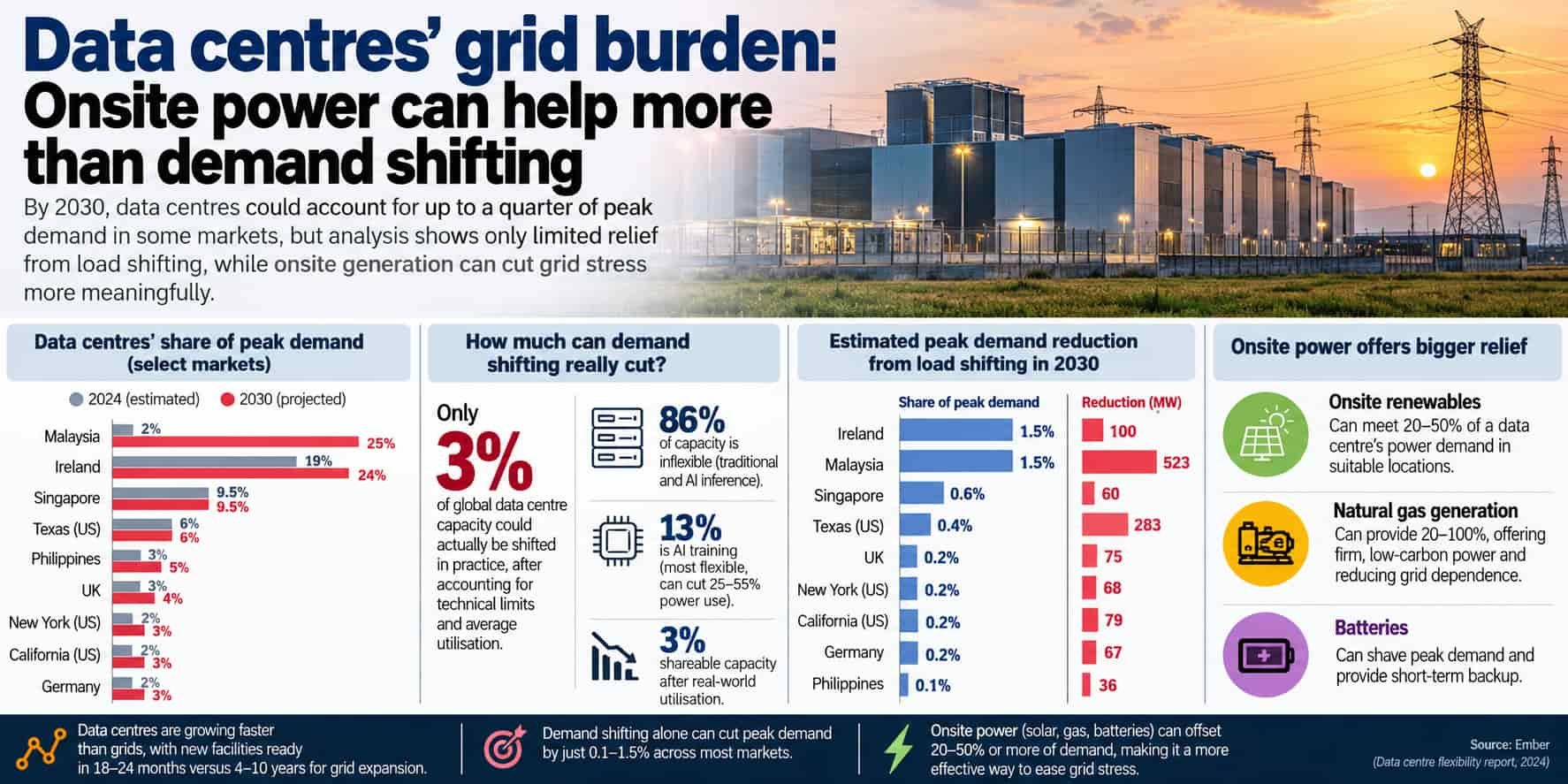
The results vary widely. In Ireland, data centres already account for an estimated 19% of peak demand. When demand hit a record 6 GW in January 2025, they likely used 1.1 GW of it. By 2030 their share is projected at 24%, or 1.6 GW against a 6.5 GW system peak.
Singapore and Texas follow a similar pattern on a smaller scale. Data centres are at an estimated 9.5% and 6% of peak demand, and these shares are expected to hold through 2030.
Malaysia, a wide range of outcomes
Malaysia is the most uncertain case. Its data centre fleet is 0.5 GW today. By 2030 it could be 1.1 GW, 7.7 GW or even 13 GW, depending on which projection plays out.
At the top of that range, data centres would take 25% of Malaysia’s peak demand, up from just 2% in 2024. That is a twelve-fold jump in share within six years. For a grid planner, such a spread is itself a risk. Plan too little and supply falls short. Plan too much and consumers pay for idle assets.
Load shifting has a ceiling
Load shifting is the flexibility option most often discussed. A data centre reschedules or relocates computing work when the grid is stressed. One study cited in the report says 21–49% of data centres would need to act flexibly for this to deliver large benefits.
The report finds the fleet falls far short of that. Traditional data centres, which run cloud services, enterprise IT and web hosting, must answer users instantly. AI inference centres, which run trained models to answer requests, are equally sensitive to delay. Together they made up about 86% of capacity in 2024. They are still expected to hold 87% in 2030, because inference, not training, drives most of the growth.
AI training centres make up the remaining 13%. They are the most flexible, able to cut 25–55% of their power demand, since training can be paused without major harm. In real-world demonstrations by Emerald AI, power use fell by up to 40% within a minute. The cut was held for several hours without hurting the highest-priority jobs.
 The 3% problem
To size the opportunity, the study makes modelling assumptions. It takes 35% of training capacity as flexible, 5% of inference capacity and none of traditional capacity. On the projected 2030 mix, that gives 6.5% of global capacity that could theoretically shift.
Then comes a reality check. Data centres do not run flat out. With average utilisation of about 48%, the shareable capacity falls to 3%. That is the headline figure of the report.
In practice, load shifting would trim peak demand by only about 1.5% in Ireland and Malaysia. In Ireland that is 100 MW, and in Malaysia 523 MW. The other seven markets see cuts of just 0.1% to 0.6%. Singapore gets 0.6%, Texas 0.4%, the UK, New York, California and Germany 0.2% each, and the Philippines 0.1%.
Small, but not worthless
The authors do not dismiss the 1.5%. In Ireland, grid operator EirGrid expects household flexibility and smart EV charging to cut 420 MW from the 2030 peak day. Data centre load shifting could add another 100 MW. The total of about 520 MW would cover 8% of projected 2030 peak demand.
Yet EirGrid does not yet count data centre flexibility in system planning. This risks building more infrastructure than needed.
Some arrangements are already emerging. EirGrid has confirmed that a few data centre sites can be asked to reduce demand to prevent system alerts. In Texas, Senate Bill 6 requires large loads of 75 MW or more, connecting after 31 December 2025 and having onsite backup generation, to be curtailable in a grid emergency.
The study is open about its limits. The 3% figure is sensitive to its assumptions, including the flexible share of each workload and utilisation during stress. It calls the number indicative, not a measure of what will be available in 2030. Workload mixes also differ across sources. One forecast gives AI about 30% of workloads by 2030, while others say 50% or 71%. Countries with more training capacity may therefore have more room to shift.
Onsite generation, nearly five times the relief
The second route is to keep workloads running but draw power from the data centre’s own generation or storage. Many developers already favour this because grid connection queues run for several years.
Texas shows the trend most clearly. The state is set to overtake Virginia as the largest US data centre market. Its grid operator, ERCOT, faces almost 400 GW of connection requests from data centres. That is nearly five times the state’s record peak demand of 85.5 GW. In response, developers have announced 40 GW of onsite generation.
The report tests this with two Texas projects, Stargate Abilene and Comanche Circle. Together they bring about 5.6 GW of new load by 2030. At 48% utilisation, they would draw about 2.7 GW on average, and likely more, since AI facilities tend to run hotter.
Load shifting at these sites could relieve about 0.55 GW in a stress event. Switching to onsite supply could cut up to 2.7 GW. That is almost five times as much, and it needs no change in how the centres operate. Against ERCOT’s projected 2030 peak, the difference is 0.4% versus 2%.
‘Flexibility is often presented as the answer. But the majority of data centres are unlikely to be able to shift their consumption,’ the report says. That is the core of its argument. For most of the fleet, shifting is a small lever and switching is the big one.
There is a caution here. If many sites switch to batteries or backup generators at the same moment during a disturbance, the sudden fall in demand could itself affect system stability. Coordination matters.
Regulators are already moving. Ireland’s energy regulator first proposed mandatory flexibility for data centres. After consultation, it replaced this with a requirement to provide generation or storage, now mandatory for sites of 10 MW and above.
Two risks, and one way out
Without good regulation, onsite power carries two risks. The first is fossil lock-in. In the US, developers seeking reliable power are turning to gas even as grids decarbonise. If data centre growth disappoints, those plants could become stranded assets.
The second is paying twice for the same capacity. Grid operators buy firm capacity through auctions. If they ignore the onsite generation a data centre already has, they may contract extra capacity for load that could largely supply itself at peak. The cost of that extra capacity is shared by all consumers.
The sums are not small. In the PJM auction for 2028–2029, data centre load alone was responsible for US$6.3 billion of the US$16.4 billion in capacity charges. That is about 38% of the total.
Clean onsite supply is possible
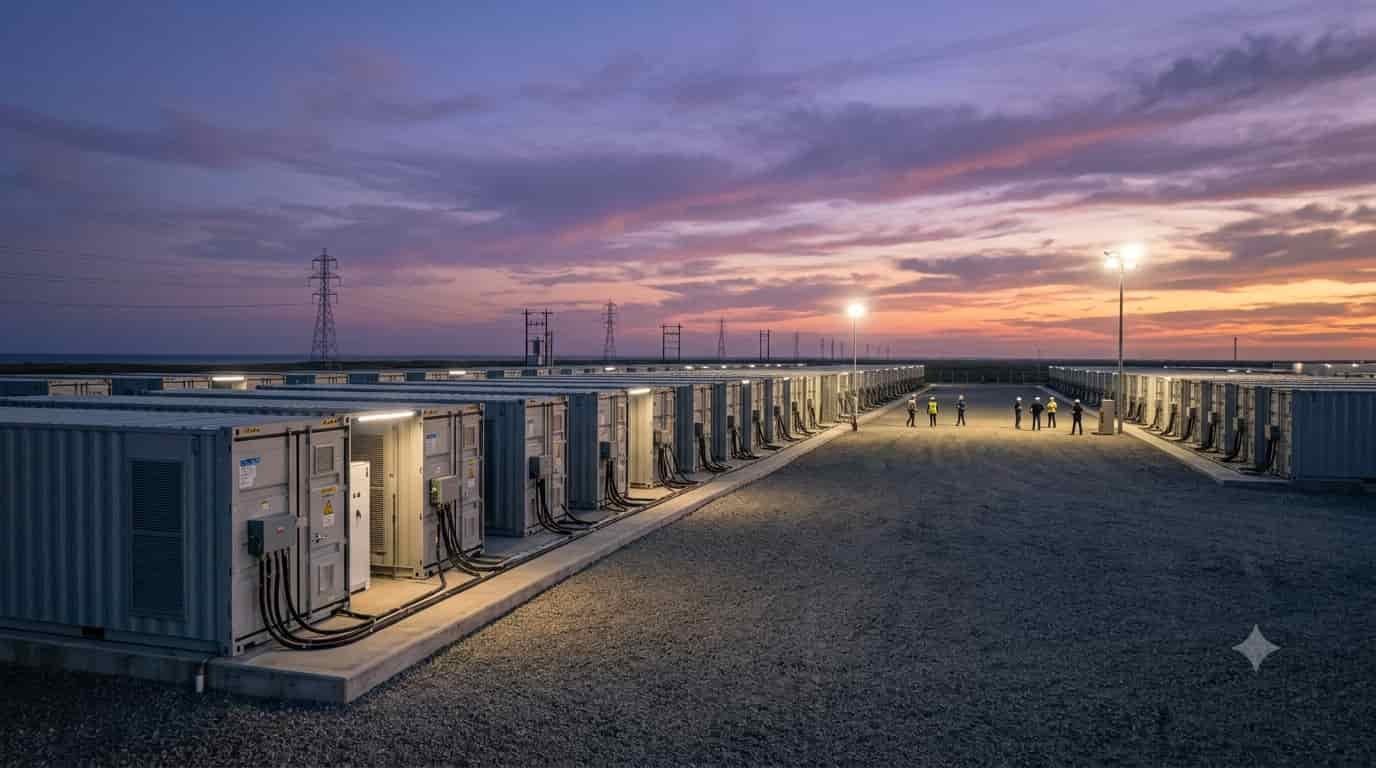
The report says this pattern is not inevitable. In Malaysia, developers are pairing data centres with large clean power projects. DayOne Data Centres has signed agreements for about 1.5 GW of solar and 2.2 GWh of battery storage. It is also exploring up to 1.5 GW of onsite generation and storage with utility Tenaga Nasional Berhad.
Overbuilding can be avoided too. One study modelled six large US sites combining onsite resources with a flexible grid connection. Grid power stayed available for more than 99% of hours. Onsite resources were needed for only 40–70 hours a year, or well under 1% of the time.
The implication is that a data centre which uses its own capacity only when needed can reduce new system build. It also moves the cost of serving its demand onto itself and away from other consumers. In the report’s words, ‘whether onsite generation benefits or harms the wider system depends on how it is regulated.’
A mix, set by workload
The two tools are not rivals. Onsite generation gives more relief at peak. Load shifting squeezes more use from existing grid and generation assets, which saves consumers from paying for rarely used infrastructure.
The right mix depends on the work being done. For traditional and inference centres, 87% of capacity in 2030, clean onsite power and storage may be the main answer. Training centres can shift work across time or location.
This also gives developers what they value most, which is faster access to power. The report calls that a far stronger incentive than usual demand response payments.
What it means for India
The report does not study India. But its logic travels. Indoen has earlier looked at why AI’s power boom is a grid bet, not just a chip story. It has also examined how AI, EVs and heat are outrunning India’s distribution planning. Both point to the same lesson: planners need to know what kind of load is coming, not only how large it is.
Grid-connection rules offer the clearest lever. If connection frameworks set clear terms on when large data centres can be curtailed, and who pays for duplicated capacity, planners could count on flexibility rather than build around it. Without such terms, the cushion exists only on paper.
Follow us on : X | LinkedIn | Facebook | Bluesky