
Solar power has spent a decade proving it can be cheap. Now it has to prove it can be reliable after dark. A new dataset suggests the second problem is being solved faster than most expected — and India's evening coal habit is precisely the case study that shows why it matters.
A record share, but only for a few hours
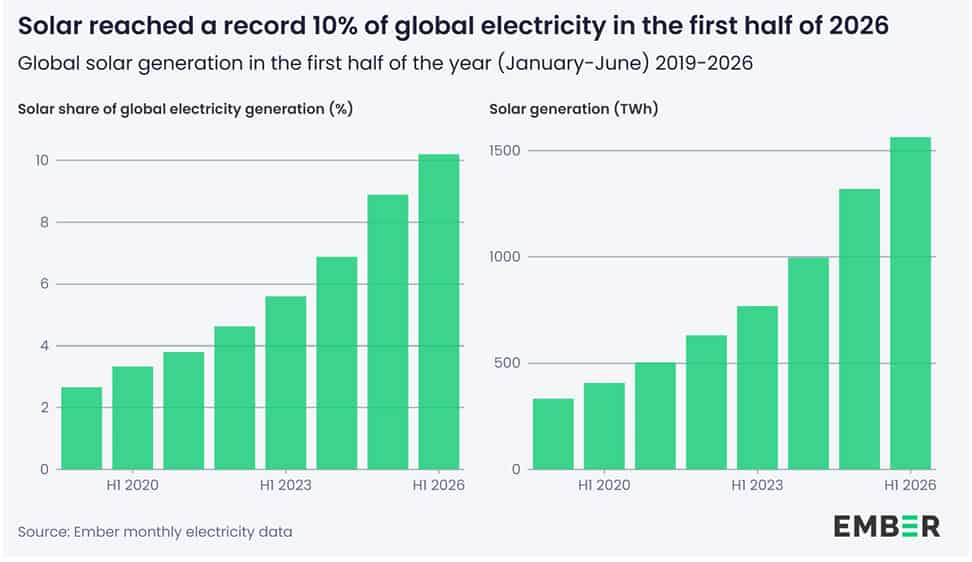
Solar generated just over 10% of the world's electricity in the first half of 2026, up from 8.9% a year earlier and nearly double its 5.6% share in H1 2023. Solar generation has grown roughly seven times faster than total power generation over the past three years, making it, by a wide margin, the fastest-moving source in global power systems.
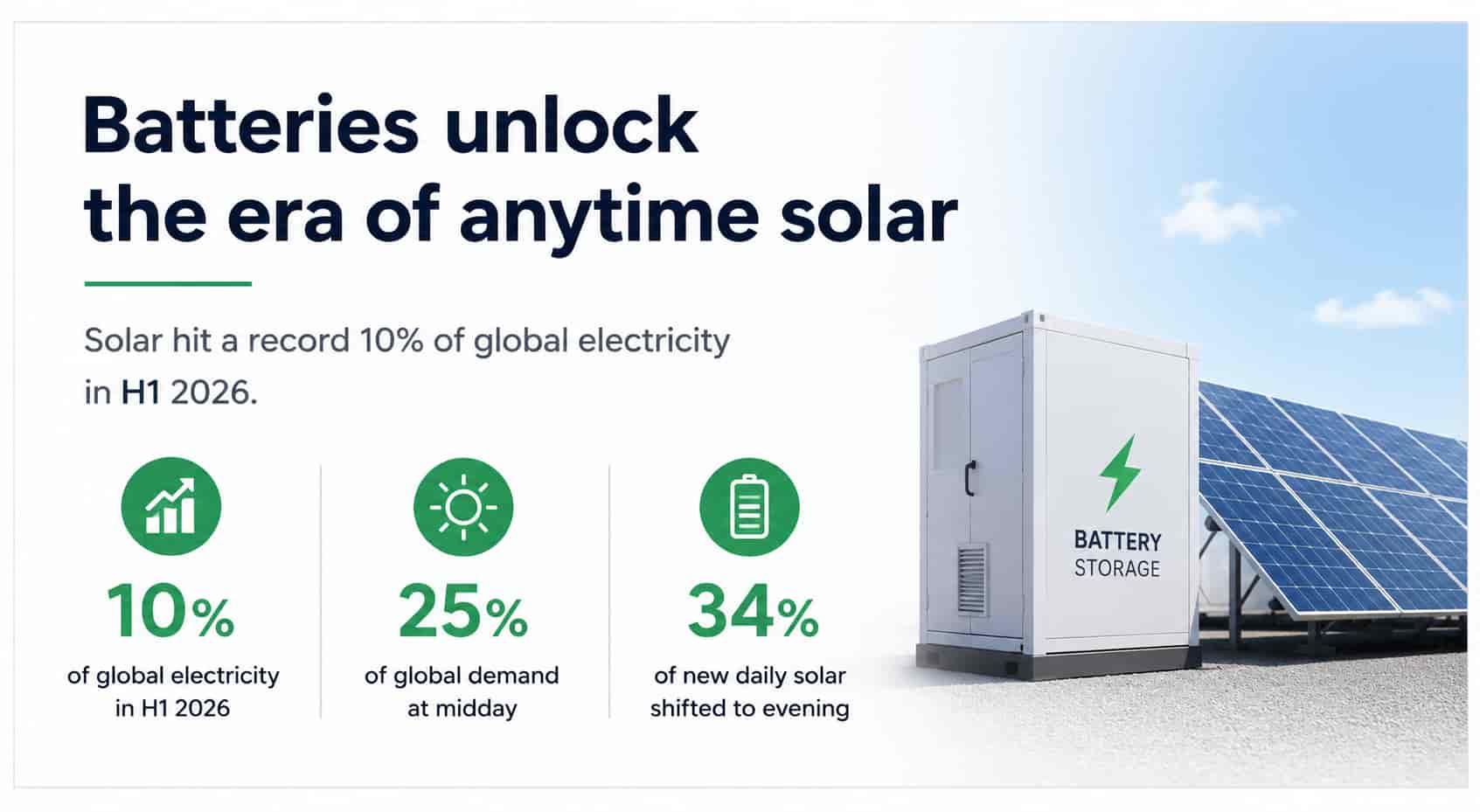
But that headline number hides a stubborn daily pattern. On the average day in H1 2026, solar met just over a quarter of global electricity demand between 11am and 2pm. By 8pm, that contribution had collapsed to near zero, and it stayed there until sunrise.
In more mature markets, the swing is sharper still. Chile's solar fleet met 71% of demand at noon in H1 2026, then fell to near zero by 9pm. The Netherlands and Germany told a similar story, each meeting more than half of midday demand with solar before flatlining after dusk.
India's coal plants are working harder, not less
India offers one of the starkest illustrations of this pattern, and it cuts both ways. On the average day in H1 2026, fossil generation — overwhelmingly coal — fell to 125 gigawatts (GW) at 1pm, around 10 GW below the same hour in H1 2023. That is a meaningful dent, roughly equivalent to taking 15 standard 660-megawatt coal units offline at midday.
The trouble comes after sunset. Fossil generation between 5pm and 7am averaged 168 GW in H1 2026, up 22 GW from three years earlier. India's coal fleet is therefore being asked to ramp down sharply at midday, then ramp back up hard a few hours later to cover the evening peak — a swing of nearly 50 GW between the 1pm trough and the 7pm peak, equivalent to more than 70 new coal units cycling on and off daily.
On the sunniest days, coal output is already brushing against its technical minimum, forcing grid operators to curtail wind and solar just to keep coal plants stable enough to run.
The European Union shows the same underlying pattern with a different cause.
Midday fossil output there fell by 16 GW between H1 2023 and H1 2026, but the evening peak barely moved, down just 5 GW. Two very different power systems, one shared constraint: without storage, cheap daytime solar simply cannot reach the hours when demand — and fossil reliance — peaks.
Batteries are closing that gap faster than solar itself is growing
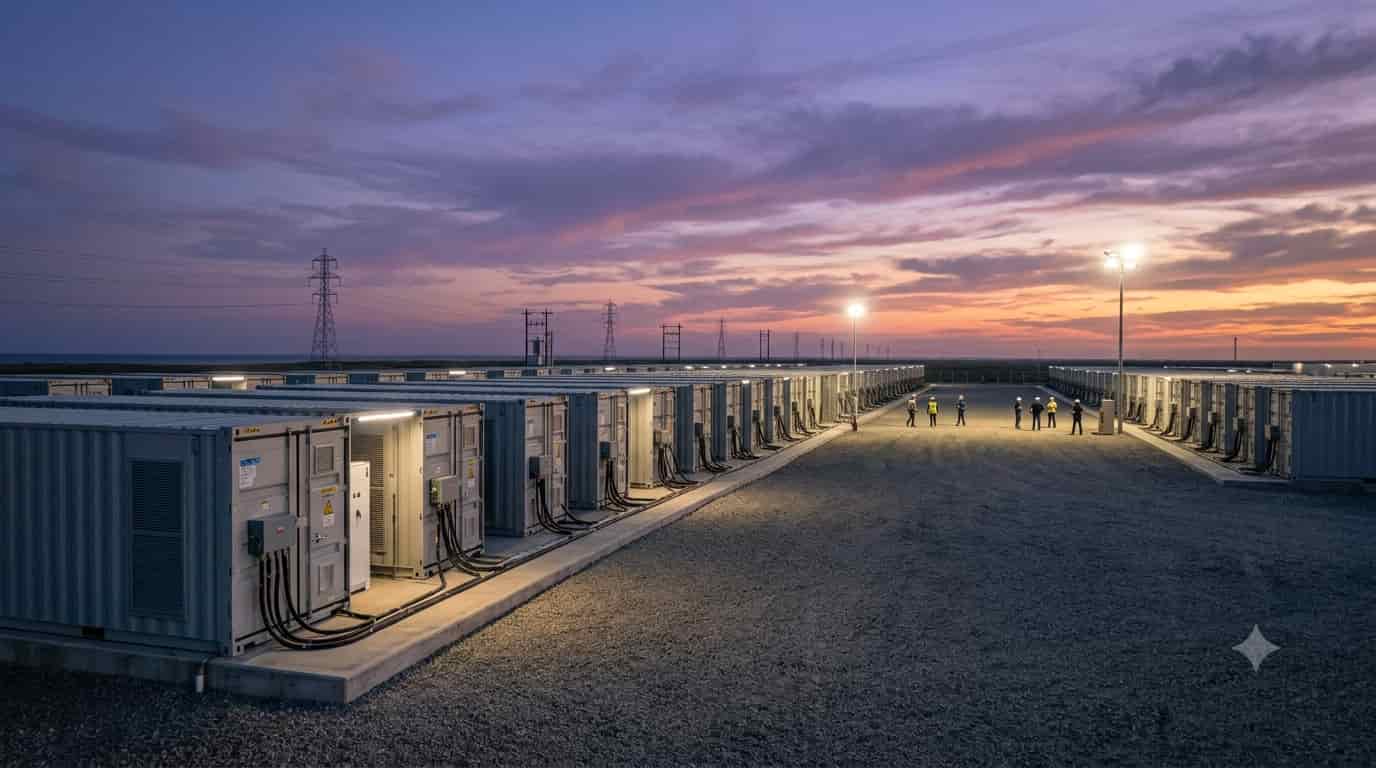
According to the Ember study, global battery additions are expected to reach 459 gigawatt-hours (GWh) in 2026, up 50% year-on-year from 307 GWh in 2025. That pace of deployment is now catching up with solar rather than trailing behind it. The theoretical share of new daily solar generation that batteries could shift into non-sunny hours has risen from just 4% in 2021 to 18% in 2025, and could reach 34% this year.
Part of the reason batteries are catching up is that solar growth itself has slowed. Global solar generation grew 18% in H1 2026, its slowest pace this decade, as new installations eased in China and the EU's solar additions contracted for the first time in ten years — a symptom of increasingly saturated middays rather than fading demand for clean power.
"Cheap daytime solar has become the most powerful transformative force reshaping power grids globally, growing faster than any other source of electricity," says Kostantsa Rangelova, Global Electricity Analyst at Ember and the report's author. "Batteries have become cheap and good enough to unlock the next stage of solar growth — delivering solar in non-sunny hours changes everything."
The economics behind that claim is an important factor.
Global average installed costs for lithium iron phosphate batteries fell 95%, from US$2,634 per kilowatt-hour in 2010 to just US$140/kWh in 2025, even as performance and cycle life improved. That cost collapse is what has turned batteries from a niche grid-balancing tool into a mainstream companion to solar; around a quarter of new utility-scale solar capacity installed globally in 2025 was co-located with battery storage.
 The leaders show what full deployment looks like
Another important factor here is how quickly small markets have overtaken larger ones. Bulgaria and Chile — both markets with negligible battery capacity as recently as 2023 — added enough storage in 2025 to shift more than three-quarters of their new daily solar generation into non-sunny hours, 77% and 76% respectively. Bulgaria's installed battery capacity jumped from virtually nothing in 2023 to 3 GWh in 2025, then more than doubled again to 8.6 GWh by May 2026.
The effect on the ground is already visible. In California, solar plus batteries met more than a quarter of electricity demand during the evening peak of 7pm to 9pm in H1 2026, up from just 6.8% in H1 2023. In Bulgaria, solar plus batteries consistently met close to a quarter of evening demand over the same window, having contributed almost nothing after dark three years earlier.
Deployment alone is not the whole story, though, and this is where the report's balance shows through. Even batteries built specifically for shifting solar are often underused. Standalone batteries in China, the world's largest storage market, cycled an average of just 299 times in 2025 — well below the roughly 350 cycles a year considered international best practice — while co-located batteries cycled even less.
Where market design allows batteries to stack revenue across arbitrage, ancillary services and capacity payments, utilisation improves; where it does not, expensive assets sit idle for hours they could be earning.
What this means for India's next phase
For India, the implications sit close to home. The country's coal fleet is already being pushed toward its technical floor on sunny afternoons, a sign that the daytime-solar phase of the transition is approaching its natural ceiling in parts of the grid.
The next stage of growth, as this report frames it, depends less on adding more solar panels and more on adding the storage that lets existing panels work through the evening peak — precisely the dynamic already visible in Indoen' Energy's recent coverage of Maharashtra's new storage mandate for rooftop solar, which now requires battery capacity alongside new commercial and industrial installations.
The report is careful not to oversell what batteries can do. Daily storage cycling does not solve seasonal shortfalls — a multi-day lull in wind and sun, of the kind Europe calls a Dunkelflaute, still leaves batteries with little surplus to draw on. Even in sunny geographies like India, solar and batteries together could theoretically meet up to 90% of annual electricity demand, but closing the remaining gap will need a broader mix of wind, hydro, nuclear and longer-duration storage technologies still in early development.
Even with that caveat, the direction of travel is clear. Solar's growth was never going to be capped by the cost of panels; it was always going to be capped by the hours in which that generation could be used. Batteries are now removing that cap, one evening peak at a time — and the markets moving fastest, from Bulgaria to Chile, are showing India and the EU alike what the next phase of the transition actually looks like in practice.
Follow us on : X | LinkedIn | Facebook | Bluesky