
Delhi does not have the option that most of India's power-hungry states have. It cannot simply build its way out of a demand crunch by opening a new coal block or clearing land for a solar park. The National Capital Territory is short of both, and its electricity story is increasingly one of managing scarcity cleverly rather than expanding supply the way other states can.
That distinction sits at the heart of a new assessment of the city's power sector, which finds a system that is performing well against the odds but is running out of easy headroom.
A briefing note published by the Institute for Energy Economics and Financial Analysis and Ember in August 2026 frames Delhi's challenge through what it calls a SCOPE lens — strengths, complexities, opportunities, policies and enablers — and its numbers describe a city whose electricity demand keeps climbing even as its physical capacity to generate power stays essentially fixed.
A city that consumes more than it makes
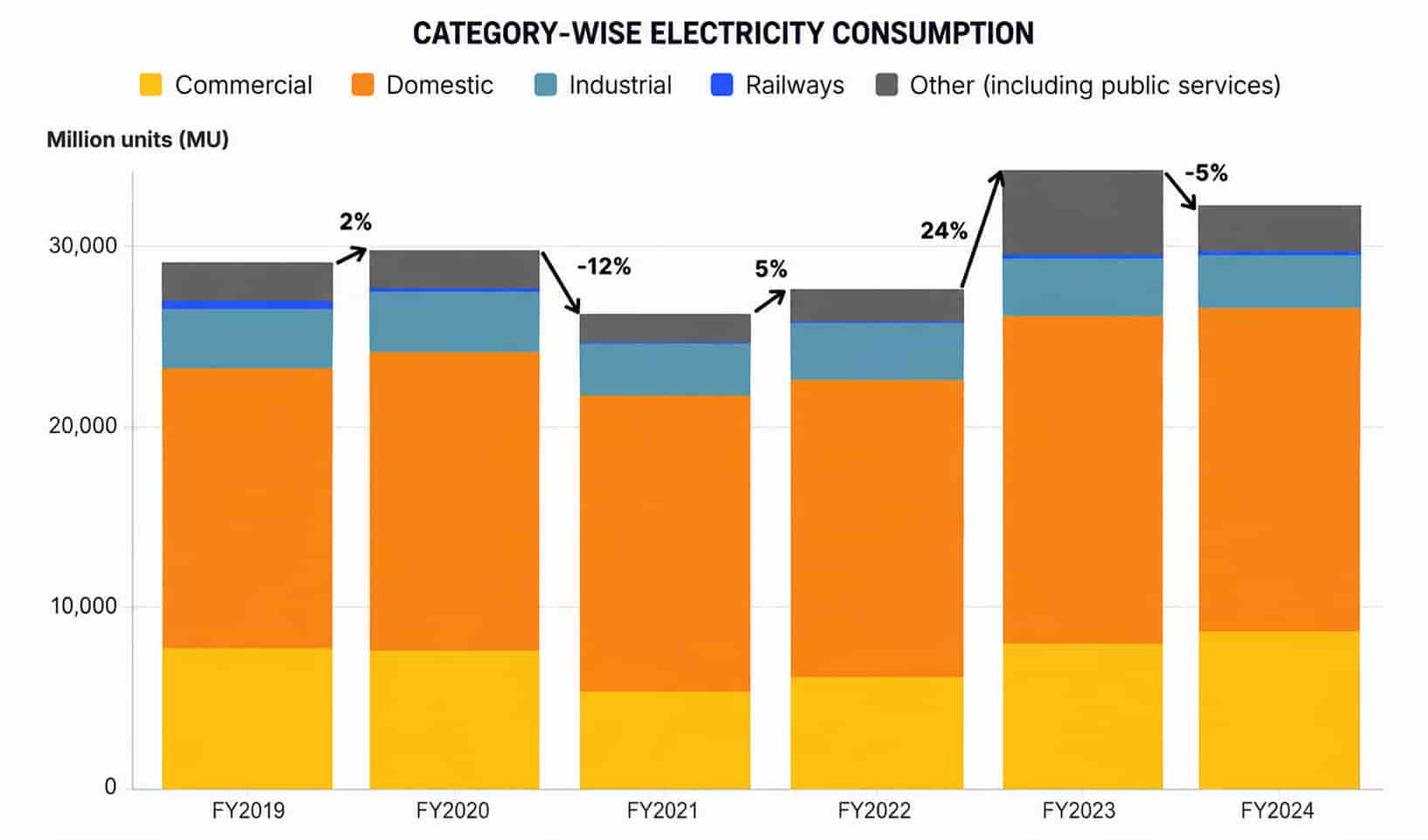
Delhi's total energy requirement touched 38,482 million units in the 2026 financial year, close to 2.2% of the entire country's electricity requirement from a territory that holds only around 1.6% of India's population.
Per capita consumption in the city reached 1,934 kilowatt-hours in FY2024, roughly 38% above the national average of 1,400 kilowatt-hours — a gap explained largely by Delhi's unusually urbanised, service-heavy economy, where nearly 97.5% of the population is classified as urban.
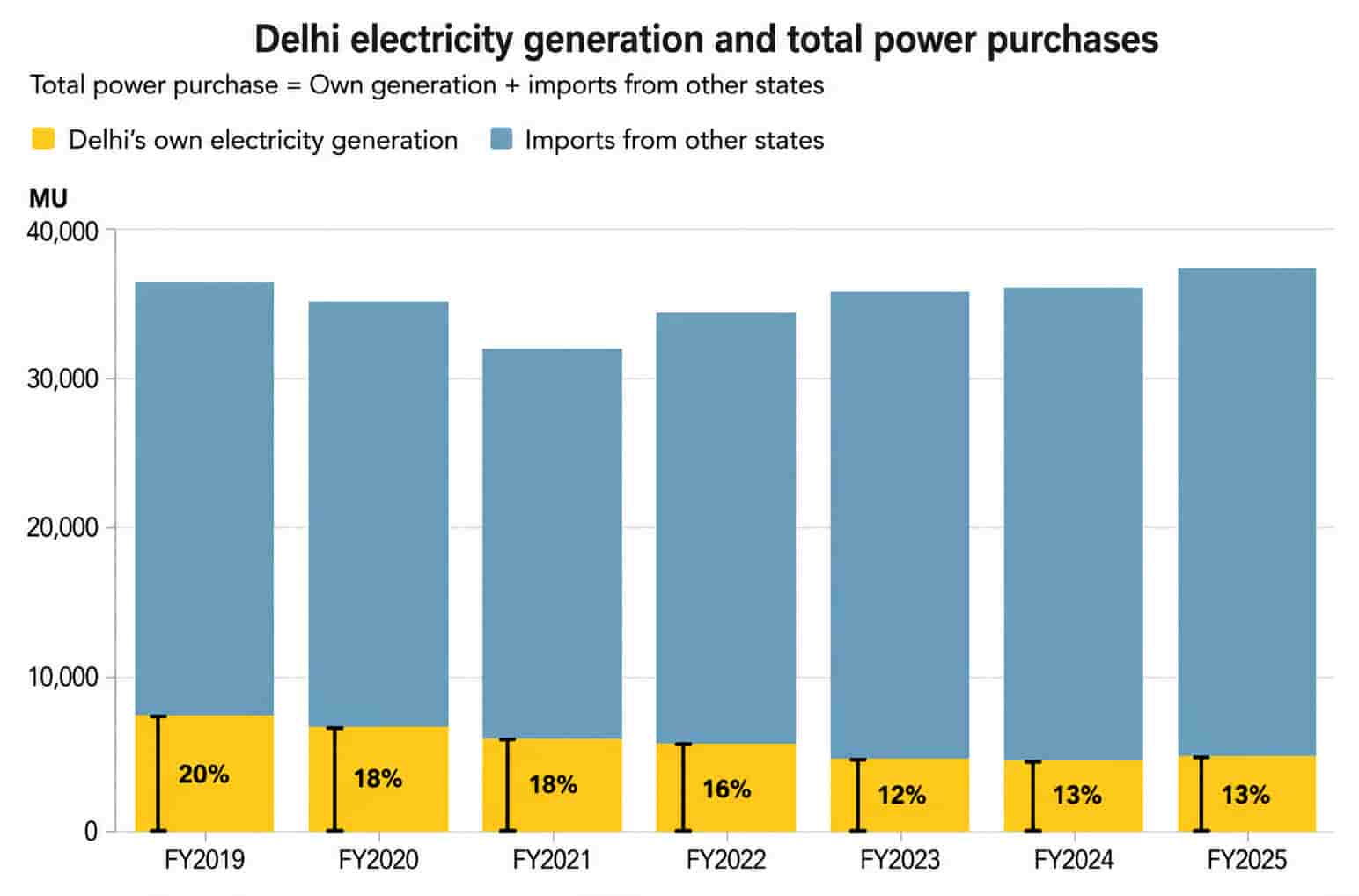
What Delhi does not have is the generation capacity to match that appetite. Its own electricity generation has been falling as a share of total power purchase, from 20% in FY2019 to just 13% in FY2025, with the gap increasingly filled by long-term power purchase agreements and short-term market buys from generation stations in other states.
Much of that decline traces to a deliberate pull-back from gas-based generation, whose share of Delhi's own output fell from 93% in FY2020–21 to 84% by FY2025, a shift driven by shortages of cheaper domestic gas and volatile import prices.
The comparison that sharpens this picture is not with another Indian state but with cities facing an almost identical structural bind.
Singapore imports over 90% of the natural gas that fuels its electricity system, and has responded by committing to import up to 4 GW of renewable power from the region by 2035 under its so-called ‘four switches’ plan — because, like Delhi, it simply lacks the land to generate its way to energy security.
Hong Kong tells a similar story, drawing over half its electricity from imported gas and aiming to push low-carbon sources to 60–70% of its mix within a decade. Delhi's own path, the report argues, will have to follow the same logic: not building more power stations, but importing smarter and using what it already draws far more efficiently.
Heat is rewriting the demand curve
If land constraints define Delhi's supply side, heat is redefining its demand side, and 2026 has made that unusually visible. The city's peak demand rose from 7.7 GW in FY2023 to 8.7 GW by June 2026, a compound annual growth rate of about 3.1%.
On 29 June 2026, Delhi recorded its highest-ever peak demand at 8,748 MW, breaking a record that had itself only been set two years earlier. Distribution utilities reported that summer arrived early this year too — the city crossed the 7,000 MW mark in late April, a threshold that in 2024 and 2025 was not reached until May.
"Delhi's demand profile has fundamentally changed in the space of a few summers," said a senior power ministry official with the Delhi Government. "What was once a single afternoon peak driven by air conditioning has become two peaks — one in the day and a second, increasingly stubborn one at night — and that shift has implications for storage that the current system was not built around."
That second observation is one of the report's more striking findings. Delhi now experiences distinct day-time and night-time demand peaks, with the night-time peak on the city's record demand day in FY2026 reaching 8,442 MW at 43°C temperature — underscoring that Delhi's heat stress does not simply fade after sunset.
Since solar generation cannot serve a night-time peak, the emergence of this second demand curve is arguably the single most consequential technical finding in the report, because it means rooftop solar alone, however successful, cannot solve Delhi's supply problem without storage attached to it.
Where Delhi is quietly ahead
It would be a mistake to read Delhi's story as one of strain alone. On several fronts, the city outperforms the rest of India by a wide margin.
Its Aggregate Technical and Commercial losses stood at around 6.48% in FY2025, down from 9.12% in FY2019, against a national average of roughly 15.04% — a gap largely credited to the public-private partnership model under which Tata Power Delhi Distribution Limited, BSES Rajdhani Power Limited and BSES Yamuna Power Limited have run the city's distribution network since privatisation in 2002.
Collection efficiency across all three utilities exceeded 99.5% in FY2025.
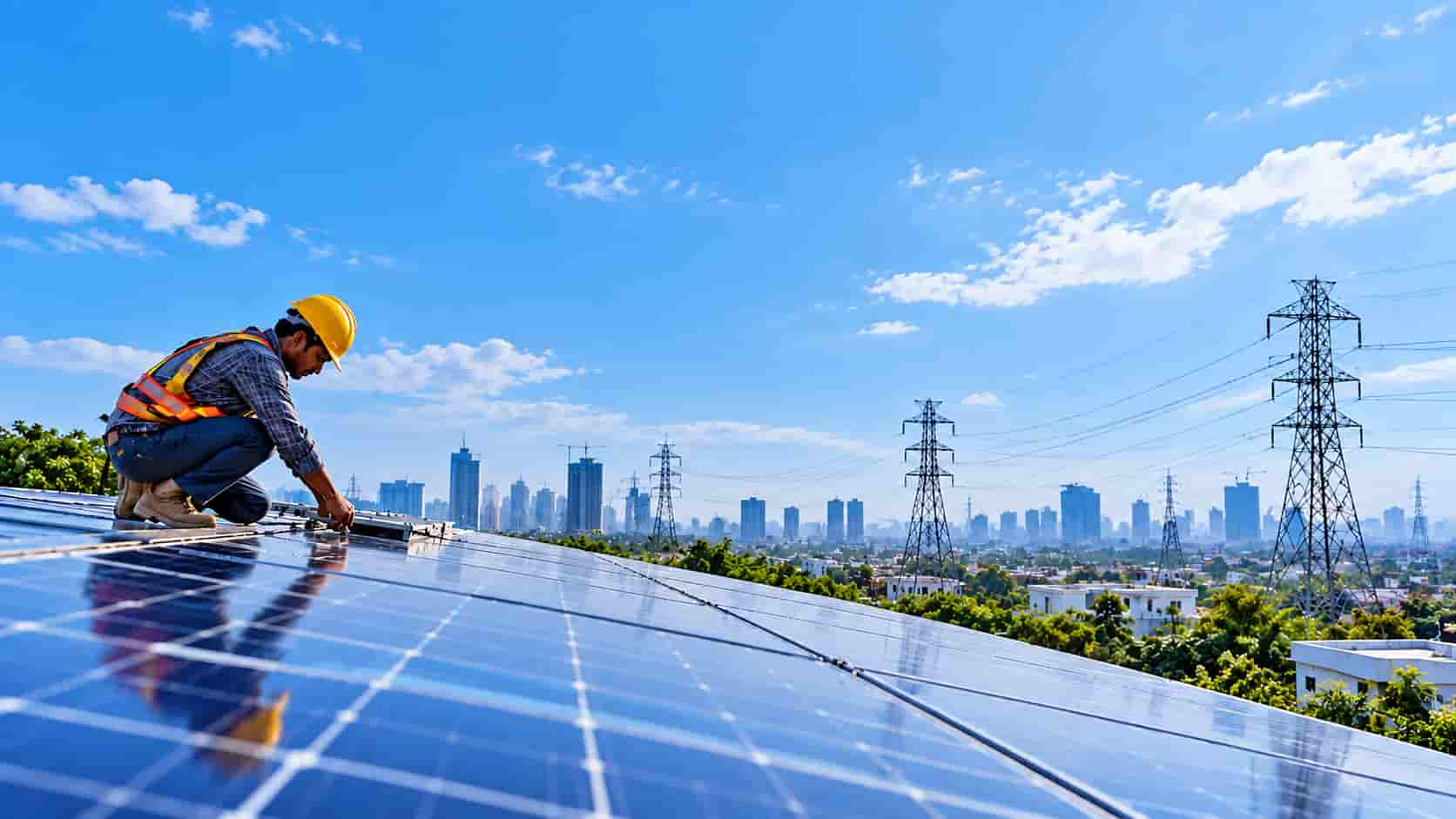
Rooftop solar has also grown briskly, from 119 MW in March 2019 to around 446 MW by June 2026, a compound annual growth rate of roughly 20%, aided by capital subsidies of up to ₹10,000 ($104) per residential consumer under the Delhi Solar Energy Policy 2023.
FY2026 alone brought the city's highest-ever annual rooftop solar addition, with 5,378 new installations. Yet even that pace leaves Delhi well short of its own 750 MW rooftop solar target for FY2027, and distributed solar today makes up only around 2% of the city's total power procurement — a reminder of how much more difficult it is to close the last mile of adoption than the first.
The smart meter bottleneck
Nowhere is the gap between ambition and delivery more visible than in metering.
Time-of-day tariffs — pricing that would reward consumers for shifting flexible loads, including electric vehicle charging, to solar-rich daylight hours — depend entirely on smart meters that can measure and bill consumption by the hour. Delhi has 3,521 smart meters sanctioned under the national Revamped Distribution Sector Scheme as of July 2026, but has made little progress on actual installation.
This is not a Delhi-specific stumble. Nationally, the Revamped Distribution Sector Scheme aimed to install 250 million smart meters by March 2026, backed by roughly ₹97,000 crore (US$10.2 billion) in budgetary support, including close to ₹900 (US$9) per meter in direct subsidy. That deadline has already slipped once, pushed to March 2028, with barely a quarter of the national target met so far.
Delhi's own tariff orders compound the problem: as of July 2026, tariff orders in the public domain went only up to FY2023, leaving consumers and investors without the price signals that would make dynamic, solar-aligned pricing meaningful even where meters exist.
"Smart metering is the single enabling technology that everything else in this transition depends on," noted a researcher at a New Delhi-based energy think tank. "Without it, time-of-day tariffs are a policy on paper, storage incentives are harder to calibrate, and DISCOMs are left guessing at demand patterns instead of measuring them."
Storage, EVs and the road ahead
Delhi's existing battery storage capacity remains modest — a 10 MW/10 MWh system run by Tata Power-DDL and a 20 MW/40 MWh system run by BRPL — against a system that will need considerably more to manage the emerging night-time peak.
The city's new electric vehicle policy, approved in June 2026, adds urgency here: from January 2027, only electric three-wheelers will be permitted fresh registration in Delhi, followed by a similar restriction on two-wheelers from April 2028, with all school bus fleets required to reach 30% electrification by March 2030.
Each of those mandates will draw more load onto a grid already running near its limits during peak hours, reinforcing the case for pairing rooftop solar with behind-the-meter storage rather than treating the two as separate investments.
Delhi's experience carries a lesson that extends well beyond the capital.
As more of India's growth concentrates in dense, land-constrained cities, the playbook that has served resource-rich states — building generation capacity within their own borders — becomes less available.
Delhi's answer, imperfect and unfinished as it is, points toward a different model for urban India: optimise what you import, meter what you consume, and store what the sun gives you during the day for the peak that increasingly arrives after dark.
Follow us on : X | LinkedIn | Facebook | Bluesky