


 Emerging economies account for the majority of the growth in renewable energy, driven by stronger growth in power generation and by the increasing share of renewables in power, especially at the expense of coal, says the recently published BP Energy Outlook report.
The report considers three scenarios – the ‘Rapid’ approach that sees new policy measures leading to a significant increase in carbon prices while the ‘Net Zero’ course reinforces Rapid with big shifts in societal behaviour. The ‘Business-as-usual’ projection assumes that governmental policies, technology, and societal preferences continue to evolve as they have in the recent past.
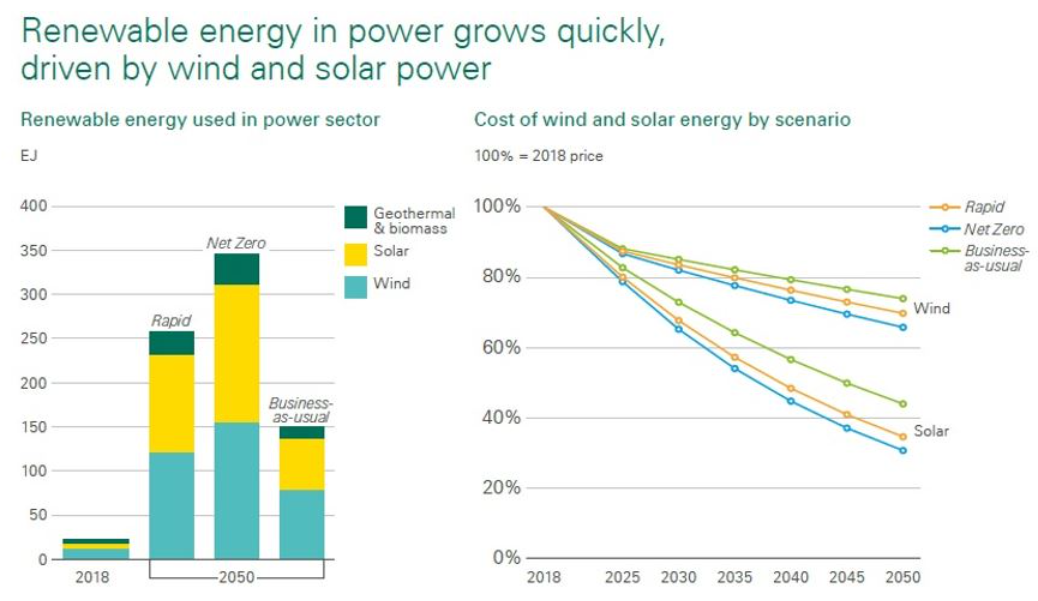
Renewable energy used in the power sector – wind, solar, biomass, and geothermal – is growing quickly in all the three scenarios, aided by falling costs of production and policies encouraging a shift to lower-carbon energy sources.
As per the report, the expansion of renewable energy in power in Rapid and Net Zero far outpaces the growth of primary energy, increasing by around 250 EJ and 350 EJ respectively over the Outlook – around five and seven times greater than the overall increase in primary energy.
The report states that the fast pace of growth will ease slightly from the 2030s onwards as the costs of balancing the intermittency associated with adding increasing amounts of wind and solar power rise. Even so, the share of renewables in primary energy grows from around 5% in 2018 to around 45% in 2050 in Rapid and 60% in Net-Zero.
The growth in renewable energy is dominated by wind and solar power underpinned by continuing falls in development costs as they move down their ‘learning curves’. Over the next 30 years, wind and solar costs are expected to fall by around 30% and 65% in Rapid respectively, and by 35% and 70% in Net-Zero.
In both Rapid and Net Zero, wind and solar power account for broadly similar absolute increases in power generation. This equates to a significantly faster rate of expansion in solar power, supported by greater cost declines.
The growth of renewables in power is less fast in Business-as-usual, although they still grow seven-fold and contribute around 90% of the growth in primary energy over the Outlook.
Data Source: BP Energy Outlook report