

Ola Electric’s cell manufacturing push signals deeper localisation race in India’s EV supply chain
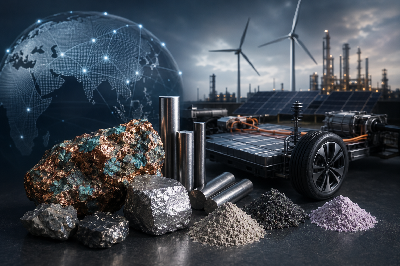
Ola Electric’s board approval for a ₹20 billion (US$ 208 million) investment into electric vehicle cell technology and manufacturing units reflects the next phase of India’s EV industrial strategy — moving beyond vehicle assembly towards deeper control over battery chemistry, energy storage intellectual property and domestic supply chains.
The move comes as India seeks to reduce strategic dependence on imported lithium-ion cells, particularly from East Asian suppliers that currently dominate the global battery ecosystem.
The investment also highlights how battery manufacturing is emerging as a core geopolitical and industrial battleground within the clean-energy transition.
As EV adoption rises, the competitive advantage is increasingly shifting from vehicle branding to battery technology, production scale and access to critical minerals. India’s production-linked incentive schemes and localisation push are encouraging domestic manufacturers to internalise high-value components rather than rely on imports.
For Ola Electric, the investment could help strengthen vertical integration while potentially improving cost competitiveness amid intensifying pressure in India’s price-sensitive EV market.
More broadly, the development reflects how Indian EV companies are evolving into energy-storage and advanced manufacturing players rather than remaining pure mobility firms.
India’s Oman-Gujarat gas pipeline plan reflects a wider strategy to diversify energy corridors
India’s efforts to accelerate the proposed ₹40,000 crore (US$4.17 billion) Oman-Gujarat undersea gas pipeline project underline growing concerns over long-term energy security, maritime vulnerability and the need to diversify fuel import routes.
The project is strategically significant because it seeks to establish a more direct gas supply corridor from the Gulf while reducing dependence on congested or geopolitically sensitive shipping pathways.
The proposal also reflects India’s attempt to position natural gas as a transition fuel capable of supporting industrial growth, fertiliser production and power-sector balancing during the broader energy transition. Despite rapid renewable expansion, policymakers continue to view gas as essential for stabilising the grid and supporting sectors that remain difficult to electrify quickly.
At a geopolitical level, the project fits into a larger trend of countries redesigning energy infrastructure in response to global supply disruptions, shipping insecurity and shifting regional alliances.
If executed, the pipeline could deepen India-Gulf energy integration while reshaping the economics of imported gas infrastructure in western India.
Waaree’s green hydrogen order highlights industrial demand emerging beyond pilot-stage projects
Waaree Clean Energy securing an order linked to a green hydrogen project in Karnataka signals how India’s hydrogen ambitions are gradually moving from policy announcements towards early industrial implementation.
While many hydrogen projects globally remain at memorandum or feasibility stages, actual equipment and execution contracts provide a clearer indication of market formation.
The development also illustrates the growing convergence between renewable generation, electrolysis infrastructure and industrial decarbonisation strategies.
Karnataka is increasingly emerging as a potential green-energy manufacturing and export hub due to its renewable resource base, industrial ecosystem and policy support.
Although India’s green hydrogen sector still faces cost and infrastructure challenges, incremental project execution is helping build domestic capability across electrolyser integration, engineering and renewable-linked industrial systems.
Such projects may eventually support India’s ambitions to become a competitive exporter of low-carbon fuels and industrial products.
Fujiyama’s new solar module facility reflects accelerating domestic manufacturing consolidation
Fujiyama Power Systems commissioning a 2 GW solar module manufacturing plant highlights the continued expansion of India’s domestic solar manufacturing base amid import substitution efforts and rising renewable deployment targets.
The scale of capacity addition indicates how Indian manufacturers are positioning themselves to benefit from both domestic demand growth and evolving global supply-chain diversification away from concentrated manufacturing hubs.
India’s solar manufacturing policy ecosystem — including import duties, approved list mechanisms and incentive schemes — has increasingly encouraged local capacity creation across modules, cells and upstream components. The latest investment reflects how industrial policy is reshaping the economics of renewable manufacturing within the country.
At the same time, the sector remains intensely competitive and capital-intensive. Manufacturers will need to continuously upgrade technology and efficiency to compete with global pricing pressure, particularly from Chinese firms that still dominate much of the international solar supply chain.
Climate-focused capital is increasingly targeting energy access infrastructure in emerging markets
Lightrock raising US$500 million to expand clean-energy access investments across emerging markets reflects the growing role of private climate finance in shaping energy infrastructure development outside advanced economies.
The funding trend is particularly important because large sections of the developing world continue to face energy-access gaps alongside rising electricity demand and decarbonisation pressure.
The development also illustrates how climate finance is evolving beyond purely emissions-driven investment frameworks towards infrastructure-oriented models focused on distributed energy systems, decentralised grids and affordability.
Emerging markets are increasingly being viewed as the primary long-term growth frontier for clean-energy deployment.
For countries like India, the expansion of climate-linked private capital could play a significant role in financing distributed renewables, storage systems and rural electrification infrastructure that traditional banking systems often struggle to support at scale.