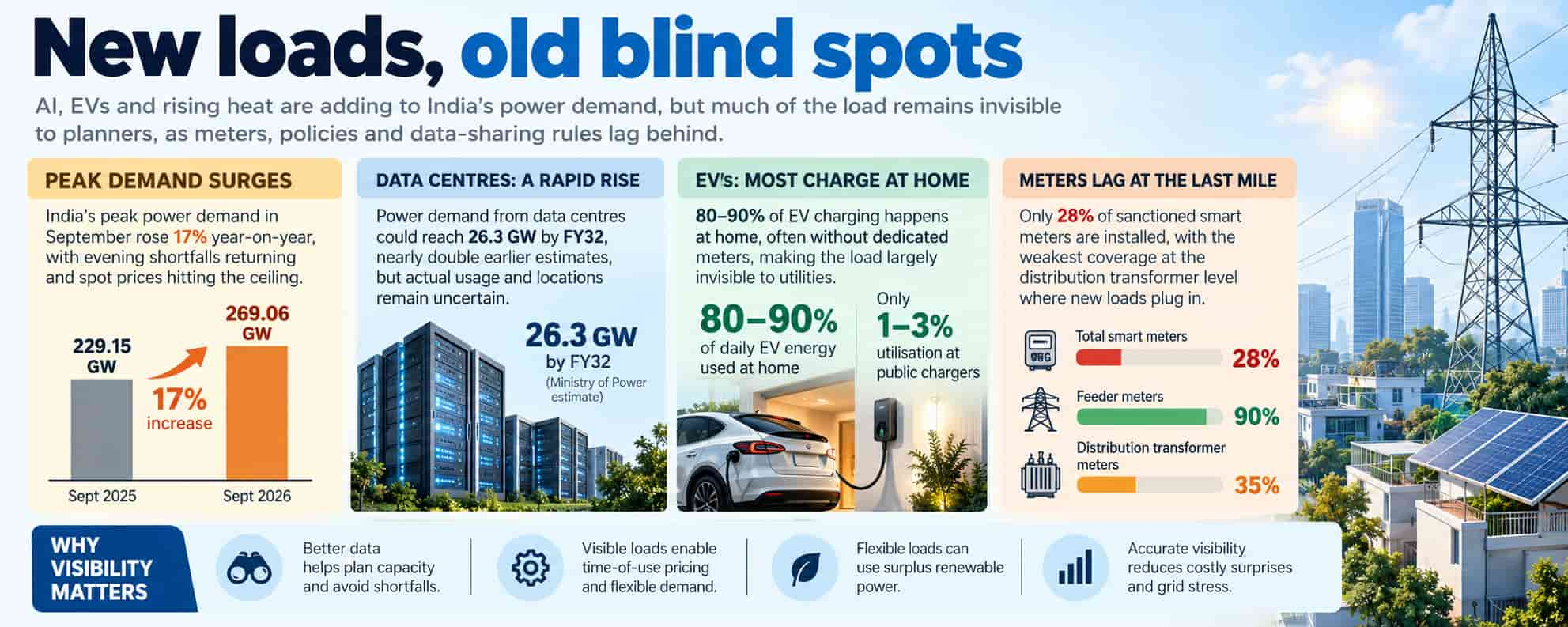
India’s peak power demand hit 269.06 GW in September. A year earlier it was 229.15 GW, according to industry data. That is a rise of about 17%. Monthly consumption grew 11.35% to 162.19 billion units.
Weather did most of the damage. The monsoon was the weakest since 2015. Hydropower output fell nearly 16% in September. Evening shortfalls crossed 2 GW on more than half the days and touched 7.7 GW, as per an analysis of grid data. Spot prices pressed against the ₹10 per unit (US$0.11) ceiling, as per market reports.
The forecasting record is more telling. In 2025, government sources spoke of a 277 GW peak by September. The grid actually met 229 GW. This year it met 269 GW. Weather moved the September peak by about 40 GW in twelve months. Models built on averages struggle with swings like that. Indoen’s earlier look at the September supply squeeze showed how thin the cushion was.
 Loads planners cannot see
Data centres show the problem best. The Ministry of Power now estimates that they could need 26.3 GW by FY32. Its March estimate was 13.56 GW. The figure nearly doubled in a few months. Private forecasts differ too. One report sees 6.5 GW of installed capacity by 2030. Another sees 12 GW. They even disagree on today’s base, at 1.5 GW and 2.2 GW for 2025.
Energy use is just as uncertain. Wood Mackenzie expects data centre demand to climb from 10 TWh in 2025 to 191 TWh by 2040, or about 7% of national demand. One recent policy commentary quotes the 191 TWh figure as if it were near-term. It is a 2040 projection.
Policy has not caught up. India has no dedicated data centre policy. Projects clear under existing environmental and building rules, according to a media report. On 14 October, a junior IT minister said a policy is coming, to keep households from paying more for power. He gave no date. The government sees a US$200 billion opportunity. Residents near an Amazon site outside Mumbai and Google’s US$15 billion project in Visakhapatnam have protested over power, water and land. Both companies deny wrongdoing.
Even the industry disagrees on what drives site choice. One commentary says network connectivity now outranks power availability. Wood Mackenzie says firm, round-the-clock power at the node level has become the main constraint. Both claims are hard to test without node-level data.
Electric vehicles are the second blind spot. Public chargers get the headlines. Homes get the load. A study of more than 80,000 residential installations found that 80–90% of daily EV energy is used at home. Public chargers, by contrast, see utilisation of only 1–3%, as Indoen has reported. In Delhi, dedicated EV meters cover barely 6% of EVs sold. Most charging load sits hidden inside household bills.
The load is small today but will not stay small. EVs were about 0.2% of electricity demand in 2024. A separate study sees them nearing 6% by 2035. Charging tends to cluster in the evening, just when cooling demand is high and solar output has gone. Field surveys also found voltage dipping to 180–190 volts in parts of Rajasthan, which makes home charging unreliable.
Where the meters are
The tool for seeing these loads is the meter. The Revamped Distribution Sector Scheme (RDSS) has an outlay of ₹3.3 lakh crore (US$34.7 billion). As of 30 June 2026, India had 7.24 crore smart meters, of which 5.73 crore came under RDSS. Against 20.33 crore sanctioned, that is about 28%. The scheme’s sunset date is March 2028.
The split by network level is the real story. Feeder meters stand at 1.85 lakh against 2.05 lakh sanctioned, about 90%. Distribution transformer meters stand at 18.5 lakh against 52.53 lakh, about 35%. Visibility is strongest at the top of the network and weakest at the transformer. That is exactly where a block of home chargers or a small data centre plugs in.
A senior official at a state distribution company put it simply. “A transformer does not care whether the new load is a data centre or a hundred scooters. We only need to know it is coming, and when it will draw power.”
A framework that asks nicely
The national data framework is meant to close part of this gap. Power Secretary Pankaj Agarwal has said the National Electricity Data Sharing Framework will launch later this month. It will bring together data on generation, transmission, distribution, grid operations and markets. A governance committee, chaired by the head of the Central Electricity Authority, will oversee it.
The June draft went further. It proposed a national data centre and portal, with public data searchable within 18 months. It also offers preferential access to Indian AI developers and start-ups. But adoption is voluntary. That raises a fair question over whether state utilities will share consistently. Sensitive data, such as cybersecurity protocols and pre-market bids, stays protected.
A policy adviser familiar with the consultations said the real test lies in incentives. “A voluntary framework works only when sharing is easier than holding back. For many utilities today, it is the other way round.”
There is an irony here. AI-led demand is a big reason the forecasting problem has grown. AI tools are also the promised fix, since the framework aims to feed demand forecasting and analytics. Models are only as good as the data fed in. Data-poor feeders will stay forecast-poor, however clever the model.
Flexibility is the prize
Better visibility pays off beyond planning. In July and August, India turned away 1.8 billion units of renewable power even as evenings ran short, according to the same commentary. It puts routine solar curtailment at about 4.2% of generation. Loads that can move, such as home chargers and some data workloads, could soak up that midday surplus. They can do so only if utilities can see and price them.
One charging company’s chief executive argues that a charger able to shift its window by two or three hours is worth more to grid stability than ten new public points. A think-tank has likewise urged time-of-use tariffs to move charging away from evening peaks.
The commentary also argues against new nuclear, pumped storage and long transmission lines, and for rooftop solar, storage and virtual power plants. Distributed resources can help. But September showed a night-time gap of up to 7.7 GW. Closing it will likely need firm capacity and distributed flexibility together, not one in place of the other. The same commentary notes that the United States already has over 40 GW of virtual power plant capacity.
What to watch
Four things deserve attention. The framework’s launch will show whether voluntary sharing draws in discoms. Any extension of RDSS beyond March 2028 will show whether transformer-level meters get priority. The data centre policy will show whether large loads must register their demand and flexibility. And the Central Electricity Authority’s resource adequacy plan, which projects 459 GW of peak demand by 2035-36, will need regular revision. As Indoen has noted, the grid is turning from a pipe into a queue. Queues run better when everyone can see their place.
The stakes are large. A 10% miss on 459 GW is about 46 GW. That is more than the swing between the last two Septembers. India has spent years asking how much power it can build. The next question is simpler and harder: where will the load actually sit, and at what hour?
Follow us on : X | LinkedIn | Facebook | Bluesky