The world has missed its best chance to hold warming at 1.5°C. That is the central finding of the Emissions Gap Report 2026, published by the United Nations Environment Programme (UNEP). The option of limiting warming to 1.5°C with no or limited overshoot, it says, is now lost.
What remains is damage control. Temperatures will cross 1.5°C by more than 0.1°C. The job now is to keep the peak low and the overshoot short.
A window that has closed
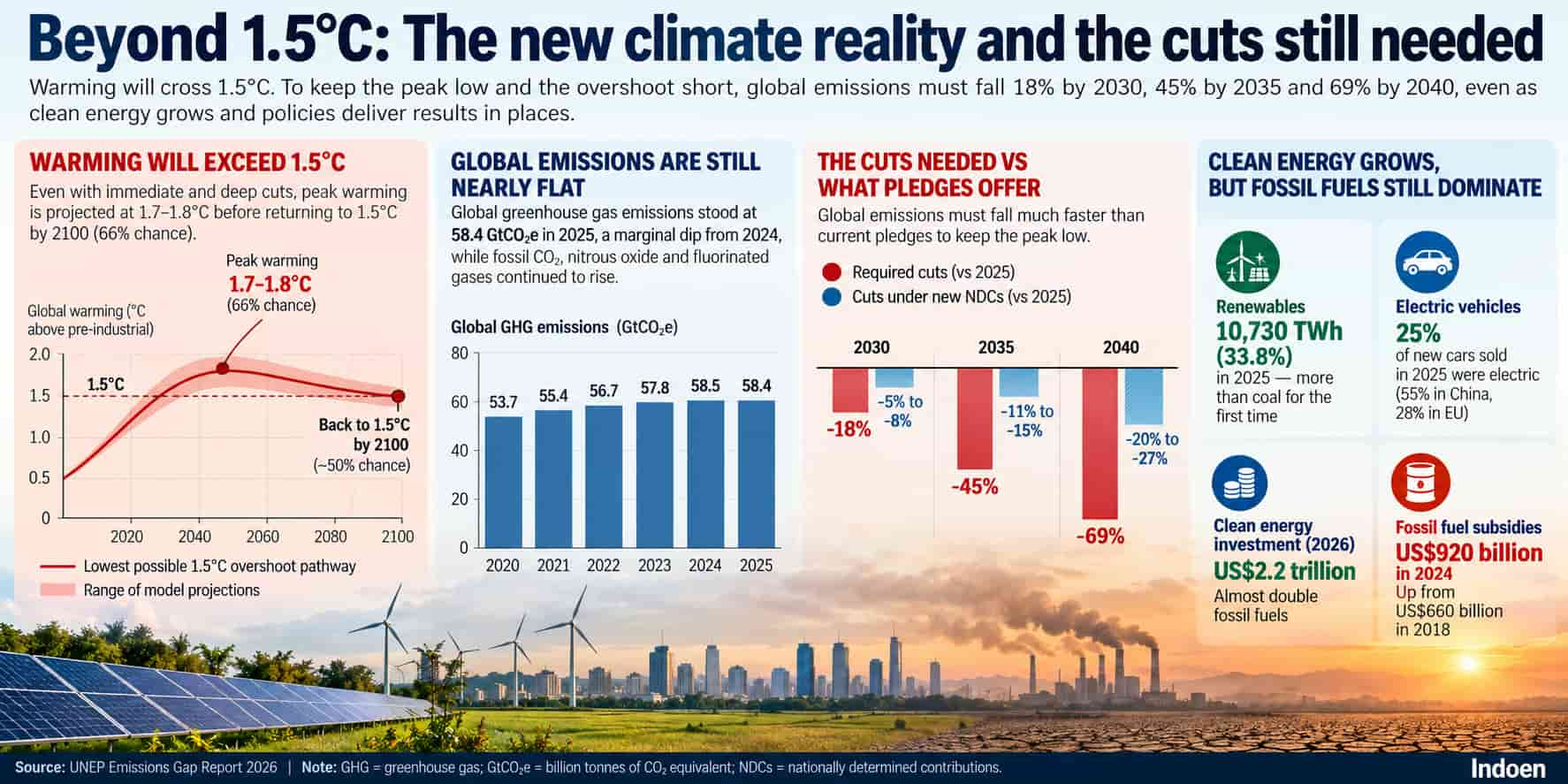
The study sets a new benchmark for this. It calls it the lowest possible 1.5°C overshoot scenario. Tough cuts must start from 2025. Peak warming then stays at 1.7–1.8°C with a 66% chance. Temperatures return to 1.5°C by 2100 with about a 50% chance.
The price is steep. Global greenhouse gas emissions must fall 18% by 2030, 45% by 2035 and 69% by 2040, all against 2025 levels. That means an average cut of 5.7% every year between 2025 and 2035. Carbon dioxide must reach net zero around 2050.
Even then, roughly 320 billion tonnes of CO2 must be pulled out of the air this century. The report admits that doing this at such scale is uncertain.
Delay carries its own cost. Every five years of emissions at current levels adds about 200 billion tonnes of CO2. It also pushes peak warming up by around 0.1°C.
 Emissions are flat, not falling
Global emissions stood at 58.4 billion tonnes of CO2 equivalent (GtCO2e) in 2025. That is a dip of just 0.1 GtCO2e from 2024. Over the past decade, emissions had grown 0.8% a year, so the pause looks welcome.
But the uncertainty range is ±5.5 GtCO2e, far larger than the change. The study says it is too soon to call a plateau.
The detail is less comforting. Fossil CO2, which makes up 68% of the total, kept rising. So did nitrous oxide and fluorinated gases. What pulled the total down was a fall of about 0.5 GtCO2e in land-use emissions. Part of this came from fewer wildfires than in the very active 2024. That is a saving that depends on weather, not on policy.
The G20 members, excluding the African Union, account for 76% of global emissions. Their emissions rose 0.7% in 2025. The United States added 133 million tonnes of CO2 equivalent, far more than any other country, on higher power demand and a rebound in coal generation.
Over the decade, 63 countries cut emissions by a combined 1.8 GtCO2e. But 124 countries raised theirs by 7.2 GtCO2e. The increases outweighed the cuts four to one.
Pledges that fall short
There is progress on paperwork. By 1 September 2026, 124 parties covering about 76% of global emissions had submitted new nationally determined contributions (NDCs). A year earlier, it was 57 parties covering 63%.
The substance has not kept pace. Full delivery of the new NDCs would cut emissions only 5–8% below 2025 levels by 2030, and 11–15% by 2035. The required cuts are 18 and 45%. The resulting gap is 5 GtCO2e in 2030 and 16 GtCO2e in 2035.
The study also records a sobering fact. There is now an unbridgeable gap of 9 GtCO2e in 2035. It lies between today’s lowest overshoot path and the path that would have limited overshoot to 0.1°C. Those cuts would have been possible had action begun earlier.
Current policies point to 2.8°C by 2100, at a 66% chance. Delivering all NDCs brings it to 2.6°C. Adding every net-zero pledge brings it to 2.1°C. Even that best case leaves peak warming about 0.25°C above the lowest overshoot path.
That extra quarter of a degree matters. “Every additional fraction of a degree and additional year of warming above 1.5°C raises the risk of irreversible changes,” the authors of the report write.
The curious case of the narrowing gap
On paper, the 2030 implementation gap looks smaller than last year. The report says this is no cause for cheer. The reason is the United States’ withdrawal from the Paris Agreement. Its target was removed and replaced with a projection based on current policies.
In other words, the narrowing reflects a change in accounting, not stronger action. Remove that effect and there is little progress.
Only six G20 members are likely to meet their unconditional 2030 targets under current policies. They are China, India, Indonesia, Russia, South Africa and Türkiye. For Russia and Türkiye, the 2035 targets sit above what current policies would already deliver. Meeting them needs no extra effort.
Where the good news sits
In 2025, renewables produced more electricity than coal for the first time. The figures were 10,730 terawatt hours (33.8%) against 10,476 terawatt hours (33.0%). Solar and wind alone avoided 4.1 billion tonnes of CO2.
Since the Paris Agreement, renewable capacity has grown three times faster than 2015 forecasts expected. Solar has grown seven times faster. If current trends hold, installed capacity will rise from 5,100 GW in 2025 to 11,500 GW by 2030. That would meet the goal of tripling.
Electric vehicles tell a similar story. About one in four new cars sold worldwide in 2025 was electric. The share was 55% in China and 28% in the European Union. Nepal stood at 68% and Viet Nam at 41%.
Money is following. Clean energy investment in 2026 is set to reach US$2.2 trillion, almost double that of fossil fuels.
Yet the old system is still being fed. Fossil fuel subsidies rose from roughly US$660 billion in 2018 to US$920 billion in 2024. Oil and gas use will likely keep growing this decade, though coal may peak before 2030. The pace of cutting forest loss must speed up more than tenfold. The lesson is plain: clean technology alone will not be enough. Fossil use must also fall.
India: Targets met, emissions still rising
India offers a nuanced picture. Data sets differ on its 2025 emissions. Two show a slight fall, one a slight rise. All agree the trend broke from a long period of rapid growth. Weather played a part, but so did the shift to renewables.
India is among the six G20 members on course for their unconditional 2030 targets. It also appears likely to meet its 2035 goal of cutting emissions per unit of GDP by 47% from 2005 levels, using policies already in place.
The report adds a caution. Because India’s target is based on intensity, emissions can still grow while the target is met. India is projected to add 1,254 million tonnes of CO2 equivalent between 2030 and 2035. It is the only G20 member with a 2035 target to show such a rise.
Per capita numbers soften this. India’s 2035 level under its NDC is 3.6 tonnes, against 9.3 for China and 11.5 for Russia. But the European Union’s own NDC implies 3.2 tonnes. The gap with richer economies is narrowing from both sides.
Policy is moving. India is scaling up its Carbon Credit Trading Scheme, expected to cover over 700 million tonnes of CO2 equivalent at the start. That would place it among the world’s largest emissions trading systems. The rooftop solar scheme, PM Surya Ghar Muft Bijli Yojana, crossed one million installations in its first year. It aims to reach 10 million households by March 2027. Indoen has earlier looked at how this household-subsidy route to net zero differs from a carbon price.
The Middle East crisis shows India on both sides of the ledger. Before February 2026, about 25% of seaborne oil trade and 19% of global LNG trade passed through the Strait of Hormuz. In response, India cut fossil fuel taxes in the short term. It also capped windfall profits and promoted public transport. Almost 30 governments, India among them, also chose structural responses such as efficiency and electrification.
What works, and what it will take
There is evidence that policy delivers. The report identifies 63 major shifts in national emissions, each above 5%, that coincided with new or tougher climate policies. More than 220 evaluations show causal links. Electricity-sector policies cut emissions by an average of 9%. Carbon pricing schemes cut 5–13%.
“Climate policies can and have reduced emissions. The challenge is how fast they can be scaled,” the report states.
The evidence has gaps. Only a few hundred of the thousands of policies in force have been tested rigorously. Less than a third of carbon pricing schemes have been evaluated. Most studies come from Europe, North America and China. Regulation, standards and subsidies, the tools most widely used, remain largely unassessed. And adding more policies does not automatically mean deeper cuts. Design matters.
COP 31 meets this November. The second global stocktake follows in 2028, and a conference on a just transition away from fossil fuels is planned for July 2027. Indoen’s coverage of this year’s Bonn talks showed how the debate is widening beyond emission targets.
The next test is 2040. New NDCs would deliver only 20–27% cuts by then, against the 69% needed. Whether countries close that gap will decide how long the overshoot lasts.
Follow us on : X | LinkedIn | Facebook | Bluesky