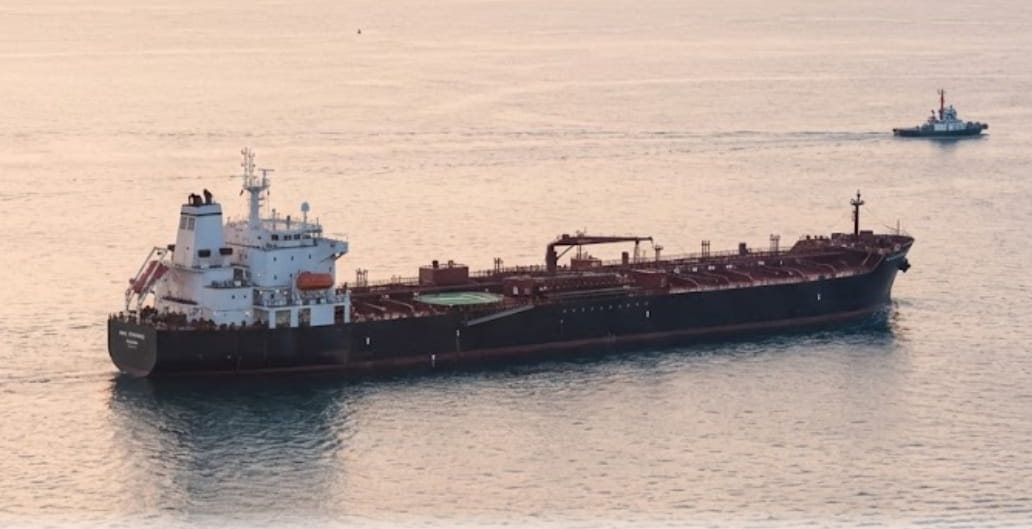


The de-escalation that briefly took Brent below US$86 a barrel in late August did not last. Iran’s Revolutionary Guard said on 2 September that two oil tankers had struck naval mines while transiting the Strait of Hormuz, just days after a Saudi Aramco tanker, the Sidr, was hit by projectiles with two crew fatalities, and a Liberian-flagged supertanker was struck off Oman.
US Central Command responded with strikes on Iranian air-defence, radar and mine-laying sites, while Tehran retaliated with missiles towards US bases in Jordan and Bahrain, most of which were intercepted.
Washington also crossed a new line, striking anchored Iranian tankers directly for the first time under what officials describe as a deliberate “tanker for tanker” deterrence policy. Brent rose roughly 5% on the news to touch US$95-96 a barrel, its highest since late July, before settling closer to US$94-95 by midweek. The episode illustrates how quickly a fragile Hormuz truce can unravel: barely a fortnight of calm was enough to convince markets the risk premium had genuinely faded.
A second front: Russian export capacity under renewed attack
Compounding the shock, Ukraine launched its largest overnight drone assault of the year on 1 September against Russia’s Baltic Sea port of Ust-Luga, sparking a fire at the terminal that loads roughly 700,000 barrels of crude a day and exported nearly 33 million tonnes of oil products last year.
Ust-Luga has now been targeted repeatedly since March, and industry estimates suggest close to 40% of Russia’s total oil export capacity has been disrupted at various points this year through drone strikes, a disputed pipeline strike and shadow-fleet tanker seizures.
This matters enormously for India, since Russian crude has swelled to more than half of India’s import basket in recent months. A sustained squeeze on Russian loadings, layered on top of a hot Hormuz, would strip away the two suppliers India has leaned on most heavily this year, from opposite ends of the risk spectrum. “The irony is that both the sanctioned and the allied halves of India’s crude portfolio are being targeted in the same week, for entirely different reasons,” said an analyst tracking global crude markets.
Indian refiners lean further into diversification
State refiners had already been hedging against exactly this scenario. MRPL and HPCL have been tendering for a combined six million barrels of spot crude for September and October delivery, with MRPL specifically instructing suppliers to avoid cargoes routed through either the Strait of Hormuz or the Red Sea, pushing refiners further towards West African grades even at a premium to Dated Brent.
“We would rather pay up for a clean route than chase a discount that comes with an insurance and delay problem attached,” said an executive at a leading Indian refiner.
That caution looks prescient this week. Shipowners who had seen war-risk premiums ease after the earlier ceasefire memorandum are again bracing for rates in the 3-10% of hull-value range, meaning a US$100 million tanker could face a war-risk bill of US$3-10 million for a single Hormuz transit, up from a pre-war norm of roughly a quarter of a million dollars. Those costs flow through to landed crude prices and, eventually, to freight-sensitive refining economics on India’s west coast.
Rupee under pressure even as reserves cushion the blow
The renewed Brent spike has coincided with a weaker rupee, which slipped towards the 95 mark against the dollar this week as hawkish signals from the US Federal Reserve lifted the dollar broadly, compounding the effect of costlier crude on India’s import bill.
The Reserve Bank of India appears to be defending the 95.70-95.80 zone, helped by record forex reserves of US$729.33 billion as of 21 August, itself built on an eighth consecutive week of inflows including substantial non-resident deposits. That buffer gives the central bank room to smooth currency volatility even as crude turns more expensive again.
For every dollar the Indian crude basket moves, the country’s annual import bill shifts by roughly ₹8,578 crore (USUS$910m), so a return to the mid-US$90s from last week’s mid-US$80s, if sustained, represents a meaningfully larger annual outlay than the market had begun pricing in.
Strategic reserves back in focus
The renewed disruption also revives scrutiny of India’s Strategic Petroleum Reserve, which the Ministry of Petroleum and Natural Gas has told Parliament sits at roughly 64% of capacity, equivalent to about 9.5 days of national consumption against the International Energy Agency’s recommended 90-day cushion for member and associate countries.
A Phase-II expansion, adding a new underground cavern at Chandikhol in Odisha, is meant to lift total capacity to 118 lakh tonnes by 2029, but that timeline offers no protection against a supply shock unfolding this week.
Retail petrol and diesel prices, already held flat through months of crude volatility, leave little room to manoeuvre: OMCs were still reporting diesel losses of roughly ₹18.9 a litre (USUS$0.20) in the June quarter even before this week’s price rise, according to brokerage estimates.
None of this changes India’s underlying strategy of buying from more than 40 countries to spread exactly this kind of risk, a diversification Indoen Energy examined in the immediate aftermath of the earlier Hormuz ceasefire.
But this week is a reminder that diversification only dilutes risk; it does not eliminate it when two major supply routes come under pressure simultaneously.
Follow us on : X | LinkedIn | Facebook | Bluesky