
For most of its life, India’s EV policy conversation has been about the front end of the transaction: subsidies, GST rates, import duties, the price gap with petrol vehicles.
That gap has narrowed steadily.
A quieter question is now moving to the centre of the room. When a bank or an NBFC finances an EV, it is not really betting on the vehicle. It is betting on what that vehicle can be resold for if the borrower defaults, or what it will be worth to a fleet operator once the lease ends. On that question, India has very little data and a market too young to have learned its own lessons yet.
Petrol vehicles have decades of depreciation curves that lenders can price against with confidence. EVs do not. Battery health, a young secondary market, and rapid technological change all make recovery values harder to predict than they are for a comparable ICE vehicle, and this uncertainty is starting to show up directly in loan pricing, according to a media report on the emerging credit dynamics in India’s EV transition.
The e-rickshaw warning nobody heeded
India has already run this experiment once, at a smaller scale. NITI Aayog found in 2021 that banks had suffered losses on earlier e-rickshaw loans after defaults left them holding repossessed vehicles worth far less than expected. The weak secondary market made recovery difficult and pushed up financing costs for the segment that followed.
That precedent matters more now than it did in 2021, because the vehicles getting financed have grown considerably more expensive. Estimates suggest financing India’s first 10,000 zero-emission trucks could expose lenders to meaningful residual-value losses if defaults occur, since recovery depends entirely on the ability to repossess and resell an asset with an even thinner buyer base than two-wheelers have.
 Why EV loans already cost more
The premium is visible in publicly quoted lending rates.
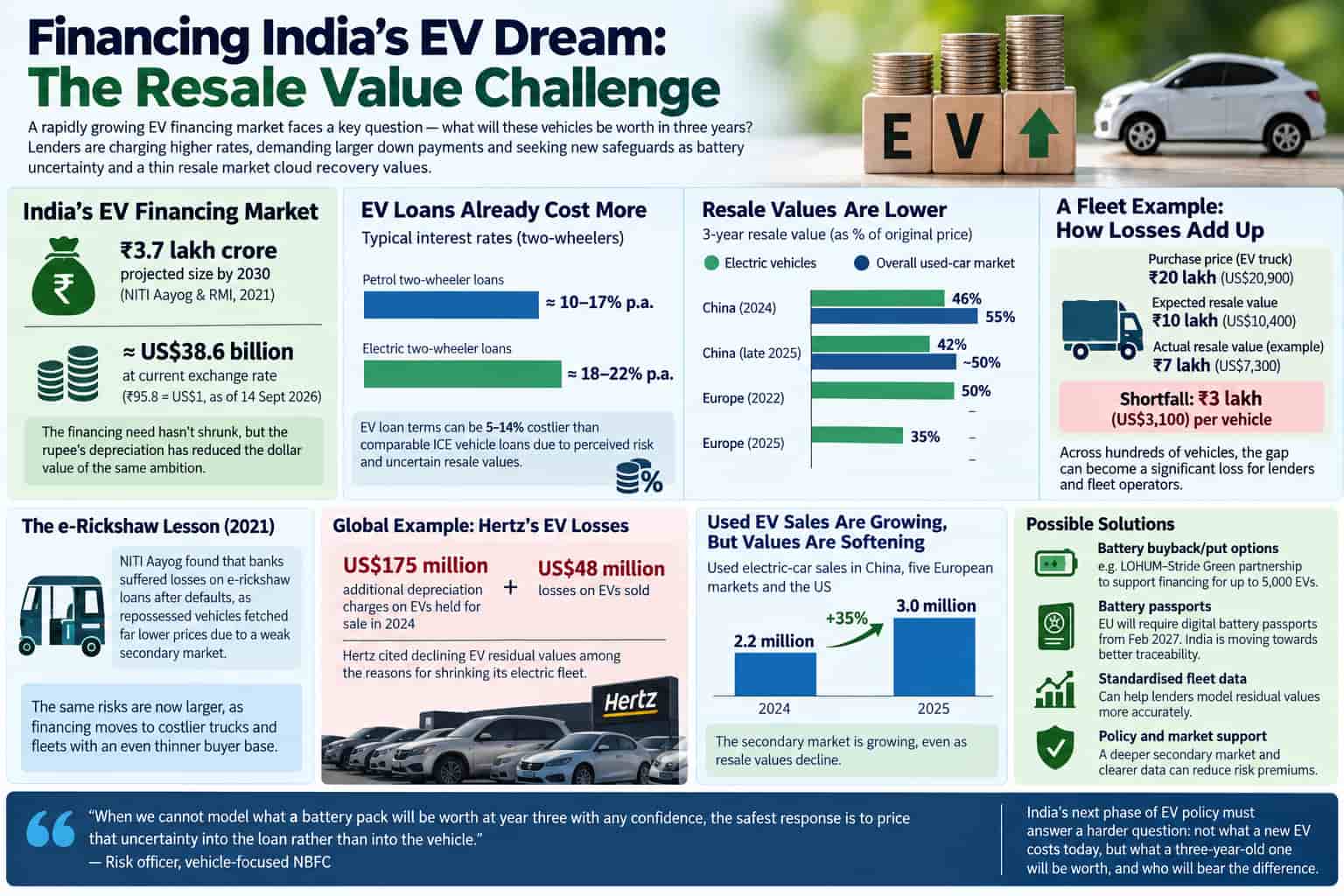
Electric two-wheeler loan rates generally range from 18 to 22% per annum, higher than equivalent petrol-model loans, reflecting perceived risk and still-evolving resale values, according to one large NBFC’s own published lending guidance. Research on electric two- and three-wheeler financing more broadly puts EV loan terms at 5 to 14% costlier than comparable ICE vehicle loans overall, according to a media report.
When lenders cannot confidently estimate what collateral will be worth, the textbook response is to reduce loan-to-value ratios, demand larger down payments, shorten tenures, or simply charge a higher risk premium. All four are already visible in the Indian EV lending market. A handful of banks offer a small green-vehicle concession of half a percentage point or so, but this barely offsets the residual-value premium layered on top by the asset class itself.
“When we cannot model what a battery pack will be worth at year three with any confidence, the safest response is to price that uncertainty into the loan rather than into the vehicle,” said a risk officer at a vehicle-focused NBFC. “That is not a judgement on EVs as technology. It is simply how credit risk gets managed when the data history is thin.”
What happens when the asset is also the business
The maths becomes sharper once financing moves from private buyers to commercial fleets, where the vehicle is both collateral and a revenue-generating asset.
Consider a leasing company that buys an EV for ₹20 lakh (around US$20,900), expecting to resell it for ₹10 lakh (about US$10,400) after its working life. If the vehicle instead fetches only ₹7 lakh (roughly US$7,300), somebody has to absorb the additional ₹3 lakh (around US$3,100) shortfall, the report mentioned earlier notes. Multiply that gap across a fleet of several hundred vehicles, and the arithmetic stops being theoretical.
Fleets do have one advantage individual buyers lack: they generate detailed data on mileage, charging behaviour, maintenance and battery performance. If that data were standardised and shared with lenders, commercial EVs could in principle become easier to value than privately owned ones, rather than harder.
The global mirror is not reassuring
India’s uncertainty would matter less if bigger, more mature EV markets had already solved this problem. They have not. In China, the world’s largest and most established EV market, three-year-old electric cars retained about 46% of their original value in 2024, against roughly 55% for the broader used-car market, according to the International Energy Agency’s Global EV Outlook 2026. By late 2025, that had fallen further to around 42%, a similar percentage-point drop to the overall used-car market, which itself eased to just above 50%.
Europe’s experience has been sharper still. Battery electric vehicle resale retention across five major European markets fell from about 50% in 2022 to roughly 35% in 2025, the same IEA analysis finds. Used electric-car sales across China, five European markets and the United States did cross 3 million units in 2025, up around 35% in a year, showing the secondary market is growing even as the values within it soften.
If China and Europe, with vastly deeper used-EV markets, longer sales histories and more mature battery-testing infrastructure, have not stabilised residual values, India’s thinner and younger secondary market has little reason to fare better without deliberate intervention.
Hertz’s experience in the United States is the clearest illustration of what mispriced residual-value assumptions cost in practice. The company recorded US$175 million in additional depreciation charges writing down EVs held for sale in 2024, plus a further US$48 million in losses on EVs it did sell, citing declining EV residual values among its reasons for shrinking its electric fleet.
The rupee’s quiet role in the number
There is a detail in India’s own EV financing projections worth pausing on.
NITI Aayog and Rocky Mountain Institute estimated in 2021 that India’s EV financing market would reach ₹3.7 lakh crore by 2030, valuing that at roughly US$50 billion using the exchange rate of the time. Converted at today’s rate, the same rupee figure is worth closer to US$38.6 billion.
None of the underlying financing need has shrunk; the rupee’s own depreciation over the intervening years has simply reduced what that ambition is worth in dollar terms. For an asset class already wrestling with valuation uncertainty on the vehicle side, currency drift adds a second, quieter layer of the same problem on the financing side, one that rarely appears in sector commentary at all.
Early fixes: data, passports and buybacks
The most promising responses so far come from spreading the risk rather than eliminating it. In 2024, battery-recycling company LOHUM partnered with EV asset-finance platform Stride Green to support financing for up to 5,000 EVs, with LOHUM providing a put option on battery residual value, giving the financier a guaranteed floor rather than an estimate, industry reports suggest.
“A put option on the battery does for a financier what a buyback guarantee does for a car buyer. It converts a guess into a contract,” said an executive at a battery-recycling and asset-finance firm. “The next step is making that kind of instrument standard rather than exceptional.”
The European Union will require digital battery passports for relevant EV batteries from February 2027, a traceability requirement that could feed directly into credit underwriting once battery health, age and remaining warranty become verifiable data points rather than dealer claims. India has begun moving towards better battery traceability, but has not yet built the architecture linking that data to lending decisions. Indoen Energy has previously covered the mineral and manufacturing side of India’s EV build-out; the financing side, so far, has drawn far less scrutiny.
India’s first phase of EV policy was built to bring the price down. Its next phase will need to answer a harder question: not what a new EV costs today, but what a three-year-old one will be worth, and who is prepared to absorb the difference if the answer is less than expected.
Follow us on : X | LinkedIn | Facebook | Bluesky