
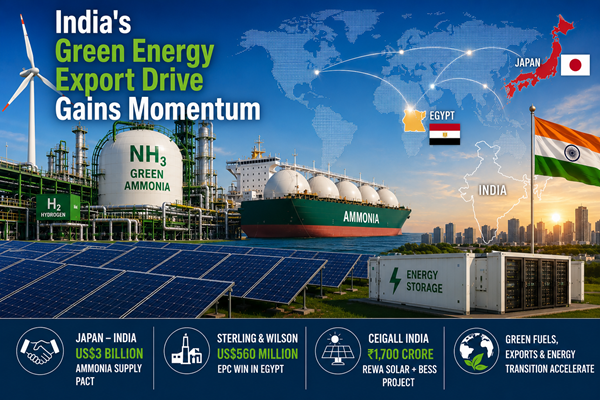

Japan locks in US$3bn ammonia demand, anchoring India's green-fuel export corridor
Japan's ACME Group and IHI Corporation have secured price-gap certification worth more than US$3 billion under Tokyo's Contract-for-Difference programme, underwriting 228,000 tonnes of green ammonia annually to be produced at ACME's Odisha facility and shipped from 2030 to seven Japanese offtakers, including Kobelco Power Kobe and Sumitomo Chemical.
The structure matters more than the headline number. Rather than a straightforward offtake agreement, this is Japan's Ministry of Economy, Trade and Industry using sovereign subsidies to close the cost gap between Indian-produced green ammonia and fossil-fuel alternatives — effectively de-risking a decade-long supply contract before construction begins. That is the financing template India's green hydrogen ecosystem has lacked: bankability underwritten by the buyer country's exchequer rather than by Indian public capital alone.
It also firmly places India within Japan's decarbonisation supply chain, at a time when Reliance-Samsung C&T and L&T-ITOCHU have already signed comparable multi-billion-dollar ammonia pacts this year. Odisha, alongside Gujarat, is emerging as India's principal green-fuel export coast, with implications for port capacity, ammonia storage infrastructure, and the pace at which domestic electrolyser manufacturing capacity is being built.
For India's National Green Hydrogen Mission, which has struggled with genuine offtake certainty, a foreign-government-backed CfD is a stronger signal of commercial viability than most domestic subsidy schemes have managed so far.
(Source: Fuel Cell Works)
Sterling and Wilson's $560m Egypt win marks India's third gigawatt-scale solar EPC export
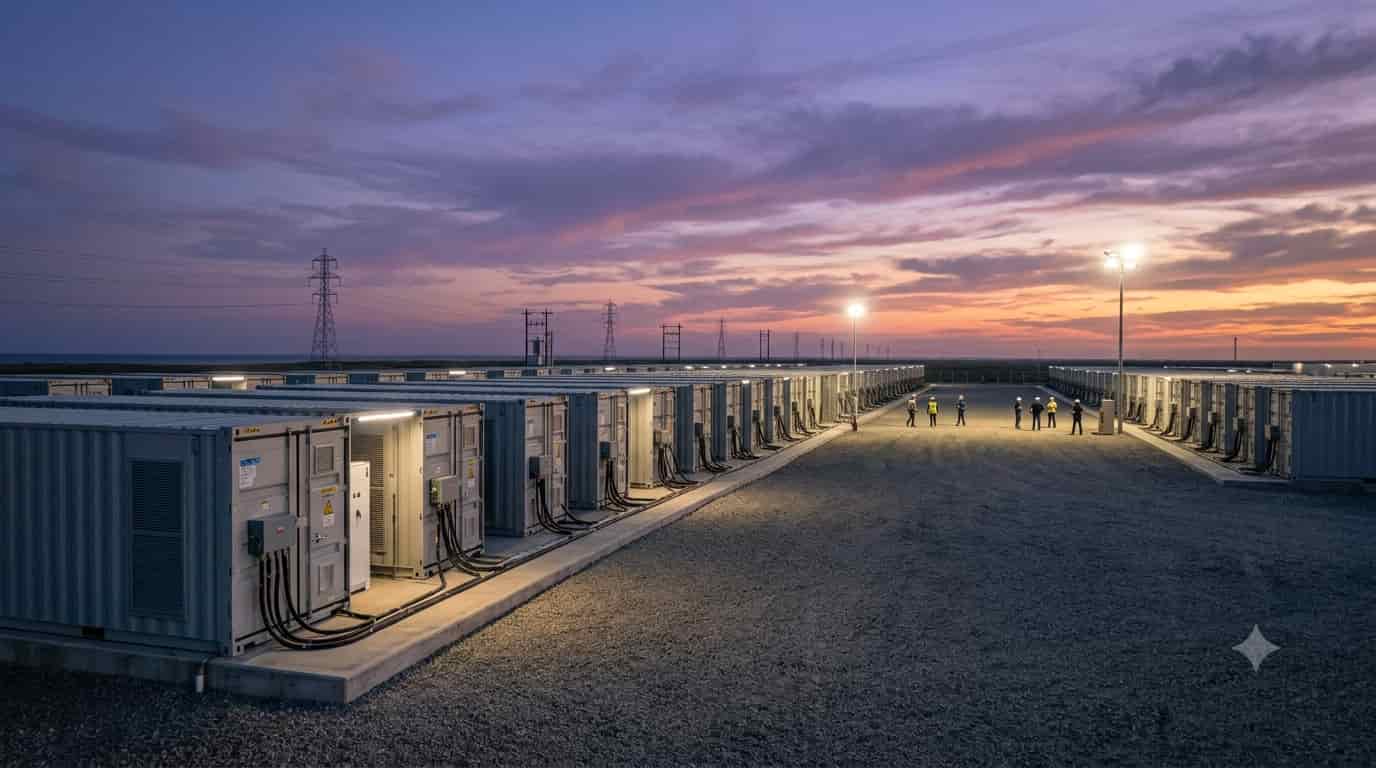
Sterling and Wilson Renewable Energy, backed by Reliance New Energy, has secured a US$560 million EPC contract through its joint venture with Hassan Allam Construction to build the 1 GW West Minya solar-plus-storage plant in Egypt's Minya Governorate, paired with a 600 MWh battery system.
This is the company's third gigawatt-scale international order since October 2025, a trend that indicates Indian EPC contractors are increasingly winning large, complex, storage-integrated projects abroad rather than serving as equipment suppliers to foreign developers. The project itself is backed by the EBRD, Meridiam and Infinity Power Holding, underscoring that Indian execution capability is now being paired with Western development-finance capital on third-country projects.
Egypt's push to source 42% of its electricity from renewables by 2035 is attracting a wave of Gulf and international capital. Indian EPC firms are positioning themselves as preferred delivery partners for BESS-integrated utility-scale plants — a segment where domestic execution experience, gained through India's tariff-linked storage tenders, is proving exportable.
For Sterling and Wilson, the order also reinforces a broader trend: Indian solar EPC majors converting domestic BESS-integration expertise into overseas revenue, marking a structural shift from the sector's earlier reliance on the domestic tendering cycle alone.
(Source: PV Magazine)
Ceigall's US$180 mn Rewa PPA confirms solar-BESS bidding is mainstream in discom procurement
Ceigall India's wholly owned subsidiary has signed a power purchase agreement with Rewa Ultra Mega Solar for a 220 MW solar-plus-BESS project at the Morena Solar Park, Madhya Pradesh, at a quoted tariff of ₹2.70 per kWh and an all-in project value of roughly ₹1,700 crore (US$180 million), inclusive of GST.
The deal is notable less for its size than for what it says about the buyer, the road contractor: Ceigall, historically a highways and elevated-corridor EPC company, has built renewables into a genuine second revenue line, with its FY26 order book showing roughly 35% of fresh inflows from renewable and storage projects. That diversification mirrors a wider trend among mid-sized infrastructure contractors, who are using BESS-integrated solar to de-risk revenue away from cyclical road-construction tendering.
The tariff itself — ₹2.70 per kWh for firm, storage-backed power — is a useful market data point. It sits well above pure solar PPA tariffs from recent years, reflecting the cost premium discoms are now willing to pay for round-the-clock dispatchability rather than variable generation, marking a structural shift in how Indian power procurement prices storage.
With construction slated for 18-24 months and a 25-year operating tail, the project adds to a growing pipeline of tariff-based solar-BESS auctions across central India, a format that state utilities increasingly favour over standalone solar as grid-balancing needs intensify.
(Source: Financial Express)
Suzlon's debut 105 MW order signals India's wind market is repricing around dispatchability
Suzlon has secured a 105 MW order from Sunsure Energy for 21 units of its newly launched S175 (5.175 MW) turbine — India's tallest and most powerful commercial wind platform — to be installed in Karnataka's Bijapur district, just two weeks after the model's launch and taking the two companies' cumulative order relationship past 400 MW.
No contract value was disclosed, which keeps this a smaller entry than the other stories here, but the underlying technology shift is structurally relevant. The S175's taller hybrid-lattice tower and larger rotor are designed to access wind resources at sites previously considered commercially unviable, expanding the addressable geography for Indian wind development at a time when land and grid-connection constraints are increasingly binding.
More significant is the buyer profile: Sunsure Energy is a commercial-and-industrial (C&I) renewable developer whose growth is being driven by data-centre, GCC, and advanced-manufacturing demand for firm, round-the-clock power — the same dispatchability logic that is pushing solar developers toward BESS integration. The repeat, escalating order pattern from a single C&I buyer is itself a market signal: India's corporate renewable demand is maturing from opportunistic solar procurement toward blended, technology-agnostic firm-power sourcing.
For India's wind original equipment manufacturers, largely eclipsed by solar's growth over the past decade, the shift toward taller, higher-yield turbines aimed squarely at C&I offtake could mark the beginning of a wind-sector repricing, provided the platform's economics hold up beyond this launch order.
(Source: Economic Times)