
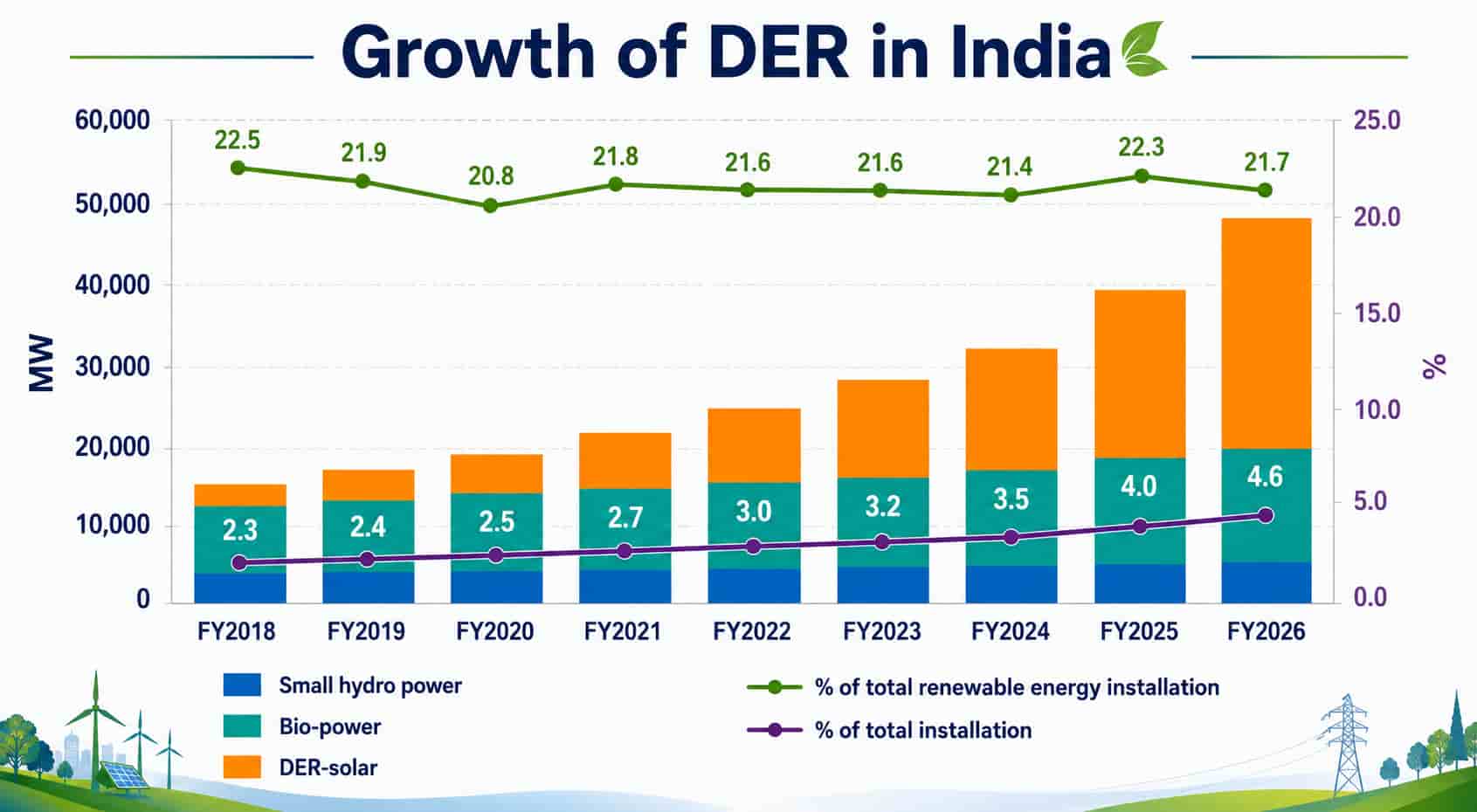
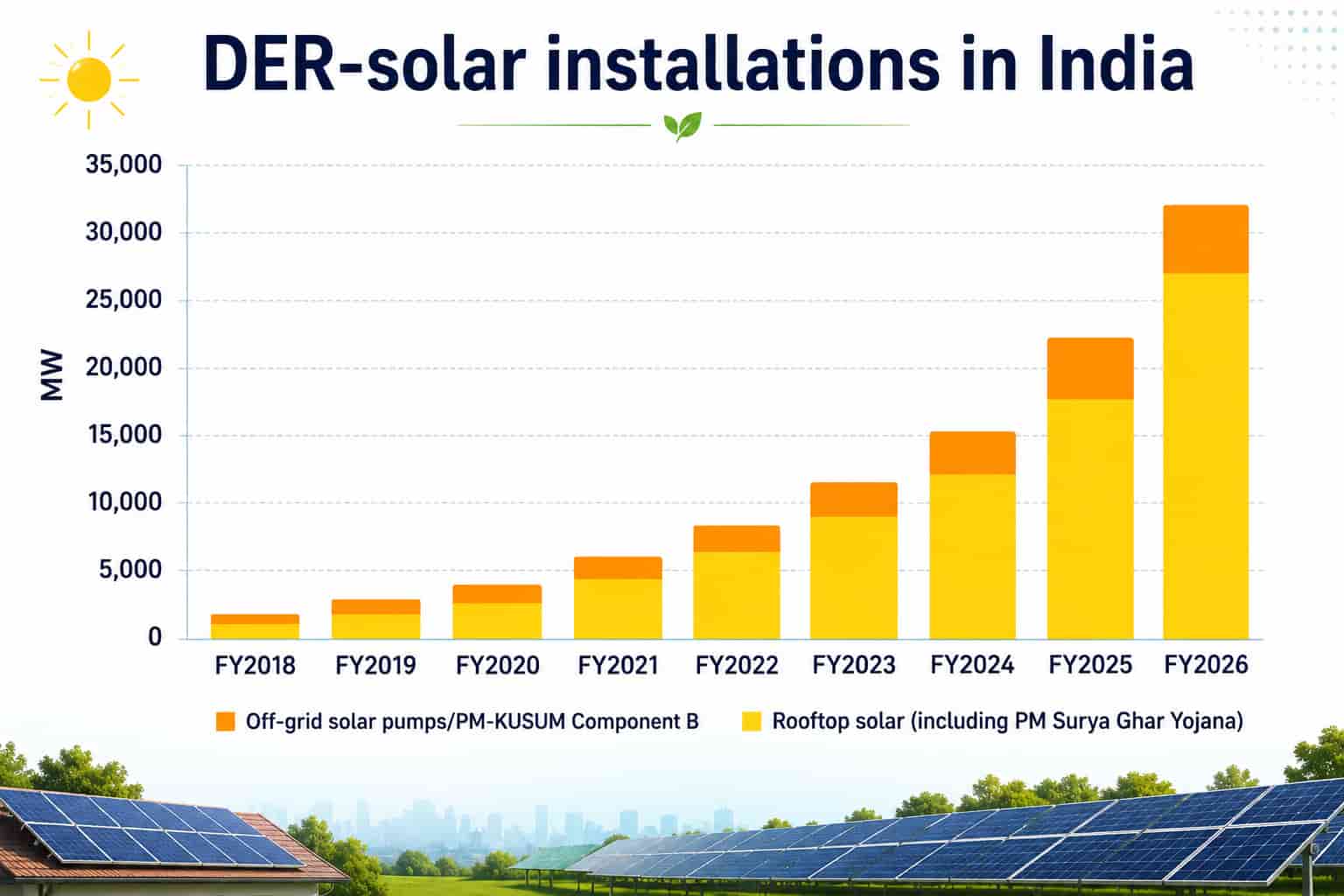
Distributed solar capacity has grown from 1.8 gigawatts (GW) in the 2018 financial year to 31.5GW in FY2026. That figure covers panels on homes, factories and irrigation pumps, not sprawling solar parks. It comes from Ministry of New and Renewable Energy (MNRE) data. The growth is roughly seventeen-fold.
Yet the share of distributed energy resources (DERs) within India's total renewable installations has barely shifted. It has hovered between 21% and 22% across the same period.
The reason is simple. Utility-scale solar parks have expanded even faster than rooftop and off-grid systems. So India's decentralised generation is growing quickly in absolute terms. But it is shrinking in relative importance.
Auctioned mega-projects are easier to finance and monitor than millions of scattered rooftops. That says as much about institutional preference as it does about consumer appetite for solar.
A subsidy-led surge, finally gathering pace
The instrument doing most of the heavy lifting is the PM Surya Ghar: Muft Bijli Yojana. It is a residential rooftop solar scheme launched in February 2024. The total outlay is ₹75,021 crore (US$7.9 billion). The scheme offers capital subsidies of up to 60%. It aims to cover ten million households by March 2027.
Progress was sluggish for most of its first year. Only 8.46% of the target had been met by January 2025. But momentum has since built sharply. By July 2026, installations had crossed 50 lakh households. That month alone added a record 5.06 lakh new connections.
Daily installation rates rose from around 5,000 a day in October 2025 to more than 16,000 a day. Roughly ₹28,024 crore (US$2.9 billion) in subsidies has been transferred directly to beneficiaries. Nearly 19 lakh households now report zero electricity bills.
That acceleration matters. India's rooftop solar technical potential remains vastly under-tapped. MNRE assessments put the residential and commercial rooftop potential at 637GW. Cumulative rooftop installations so far total roughly 25–26GW.
Even after two years of record additions, India has captured well under a tenth of what its own roofs could theoretically host.
The agricultural counterpart is PM-KUSUM. It targets 30.8GW of distributed solar through solar pumps and feeder-level solarisation. Off-grid pump capacity has grown from 0.7GW to 5.8GW. Farmers pursuing solar irrigation reduce their dependence on diesel. They also ease the subsidy burden state utilities carry for agricultural power. But as in Bangladesh's diesel-dominated irrigation sector, the transition remains far from complete.
Where the growth is really coming from
A closer look at who is installing rooftop solar complicates the popular narrative. This is not chiefly a residential phenomenon. In 2025, industrial and commercial consumers together accounted for about 23% of new rooftop installations — 18% industrial, 5% commercial.
A study from the Institute for Energy Economics and Financial Analysis (IEEFA) places that pattern within a broader multi-country assessment of Australia, India and Bangladesh.
The residential segment, boosted by government subsidy, still delivers most of the additional volume. But commercial and industrial (C&I) sites have long been India's structural anchor for rooftop solar. High retail tariffs and short payback periods drive that segment, not public money.
That C&I dependence is not without friction. Delays in net-metering approval remain the single most cited obstacle to rooftop deployment. State electricity regulators typically prescribe 15-to-30-day approval windows.
Stakeholders say these frequently stretch to 30–90 days in practice. Distribution companies (DISCOMs) fear losing revenue from their highest-paying industrial customers to self-generation. In places, they have been accused of slow-walking approvals. Bangladesh shows almost the same pattern. Its net metering guidelines mandate 10-to-15-day approvals. These, too, regularly run over.
"Every state effectively runs its own rooftop solar regime," said a researcher at a New Delhi-based energy think tank. "A developer moving from Gujarat to Uttar Pradesh is not just changing geography. They are learning an entirely new approval process, documentation format and DISCOM culture."
Regulatory fragmentation of this kind is now widely seen as the binding constraint on India's C&I rooftop segment — more than financing or hardware costs.
The Australian counterpoint: what scale really looks like
Australia offers a useful mirror. Roughly 40% of Australian homes carry rooftop solar.
India is nowhere near replicating that penetration rate, given its far larger and more dispersed housing stock. Between 2014 and 2025, rooftop solar's share of generation in Australia's National Electricity Market rose from near-zero to over 13%.
Coal's share fell from 75% to 52% over the same period. That is a genuine displacement effect. India's DISCOMs are still wrestling with curtailment and grid stability concerns during high-solar hours. They have yet to achieve anything comparable.
The more instructive lesson may be what came after rooftop solar matured: batteries. Australia's federal Cheaper Home Batteries Program launched in July 2025. Within ten months, Australians installed more than 340,000 small-scale batteries. That added 9.4 gigawatt-hours (GWh) of storage.
The figure is worth pausing on. It already approaches the 16.6GWh of registered utility-scale battery storage the entire National Electricity Market had accumulated by early 2026. India, by contrast, has barely begun integrating storage into its flagship residential solar programme. PM Surya Ghar remains, for now, a generation-only scheme.
Bangladesh's undercounted boom
If Australia shows India where distributed storage could go, Bangladesh illustrates a different problem: measurement. Government data puts the country's rooftop solar capacity at 418.1MW as of June 2026.
IEEFA's own field survey of 239 establishments found combined capacity of 667MW. Including small-scale systems below 0.15MW, actual capacity could already sit near 1,000MW — well over double the official figure.
That gap is driven by patchy monitoring, not deliberate undercounting. It is a caution for India too. MNRE's own dashboards depend heavily on self-reported DISCOM data.
Bangladesh's rooftop growth has left a measurable fingerprint on the grid. Daytime power demand between April–June 2024 and the same period in 2026 fell by up to 6%, though weather and an industrial slowdown also played a part.
High import duties on solar accessories, ranging from 28.73% to 61.8%, continue to discourage households and small traders. Bangladesh's government has trimmed duties for larger EPC-run projects. But that gap in treatment is a reminder: fiscal design, not just subsidy generosity, decides who actually benefits from a distributed energy push.
The fiscal and grid trade-offs India cannot avoid
None of this growth is free of tension. Subsidy-funded rooftop schemes carry a real exchequer cost. DISCOMs, already financially stretched in several states, face a structural dilemma. Every unit of rooftop solar self-consumed is a unit of retail revenue lost, even as it reduces their peak procurement bill.
Critics of aggressive rooftop targets make a clear case.
Without parallel reform of DISCOM finances and network tariffs, they argue, the subsidy-led model risks becoming fiscally unsustainable at scale.
This echoes debates already under way over India's shift toward domestic-content solar manufacturing rules. Proponents counter that reduced transmission losses and lower peak power procurement offset much of that revenue loss over time, particularly given how expensive short-term power markets can be.
"Rooftop solar reduces our import bill and our peak demand stress," said a senior official at a central government ministry. "But it also means DISCOMs have to rethink a revenue model built for a one-way grid."
That tension, between decentralised generation and centralised utility economics, is likely to intensify as India's rooftop segment scales toward its 2027 target. It is a debate Indoen Energy has tracked closely, as the sector fractures into starkly different regional trajectories.
What comes next
Three developments are likely to define India's distributed energy decade.
First, virtual power plants and vehicle-to-grid integration are barely discussed in India today. That will probably change within three to five years, as electric vehicle penetration rises and residential batteries — still rare — become commercially viable, echoing cost declines already seen in Australia.
Second, expect renewed pressure to harmonise net-metering rules nationally. India currently leaves each of its more than fifty DISCOMs to run its own approval regime. Regulators have discussed this reform for years but rarely delivered it.
Third, smart meter rollout under the Revamped Distribution Sector Scheme targets more than 250 million installations. That could eventually give India the real-time visibility into rooftop generation that Bangladesh, and even parts of Australia, still lack.
The counterintuitive lesson from placing India alongside Australia and Bangladesh is this: the biggest constraint on distributed energy is rarely solar panels themselves.
It is everything downstream of the panel. Storage economics. DISCOM finances. Metering infrastructure. The patchwork of state-level rules. Together, these will decide whether India's rooftop revolution becomes a structural feature of its power system, or merely a fast-growing footnote to a utility-scale story.
Follow us on : X | LinkedIn | Facebook | Bluesky