

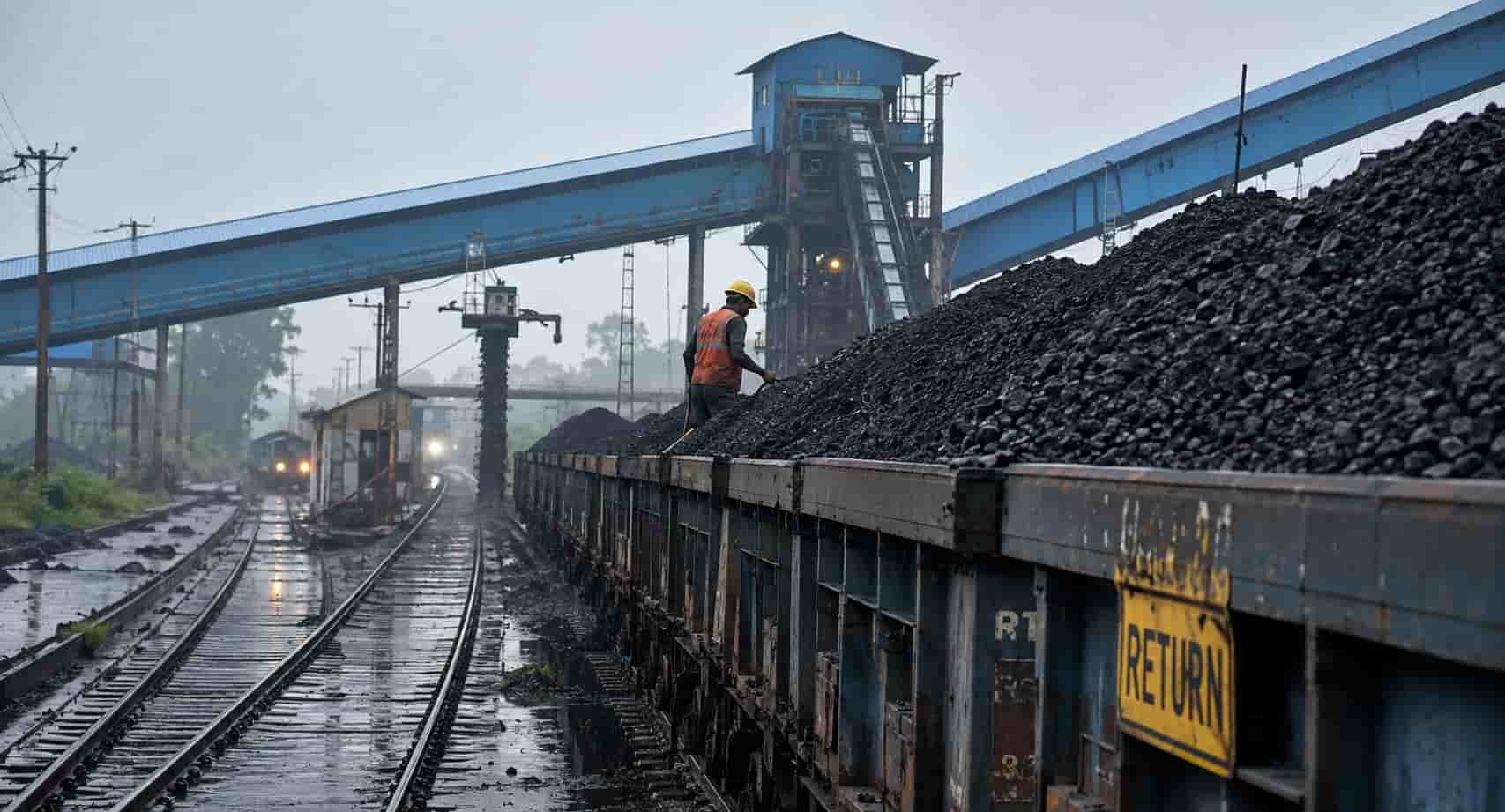

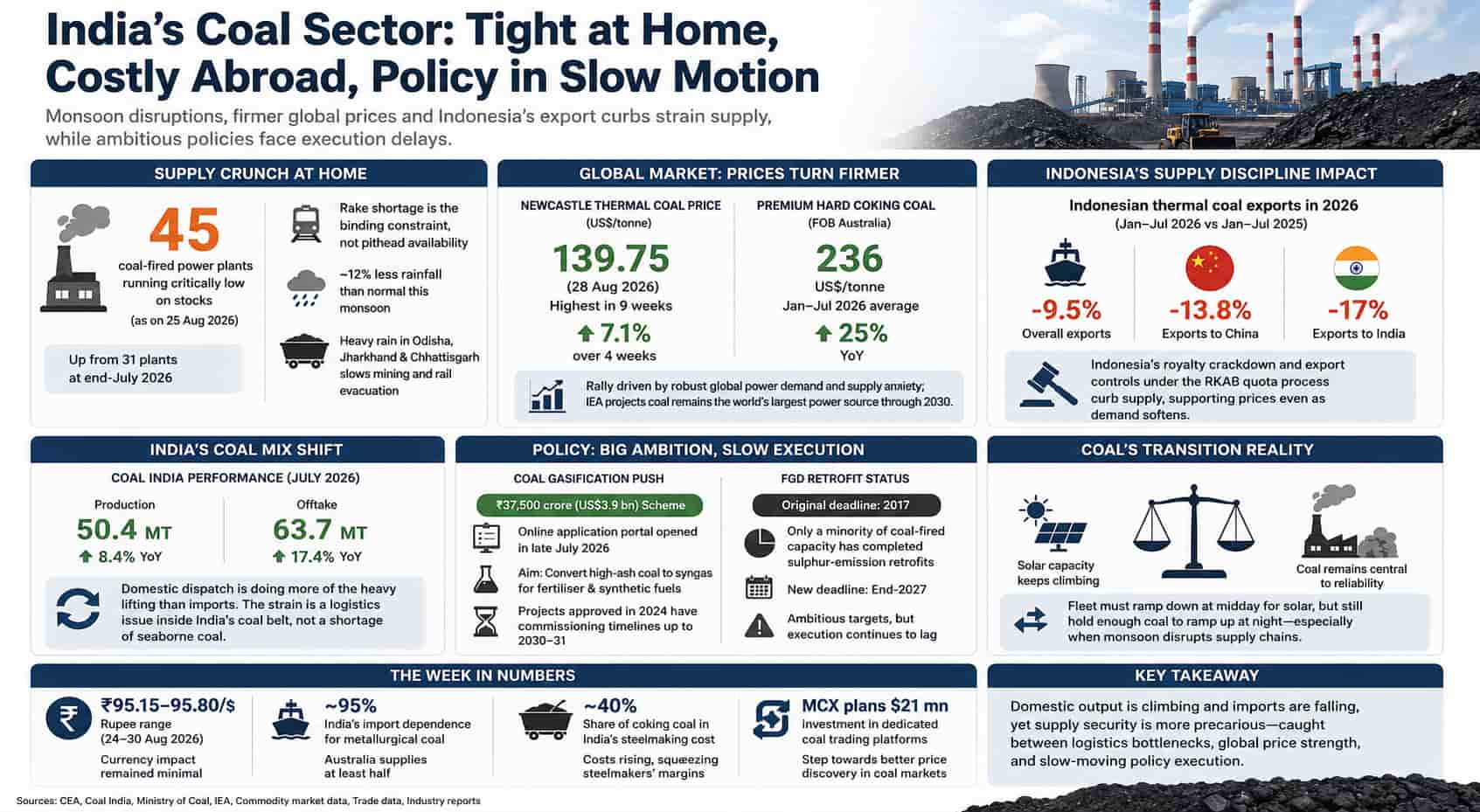
The most striking story of the week was not a price chart but a stock chart. Central Electricity Authority data through 25 August showed forty-five coal-fired power plants running critically low, up sharply from thirty-one at the end of July, with forty of the affected units burning purely domestic coal.
An uneven monsoon — India has received roughly 12% less rainfall than normal this season — has driven cooling-linked power demand higher even as heavy rain in Odisha, Jharkhand and Chhattisgarh has slowed both mining and rail evacuation, as recent reporting on the shortfall shows.
“There is a need for five to six rakes at some plants, but we are receiving only half that number,” an executive at a leading thermal utility said, describing the rake shortage as the binding constraint rather than pithead availability itself.
This domestic tightness arrived just as international prices turned firmer. Newcastle thermal coal closed at US$139.75 a tonne on 28 August, its highest level in nine weeks and up 7.1% over four weeks, according to commodity market data. The rally reflects robust global power demand and supply anxiety rather than any single shock, with the IEA continuing to project coal as the world’s largest single power source through 2030.
The landed-cost equation gets harder to read
For Indian buyers, the arithmetic of an imported tonne depends on three moving parts: the benchmark price, freight, and the rupee. The rupee held in a narrow band through the week, trading between roughly ₹95.15 and ₹95.8 to the dollar, so currency contributed little extra pressure. The bigger swing came from price itself.
With Newcastle up and premium hard coking coal averaging US$236 a tonne FOB Australia in the first seven months of 2026 — a 25% jump on the same period last year, industry data shows — the cost of imported coal into Indian ports has been rising steadily since the spring, independent of freight or currency moves.
Coking coal accounts for close to 40% of steelmaking cost in India, which imports about 95% of its metallurgical coal needs, with Australia supplying at least half. “Margins are being squeezed at a time when steelmakers are trying to fund capacity expansion, not defer it,” an analyst tracking Indian thermal coal markets said.
 Indonesia’s supply discipline, not demand, is driving the rally
The more unusual thread this week concerns Indonesia. Jakarta’s push to enforce royalty payments and curb under-invoicing — part of a wider state export-control effort — has coincided with falling Indonesian shipments even as prices climb.
Indonesian thermal exports are running at roughly a 9.5% year-on-year decline in 2026, with China buying 13.8% less and India 17% less than a year earlier, trade data indicates.
A price recovery built not on hungrier buyers but on a tighter, administratively managed seller was evident in the market. If Jakarta’s enforcement genuinely constrains supply through the RKAB production-quota process, prices could stay firm even as Chinese and Indian appetite softens — a more fragile foundation than the headline number suggests.
The second, related oddity is closer to home. India is importing less Indonesian coal even as its own power plants run critically short. That is not a contradiction so much as a substitution story: Coal India’s July output rose 8.4% year-on-year to 50.4 million tonnes with offtake up a sharper 17.4% to 63.7 million tonnes, company data shows, meaning domestic dispatch is doing more of the heavy lifting than imports.
The strain, in other words, is a logistics problem inside India’s own coal belt, not a shortage of coal on the water. Indoen Energy’s Coal Watch tracker carries the granular weekly tonnage detail for readers who want it.
Policy: Gasification gathers pace, retrofits lag behind
On policy, the Ministry of Coal’s Scheme for Promotion of Surface Coal and Lignite Gasification Projects — worth ₹37,500 crore (USUS$3.9bn) — opened its online application portal in late July and continued taking submissions through this window, part of a push to convert high-ash domestic coal into syngas for fertiliser and synthetic fuels, ministry notifications confirm.
“The gasification mission gives coal a second life beyond combustion, but execution has historically lagged ambition,” a senior official at the Ministry of Coal said, noting that projects approved even in 2024 carry commissioning windows stretching to 2030-31.
That caution is worth weighing against the FGD retrofit record. Years after the original 2017 deadline, only a minority of India’s coal-fired capacity has completed sulphur-emission retrofits, with a further deadline now set for end-2027. The pattern across both schemes is similar: ambitious rupee figures attached to slow-moving execution timelines.
Coal’s transition paradox persists
None of this changes coal’s structural position in India’s energy mix, even as solar capacity keeps climbing. Indoen has previously examined how India’s coal fleet must learn to flex as renewables scale, and this week’s stock crisis is a reminder that flexibility and adequacy are separate problems: a fleet asked to ramp down at midday for solar must still hold enough fuel to ramp up reliably at night, particularly when the monsoon disrupts the supply chain that feeds it.
The Multi Commodity Exchange’s move to build dedicated coal trading platforms reflects a slow institutional recognition that price discovery in this market remains underdeveloped for a fuel this central to energy security.
For now, the week’s takeaway is a familiar Indian coal paradox in sharper relief: domestic output climbing, imports falling, yet supply security more precarious than either trend alone would suggest.
Follow us on : X | LinkedIn | Facebook | Bluesky