
For a decade, India’s renewable story has been told through capacity numbers. Installed non-fossil capacity reached 283.5 GW by March 2026, growing at around 11% a year, comfortably on track for the 500 GW target set for 2030. What has received far less scrutiny is whether all that capacity can actually be insured on reasonable terms.
Zurich Resilience Solutions’ assessment, Powering Up: Building Climate Resilience into India’s Renewable Energy Future, used Global Energy Monitor data covering 1,020 planned solar, wind and hydropower sites across India. Nearly 90% of that pipeline capacity, 871 assets, sits in just ten states and union territories, and it is this concentrated set that the report assesses in detail against 16 climate hazards under an IPCC-aligned warming scenario.
The finding: 729 of those sites, representing roughly 239 GW, or 90% of the assessed capacity, are at high or critical risk of being adversely affected by climate hazards by 2030 — enough capacity to power the annual needs of 300 million households.
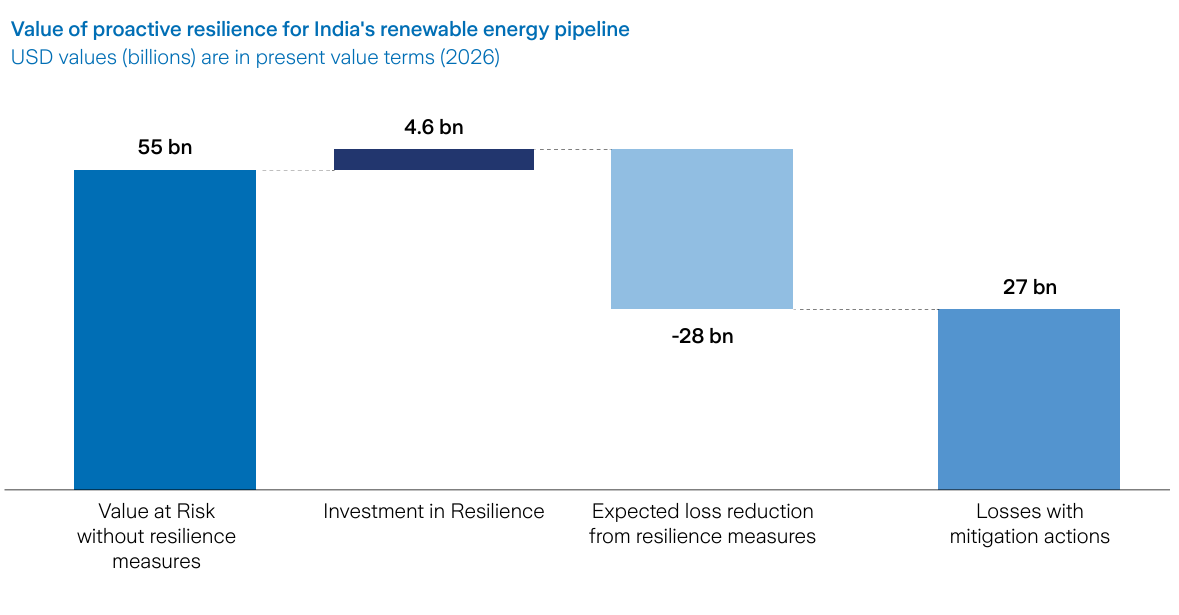
Zurich puts the resulting Value at Risk, the replacement cost exposed under a severe climate scenario, at approximately US$55 billion. It is not a call to slow down. The report’s central argument is that a relatively modest resilience investment, around US$4.6 billion, equivalent to roughly 2% of the portfolio’s total replacement cost, could cut that exposure to about US$27 billion — a US$28 billion reduction, or a sixfold return on every dollar spent, provided it is spent while projects are still in planning or construction.
Solar, wind and hydropower carry very different exposure
The risk is not evenly spread across technologies. Solar dominates India’s pipeline by both site count and capacity, accounting for 593 of the 871 assessed sites and 182,286 MW, nearly 70% of assessed capacity.
By 2030, 76% of that solar capacity sits in the report’s two highest-risk categories, driven chiefly by tornado, hail, wildfire and flood exposure. Wildfire smoke alone can cut solar irradiance by as much as 70%, while hail causes both visible module damage and hidden defects that only show up later as degraded output.
Wind tells a markedly different story. Of the 230 wind sites assessed, accounting for roughly 44,177 MW, just 4% sit in the highest-risk category, a far more benign profile than solar.
Hydropower sits at the opposite extreme: only 48 sites and 40,188 MW by capacity, but 92% of that capacity falls into the two highest-risk bands, reflecting how exposed large, capital-intensive dams are to changing flow patterns, sedimentation and slope instability, particularly in the Himalayan foothills.
Geography, not just technology, decides insurability
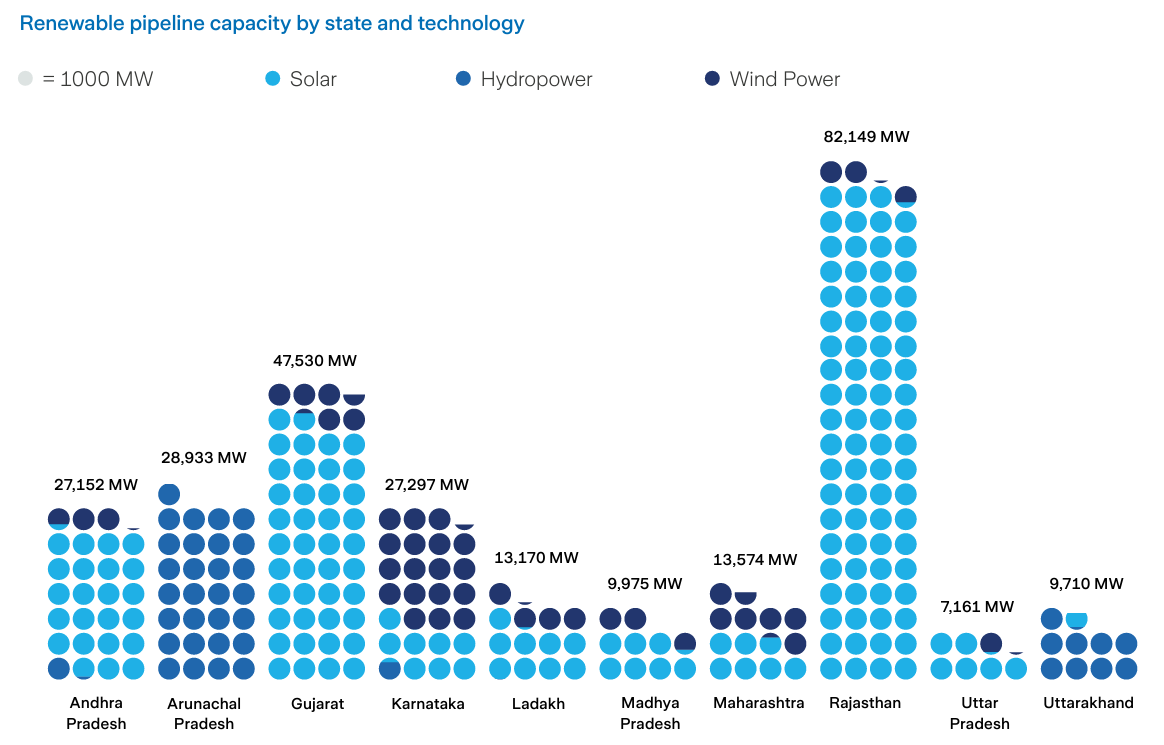
The state-by-state figures are, in some ways, the most striking part of the report.
Rajasthan, India’s largest renewable state by a wide margin, carries the highest absolute Value at Risk in the portfolio at US$16.4 billion, with 85% of its assets in the critical-risk band; temperatures there regularly exceed 50°C, stressing panels and balance-of-plant simultaneously.
Gujarat carries a US$8.6 billion exposure with 90% of assets at critical risk, its coastline adding cyclone and storm-surge risk on top of the hail and tornado exposure it shares with Rajasthan.
Arunachal Pradesh presents the sharpest illustration of concentrated exposure: just 30 assessed sites, almost entirely hydropower, carry a Value at Risk of US$13.1 billion, with 96% of that capacity at critical risk, sited in Himalayan foothills where precipitation, slope instability, seismic activity and flood risk compound each other.
Karnataka is the outlier at the other end: predominantly wind, it carries the lowest critical-risk share in the assessment at just 5%, and a correspondingly modest US$1.9 billion Value at Risk. The contrast underlines a point insurers are only now pricing consistently: two states holding similar capacity can face entirely different bankability outlooks purely on the strength of their hazard geography and technology mix.
“Engineering strength is not the same as climate resilience,” said a senior executive at one of India’s leading renewable energy developers, describing how even a well-designed asset can remain financially exposed if hazard-specific risks are not built into siting and procurement decisions from the outset.
That distinction sits at the heart of Zurich’s case study of a 2.5 GW utility-scale solar project, where severe hail exposure was identified as the critical risk. Without mitigation, the project’s Value at Risk stood at US$178.5 million; switching to a single-axis tracker system with an automated “hail-stow” function that tilts panels into a protective angle during storms cut that exposure to US$43 million, a roughly 75% reduction, for an incremental capital cost of about US$34 million, a 30% premium over a fixed-tilt design.
The same design change lifted expected generation output by around 20% through better tracker optimisation and cut projected recovery time after a severe event from around 21 months to 12.
Capital is repricing risk at the same time
The insurance question would matter less if global capital were flowing in regardless of risk. It is not, at least not evenly. Global renewable energy investment held broadly flat in the first half of 2026 at US$327.5 billion, down 21% from the peak recorded in the second half of 2024. Stand-alone utility-scale solar financing fell 20% year-on-year to US$75.4 billion, its lowest level since the solar boom began in 2021, hurt by worries over curtailment, price cannibalisation and grid congestion.
Industry reports suggest that capital is not leaving renewables altogether, but rotating into projects co-located with storage, which drew a record US$25 billion in the first half of the year, nearly triple the amount a year earlier.
There is a quieter, equally telling detail in the same data.
When BloombergNEF flagged the markets posting standout growth in the first half of 2026, it named Vietnam, Nigeria, Central Asia and Brazil.
India, despite being the world’s third-largest renewable market by capacity, did not make that list — not a sign of India’s build-out stalling, but a suggestion that the marginal, opportunistic capital chasing outsized growth stories is currently looking elsewhere, even as India’s own financing needs remain enormous.
India’s power grid has stopped being a pipe. It is becoming a queue, and that congestion is itself a factor investors weigh when deciding where the next marginal dollar goes.
A gap that predates this year, and a regulatory patch-up
None of this is a wholly new problem. Industry estimates of the capital shortfall facing the global energy transition have run into the trillions for several years now. What has changed is the texture of the shortfall: it is no longer simply too little capital chasing too many projects, but capital becoming more selective about the risk it underwrites, project by project, site by site.
A domestic estimate published this month put India’s own renewable financing shortfall at roughly US$35 billion, a gap industry voices argue could be narrowed by unlocking capital already sitting in operating solar and wind portfolios through investment trusts. According to a media report, that shortfall threatens to raise the cost of capital for developers and slow the storage and transmission build-out renewables now depend on.
India’s regulators are not standing still. The Central Electricity Regulatory Commission has opened a proceeding to set generic tariffs for the 2026–27 financial year, covering small hydro, biomass and biogas projects among other categories, fixing benchmark capital costs, operating expenses, financing costs and return on equity that smaller developers can plan around.
A media report noted that such tariff certainty matters disproportionately for smaller, distributed projects that rarely have the scale to negotiate bespoke financing terms.
“Predictable tariffs help on the revenue side, but they don’t touch the underwriting problem,” said a researcher at a New Delhi-based energy think tank. “A biomass plant can have a guaranteed tariff and still struggle to get affordable cover if insurers see it as a poorly understood risk.” That gap between regulatory certainty and insurance certainty is, in effect, the story India’s renewable pipeline is quietly building towards.
What comes next
Zurich’s own conclusion is not that India’s renewable ambitions are faltering, deployment figures show otherwise, but that the financial architecture underpinning them has not kept pace with the risk profile of what is being built.
The report sets out five practical steps: make forward-looking climate screening standard at planning and permitting; stress-test the highest-risk assets first, while design choices are still flexible; build hazard-specific resilience into procurement standards rather than treating it as an optional upgrade; treat grid connections, access roads and emergency response as part of asset resilience, not separate from it; and use resilience quantification, in rupee and dollar terms, to strengthen the investment case with lenders, insurers and shareholders.
None of these requires a fundamental change to the economics of clean energy, only earlier analysis and a more integrated view of asset, operational and financial risk.
For a sector accustomed to measuring progress in gigawatts, the more consequential number over the next few years may turn out to be a quieter one: how much of that capacity the market is actually willing to insure.
Follow us on : X | LinkedIn | Facebook | Bluesky