

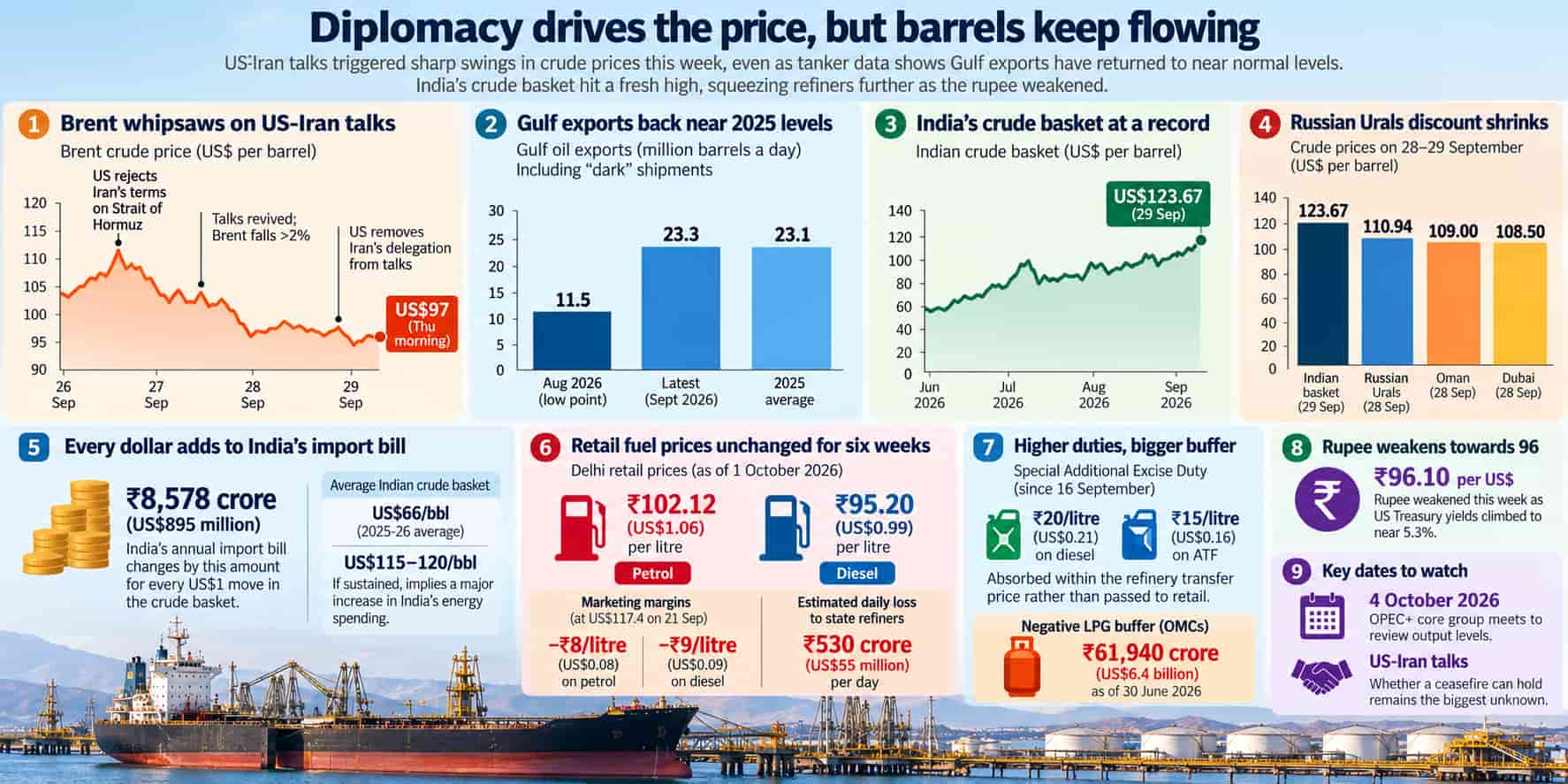
Oil had its roughest week yet for headline-chasing. Prices jumped on Monday after the US rejected Iran’s terms for reopening the Strait of Hormuz, with some analysts noting that Gulf flows had already recovered past 90% of pre-war levels, which may explain both Iran’s eagerness to strike a deal and Washington’s reluctance to compromise.
That rally reversed sharply within 24 hours. US and Iranian officials resumed indirect talks through mediators on Monday, centred on a modified version of Iran’s “seven-day plan” covering a ceasefire and the strait’s reopening, pulling Brent down by more than 2% intraday. By Tuesday, Brent had slipped below US$100 a barrel for the first time since 8 September.
The calm did not last either. By Wednesday, Trump was denying reports that Washington had offered Iran sanctions relief in exchange for nuclear concessions, and by Wednesday night, officials said the US had removed Iran’s delegation from talks after it had “overstayed its welcome.” Brent still closed September with its largest monthly gain since July, up around 14%, even after easing to around US$97 a barrel by Thursday morning.
Gulf exports are already back to (near) normal
Goldman Sachs estimated that Gulf oil exports, including “dark” shipments from tankers running with transponders switched off, have recovered to 23.3 million barrels a day over the past week, broadly in line with the 2025 average, after doubling through September. Saudi Arabia formally resumed tanker loadings from Yanbu on Tuesday, following last month’s pipeline restart.
In other words, physical oil is already moving close to normal even as the political headlines suggest a war still raging. “The market is trading the diplomacy, not the barrels, at this point, since the barrels have mostly found their way out already,” said an analyst tracking global crude markets.
 India’s basket sets a fresh record
India has not been spared the volatility. The Indian crude basket touched US$123.67 a barrel on 29 September, according to pricing data, edging past the previous peak and keeping September’s average among the highest since the war began.
Russian Urals crude traded at US$110.94 a barrel on 28 September, now sitting uncomfortably close to Gulf grades like Oman and Dubai, a sign that the discount which once made Russian barrels so attractive to Indian refiners has narrowed considerably.
For every dollar the basket moves, India’s annual import bill shifts by roughly ₹8,578 crore (USUS$895m), so a basket averaging above US$115-120 for a sustained stretch, against a 2025-26 average of around US$66 a barrel, implies an enormous step-change in the country’s energy spending if it holds.
Retail freeze enters its sixth week
Despite the record basket, Delhi’s retail prices stood at ₹102.12 (USUS$1.06) for petrol and ₹95.20 (USUS$0.99) for diesel as of 1 October, unchanged for weeks running. Marketing margins had already turned negative by ₹8 a litre (USUS$0.08) on petrol and ₹9 a litre (USUS$0.09) on diesel when the basket was still at US$117.4 on 21 September, costing state refiners an estimated ₹530 crore (USUS$55m) a day.
With the basket since climbing further, that daily loss figure is almost certainly an understatement of where things stand now.
A Special Additional Excise Duty of ₹20 a litre (USUS$0.21) on diesel and ₹15 a litre (USUS$0.16) on ATF, in place since 16 September, continues to be absorbed within the refinery transfer price rather than passed to retail, protecting consumers but adding to the squeeze further up the chain.
The cumulative negative LPG buffer carried by OMCs stood at ₹61,940 crore (USUS$6.4bn) as of 30 June, a liability that keeps compounding quietly in the background. “Every week the basket stays above US$110 without a retail revision adds meaningfully to our working-capital borrowing,” said an executive at a leading Indian refiner.
Rupee adds a second squeeze
Compounding the crude shock, the rupee weakened towards 96.10 against the dollar this week as US Treasury yields climbed to a two-decade high near 5.3%, with markets awaiting Friday’s US non-farm payrolls data as the next catalyst.
A weaker rupee raises the landed cost of every imported barrel independent of the dollar crude price, meaning India is currently absorbing both a price shock and a currency shock simultaneously, a combination that has not featured as prominently in recent weeks.
What to watch next
The OPEC+ core group meets again on 4 October, just after this window closes, to review output levels and discuss longer-term capacity assessments. With actual Gulf exports now reportedly near normal regardless of the group’s formal quotas, the meeting’s practical significance may be more limited than usual.
The more consequential variable remains whether Washington and Tehran can hold a ceasefire for longer than a news cycle, something this week’s whiplash suggests remains an open question even as the physical oil market has quietly moved on.
Follow us on : X | LinkedIn | Facebook | Bluesky