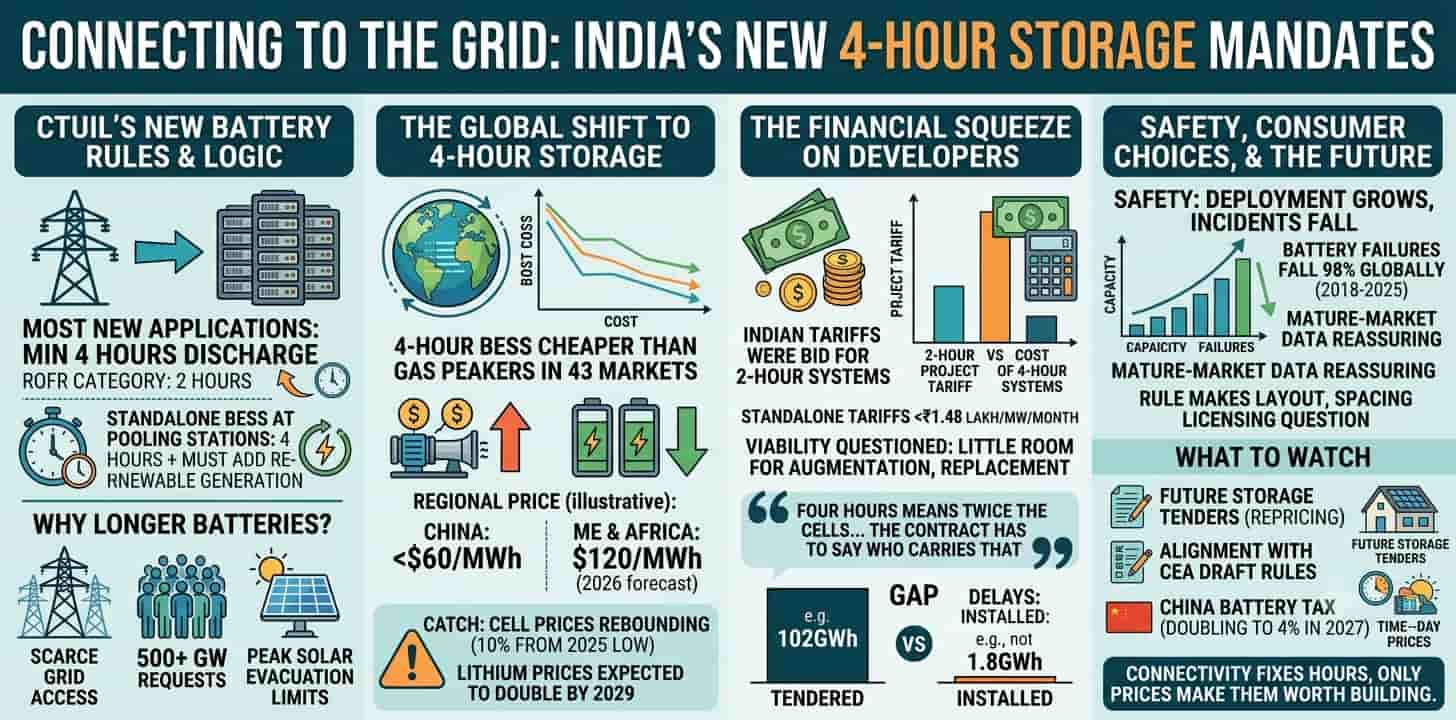
The Central Transmission Utility of India Limited (CTUIL) has changed how batteries reach the grid. According to a media report, applicants in the right of first refusal (RoFR) category must offer at least two hours of discharge. Everyone else needs four. So do standalone batteries at renewable pooling stations.
This is more than a technical tweak. Storage duration is now a condition of entry. A developer cannot simply ask for wires. It must show hours.
Other conditions follow. Standalone projects at pooling stations must apply for co-located renewable generation. Other non-RoFR developers are encouraged to add generation matching the battery’s rating in MWh. The charging plant must be ready from the day connectivity starts, or within 36 months of the grant, whichever is later. Grid charging is allowed when transmission margins permit.
Pending applicants get an escape route. They can raise MWh without raising MW. In plain terms, a 100 MW, two-hour project can become a 100 MW, four-hour project. The wire stays the same. The battery doubles.
The logic is scarcity. Connectivity requests with the central utility already exceed 500 GW, and about 12 GW of renewable capacity faced evacuation limits at peak solar hours, as Indoen Energy reported earlier. A four-hour battery uses a connection for a bigger part of the day than a two-hour one. The direction was also signposted. Minutes of a CTUIL consultation meeting record a Central Electricity Authority study recommending two hours at first, rising to four to six hours in phases.
 The global arithmetic favours longer batteries
Outside India, four hours is fast becoming the benchmark. Wood Mackenzie’s latest cost study finds that four-hour battery storage is now cheaper than open-cycle gas turbines in all 43 markets where both were modelled. In the Middle East and Africa, four-hour storage costs US$120 per MWh in 2026. It is forecast to fall 33% to US$80 per MWh by 2035.
Asia Pacific is more uneven. The regional average is US$134 per MWh, while China sits more than 55% below it. By simple arithmetic, that puts the Chinese benchmark under about US$60 per MWh. Competitive Chinese supply should pull the regional average to US$92 per MWh by 2036. Markets with import duties and local manufacturing rules will stay at a premium.
The surprising point is about gas. The study says turbine shortages and fuel volatility are pushing peaking costs up. India feels this already. Earlier Indoen analysis noted that gas turbines are booked into 2031. The evening is where the grid hurts. This month, a wind lull pushed Tamil Nadu evening power to USUS$0.39 a unit. A four-hour battery is a peaker that can arrive before a turbine can. In that sense, the rule is also a gas-avoidance policy, though the advisory never says so.
There is a catch. In Europe, turnkey battery capex rose about 2%, the first rise in three years, as cell prices rebounded around 10% from their 2025 low. The study expects lithium prices to roughly double in 2029. Indian bids were struck before this turn, as Indoen Energy has reported. Longer batteries need more cells, so the price tide matters more now.
Who pays for the extra two hours?
Here the story gets harder. Oyster Renewable’s chief operating officer says standalone storage tariffs fell as low as ₹1.48 lakh per MW per month (US$1,560) for two-hour systems in 2025. Independent analysts have questioned their viability. Such bids leave little room for augmentation, replacement and performance guarantees.
A simple illustration shows the squeeze. A 100 MW project at that tariff earns ₹1.48 crore (US$156,000) a month, or about ₹17.8 crore (US$1.9 million) a year. Doubling the hours doubles the batteries bought. The tariff does not double by itself. The advisory deals with connectivity, not contracts, and the reporting does not say whether existing tariffs can be reopened.
“Our bids were built on a two-hour battery,” said an executive at one of India’s leading renewable energy developers. “Four hours means twice the cells behind the same megawatt, and the contract has to say who carries that.”
The gap between paper and plant is already wide. India tendered about 102 GWh of storage in 2025, yet grid-scale installed capacity was only about 1.8 GWh by March 2026, as per the same interview. Delays in connectivity and in signing power purchase agreements widen the gap. A tougher entry test adds one more filter.
A quieter tension sits inside the rule. Oyster notes that wind-solar hybrids have a flatter output than solar alone, and wind often generates through the evening and night. That reduces the duration needed. A flat four-hour floor may over-build batteries for such projects. Meanwhile, CTUIL’s own earlier illustration says a 200 MW, four-hour battery needs renewable generation able to produce 800 MWh to charge in one cycle. So the rule also pulls more generation, land and inverters next to every battery.
Twice the energy at every site
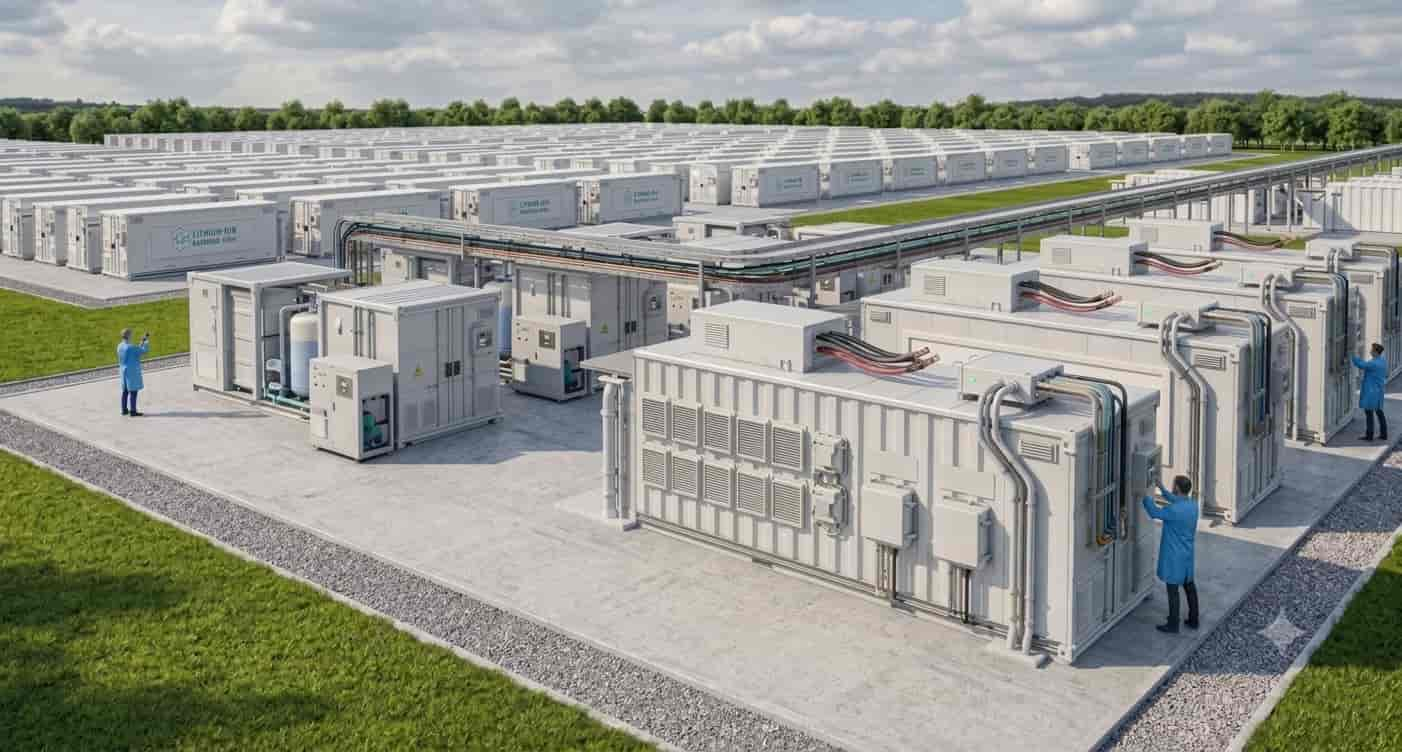
Longer duration raises the stored energy at each connection point. That matters for safety. A new EPRI study finds that battery failures per deployed GWh fell 98% globally between 2018 and 2025, even as new installations passed 300 GWh in 2025. The failure rate is now comparable to that of large oil-filled transformers. About 93% of recorded incidents caused no injury or death, and no fire spread beyond a facility’s boundary.
The report also carries a warning. Indoor facilities are overrepresented in failures and suffer more damage. EPRI stresses barriers that stop fire spreading between units. Even good suppression can leave trouble behind: NextEra has suspended two Long Island sites over fears of water contamination from a 2023 incident. The study could not isolate cell chemistry as a risk factor on its own.
India’s fleet is small and young. Operating capacity stood at 9.08 GWh at the end of August, against more than 300 GWh installed worldwide in 2025 alone. Mature-market data are reassuring. But a rule that doubles MWh per site makes layout, spacing and propagation control a licensing question, not just an engineering one.
Households buy power, not hours
One more data point shows how duration really gets decided. Lawrence Berkeley National Laboratory data show that 37% of new US home solar systems in 2025 included batteries, up from 25% a year earlier. California reached 74%, after its net billing change cut the value of exported solar in April 2023. Outside California, the share rose from 7% to 17%.
The sizing is the surprise. Median home battery capacity stayed at 13.5 kWh in both years. Median discharge power rose from 6 kW to 11.4 kW. By simple division, the typical home battery went from about 2.3 hours to about 1.2 hours. Households chose more power, not more hours.
The comparison is imperfect. Home batteries serve backup and self-use, while grid batteries serve the evening ramp. But the lesson holds. Duration follows what the market pays for. India’s regulator now sets hours by rule, while revenue still rests on fixed tariffs and subsidy. Oyster argues for time-of-day prices with a real peak-to-off-peak spread, state-level enforcement of storage obligations and, in time, a move beyond viability gap funding (VGF). The two VGF tranches together support 43.2 GWh.
“Connectivity can fix the hours,” said a policy adviser familiar with the grid-connectivity discussions. “Only prices can make those hours worth building. Without time-of-day signals, four hours becomes an obligation, not an opportunity.”
What to watch
Three markers will show whether the rule works. The first is the next storage tenders: do four-hour bids reprice upwards? The second is alignment between rules. A draft CEA proposal would require new solar and wind plants to add two hours of storage from July 2027 and four hours from July 2029, as noted earlier. Connectivity rules and technical rules must point the same way. The third is cell prices, with China’s battery consumption tax due to double to 4% in September 2027.
India has found a way to ration scarce wires by the hour. The harder task is to pay for those hours.
Follow us on : X | LinkedIn | Facebook | Bluesky