Not long ago, a company could enter India’s solar business by buying a module line and importing the cells. That route is narrowing. Domestic-content rules now ask for locally made cells, and wafers are next. Smaller firms are answering the way Indian business often does when capital runs short. They are pairing up.
From assembly line to cell line
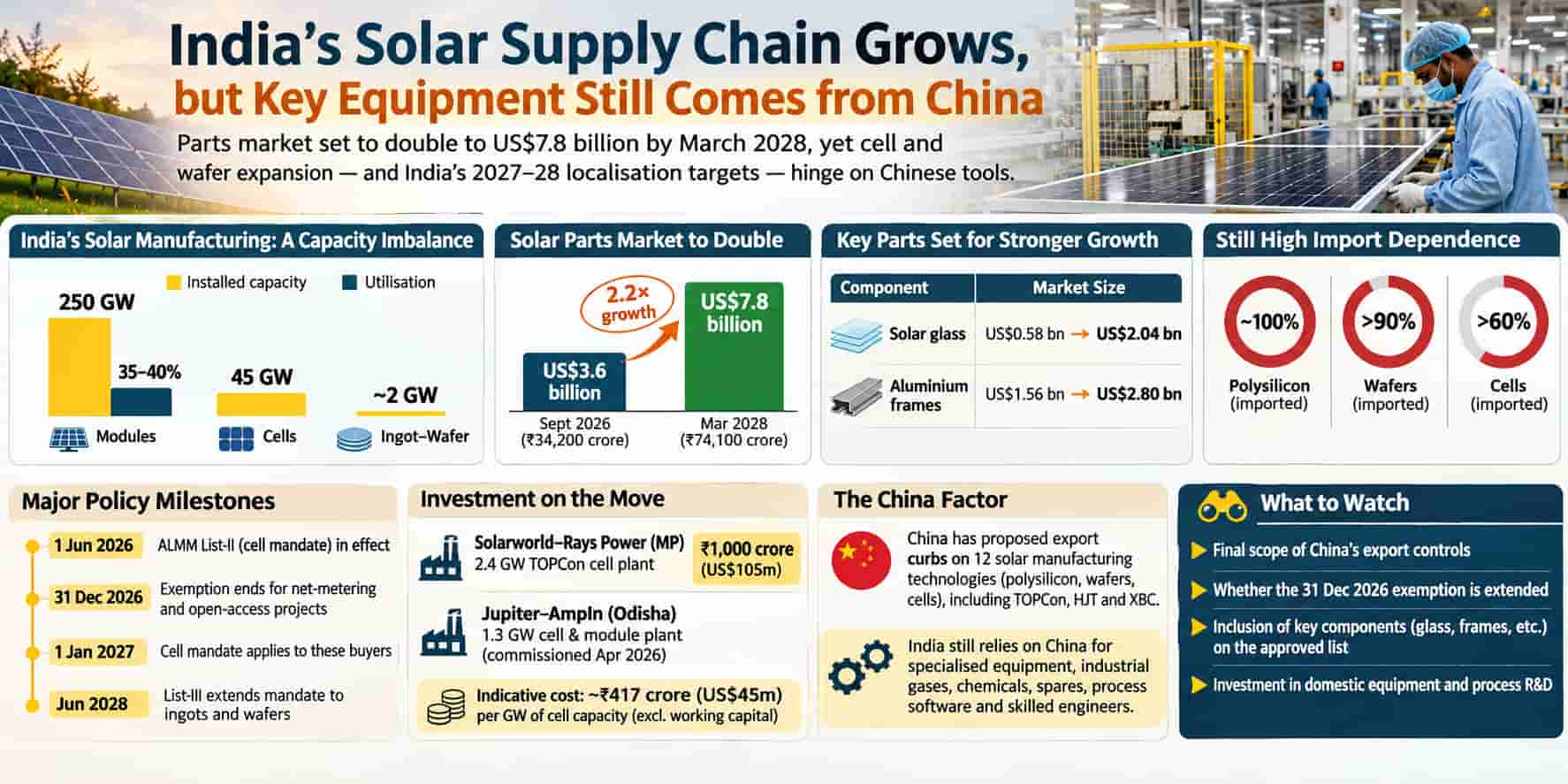
The latest pairing is a 50:50 venture between EPC firm Solarworld Energy Solutions and Rays Power Infra. As per a recent media report, the two will build a 2.4 GW TOPCon cell plant in Madhya Pradesh for about ₹1,000 crore (US$105m). Solarworld has committed up to ₹100 crore (US$11m) in equity and ₹320 crore (US$34m) in project financing. Rays Power will add up to ₹100 crore (US$11m). Solarworld also redirected funds earmarked from its IPO and pre-IPO proceeds for an earlier, smaller 1.2 GW plan.
The numbers give a yardstick. The project costs about ₹417 crore (US$45m) for each GW of cell capacity, before working capital. Other announced plants can be measured against it.
An older partnership works on a different logic. Jupiter International and AmpIn Energy Transition announced a venture in October 2023 for up to 1.3 GW of cell and module capacity in Odisha. The facility was commissioned in April 2026. Jupiter brought factory experience. AmpIn brought a project pipeline that can absorb the output. Both firms are unlisted, so neither could count on public markets.
The pressure comes from a lopsided industry. Module capacity is expected to reach 250 GW by the end of this year, up from 233 GW in June, with utilisation of only 35–40%. Cell capacity was barely 45 GW in October. An independent overcapacity analysis found that module capacity could stay ahead of demand through 2030.
By July, the strain was visible. Nearly a third of India’s 140 small and medium panel makers, which hold about 60% of module capacity, had halted output. The rest had cut production to three or four days a week, an industry body said. The clean energy ministry said it had no formal reports of halts and expected adequate cell capacity within six months. For such firms, a cell partner is less about margins than about getting cells at all.
 The tool problem
The harder question is where the machines come from. On 16 October, China proposed adding 12 solar manufacturing technologies to its export control catalogue, covering polysilicon, wafers and cells. Advanced cell processes such as TOPCon, HJT and XBC would be restricted rather than banned, as per wire reports. The public comment window closed on 15 November, and a temporary pre-export registration took effect when the proposal was announced, according to a market analysis.
Final rules had not been reported at the time of writing this report.
Analysts urge caution. JM Financial warned against assuming that every TOPCon line or technology transfer would be barred. It also noted that India still relies on China for specialised equipment, industrial gases, chemicals, spares, process software and skilled engineers, as per a brokerage note. That list goes well beyond machines. It is know-how.
Reliance’s battery plant is the warning. Equipment worth up to US$1.1 billion has reached Jamnagar, yet commercial production cannot begin without further Chinese technology, a detailed April investigation found. Owning the machines is not the same as owning the process. Indoen has looked at the same upstream gap in batteries.
Trade data show the same drift. Cell imports rose from US$1.85 billion to about US$3 billion between 2023–24 and 2025–26, and a policy-centre study says import dependence has moved up the value chain rather than disappeared. Close to 100% of polysilicon, more than 90% of wafers and over 60% of cells are still imported, as per one industry analysis. India did not escape dependence. It moved it one layer up. Now it is moving again, into the tools.
“A joint venture shares the investment risk. It does not share away the equipment risk,” said an executive at one of India’s mid-sized module makers. “If the line is late, both partners wait.”
A parts market with a hole in the middle
None of this means the parts market is stuck. A CEEW study estimates it could grow 2.2 times, from ₹34,200 crore (US$3.6 billion) in September 2026 to ₹74,100 crore (US$7.8 billion) by March 2028, if factories are commissioned on time and demand holds. India already makes almost every module part except cells.
The study’s annexure shows where the money sits. Solar glass could grow from a US$0.58 billion market to US$2.04 billion. Aluminium frames could grow from US$1.56 billion to US$2.80 billion.
Here is the quieter point. The fastest-growing parts are those China’s proposed curbs do not target. Glass and frames need steady orders, not scarce technology. CEEW wants all six components brought under the approved list, with listings by January 2028 and enforcement from January 2029, according to a report on the study. That would give component makers the demand certainty cell makers already have. Further out, an industry association sees a fully integrated sector attracting US$89 billion by 2047 and supporting 3.23 million jobs, as reported.
When the rulebook meets the supply chain
The cell mandate, ALMM List-II, took effect on 1 June 2026. A limited exemption for net-metering and open-access projects runs until 31 December 2026, so those buyers face the rule from 1 January 2027. Rooftop economics, which Indoen has examined before, will feel it first. The bigger test comes in June 2028, when List-III extends the rule to ingots and wafers. Makers seeking a wafer listing will need equal ingot capacity.
India starts that race far behind. Government data cited earlier showed roughly 2 GW of ingot-wafer capacity, against about 172 GW of listed module capacity and 27 GW of cells, as per recent reporting. Localisation also costs money. One estimate puts the added procurement cost of Lists I and II at ₹32,500–37,900 crore (US$3.5–4.1 billion) in FY2026–27.
Policy now pulls two ways. The rule exists to reduce dependence. But if Chinese equipment becomes harder to get, cell prices could rise. JM Financial notes the government may then relax List-II beyond December. A mandate written to build resilience may have to bend because resilience has not yet been built.
Timing adds a twist. Developers commissioned 34 GW in the first half of 2026, 38% more than a year earlier, racing the June deadline, a consultancy estimate shows. Some of 2027’s demand may already have been used up. An earlier rating agency estimate expected cell capacity to reach about 100 GW by December 2027, against annual solar additions of 45–50 GW. Plants started now may reach the market in 2028, when the cell shortage could have turned into a glut. The original report on the Solarworld deal even suggests that firms planning cell plants for 2028 should relook their plans.
Yet it would be premature to say only giants will survive. Specialist firms with technology partners and reliable domestic inputs may still find room. “India has shown it can build scale,” said a researcher at a New Delhi-based energy think tank. “The next test is owning the process knowledge behind that scale. Capacity numbers alone do not show that.”
What to watch
Four markers will tell the story. First, whether China’s final catalogue restricts or bans the cell tools. Second, whether the 31 December exemption is extended. Third, whether component makers win a place on the approved list. Fourth, whether India invests in its own machines and process research, as recent industry commentary has urged. Some firms are also going ahead with plans of their own, such as Jakson Solar, whose plan Indoen has covered.
The partnerships are a sensible first response. But the real contest is not between big and small. It is between those who can secure tools and know-how and those who cannot. A solar industry built on imported machines has moved its import bill, not removed it.