
For much of the past two years, the dominant story about India’s electric vehicle transition has been a story about dependency. Batteries are imported, cell manufacturing is a decade or more away from scale, and critical minerals sit largely outside Indian control.
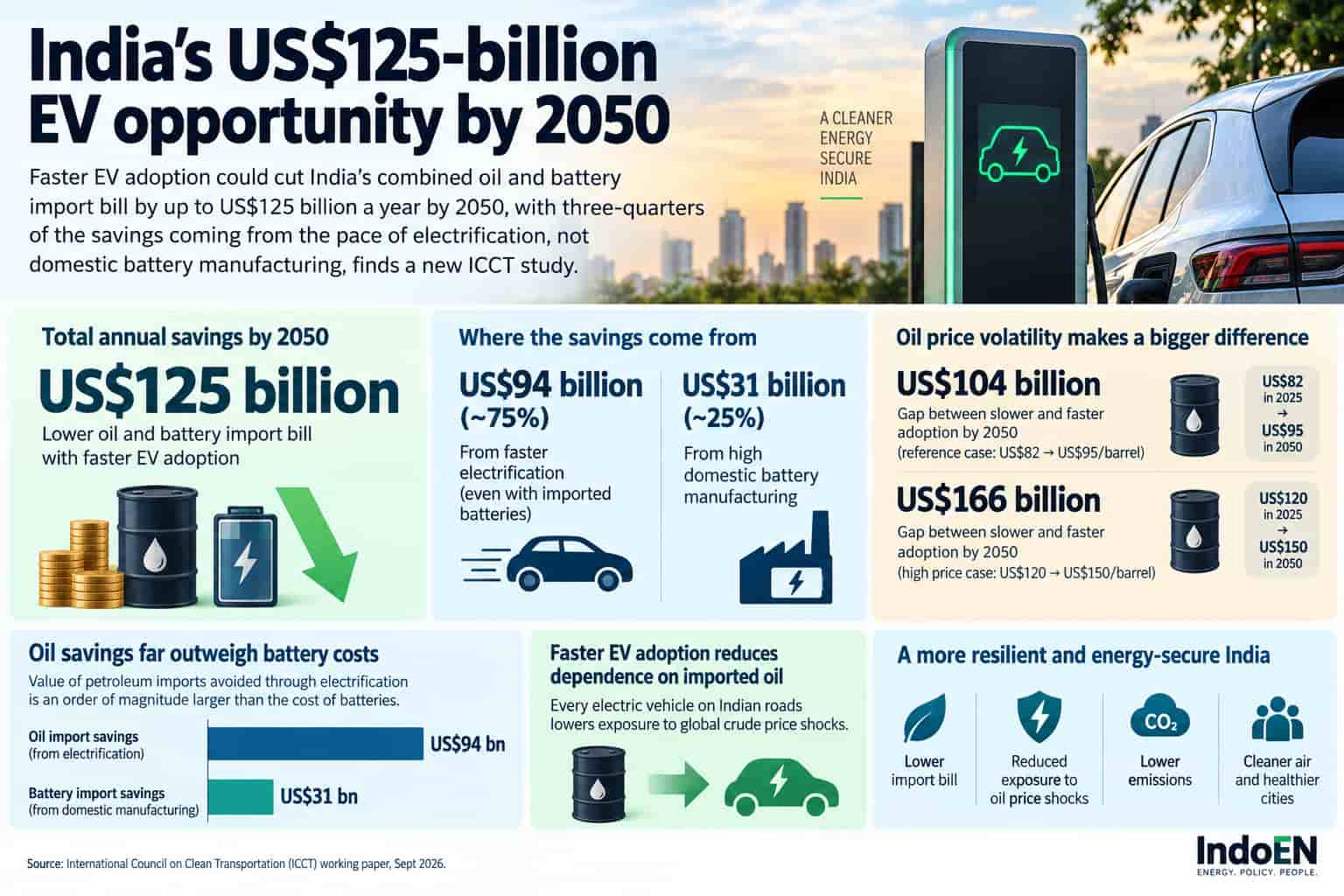
That framing is not wrong. But a new working paper from the International Council on Clean Transportation (ICCT) adds a number to the conversation that shifts its emphasis considerably: India could reduce its combined annual oil and battery import bill by as much as US$125 billion by 2050 through faster electrification of two-wheelers, three-wheelers, cars, buses and trucks, according to a recent report.
The detail worth sitting with is how that saving splits.
Roughly US$94 billion of it, about three-quarters, comes purely from accelerating the pace of electrification, even if India continues importing every battery cell it needs. Only around US$31 billion comes from moving to high domestic battery manufacturing. The underlying ICCT working paper attributes this to a simple asymmetry: the value of petroleum imports avoided through electrification is an order of magnitude larger than the cost of the batteries themselves, imported or not.
That is a meaningfully different emphasis from where India’s EV policy conversation has generally sat, including in earlier coverage of the country’s 260-GWh battery build-out, which found domestic cell manufacturing remains ten to fifteen years from meaningful scale. The ICCT numbers do not dispute that gap. They argue it matters less than assumed, at least for the immediate economics of the transition.
Oil price volatility raises the stakes further
The gap between India’s slower and faster adoption pathways is not fixed; it widens or narrows with the price of crude. Under ICCT’s reference oil price case, rising gradually from US$82 a barrel in 2025 to US$95 by 2050, the difference between a baseline and an ambitious electrification scenario is US$104 billion in 2050.
Under a high oil price case, assuming prices climb from US$120 to US$150 a barrel over the same period, that gap widens to US$166 billion. A slower transition, in other words, does not simply cost India less oil savings; it leaves a larger share of road transport directly exposed to whatever happens in global crude markets.
This is not an India-specific phenomenon. According to a media report, energy consultancy Wood Mackenzie’s modelling of an “electric shock” scenario finds that persistently high fuel prices could leave EV fleets in major markets more than 50% larger than currently forecast by 2040, with global oil demand roughly flat versus today rather than rising.
The mechanism is the same one at work in the ICCT numbers: oil price shocks make electrification an energy security hedge, not merely an industrial policy choice.
“Every electric vehicle India puts on the road reduces its dependence on imported oil, whether the batteries are manufactured domestically or imported,” said Namita Singh, an ICCT researcher and co-author of the study, in comments carried alongside the report’s release. A second co-author, Sumati Kohli, added that with oil savings “far exceeding the cost of battery imports,” EVs could meaningfully reduce India’s exposure to volatile global prices, even before domestic battery manufacturing strengthens that benefit further.
 Charging infrastructure, not cell factories, becomes the binding constraint
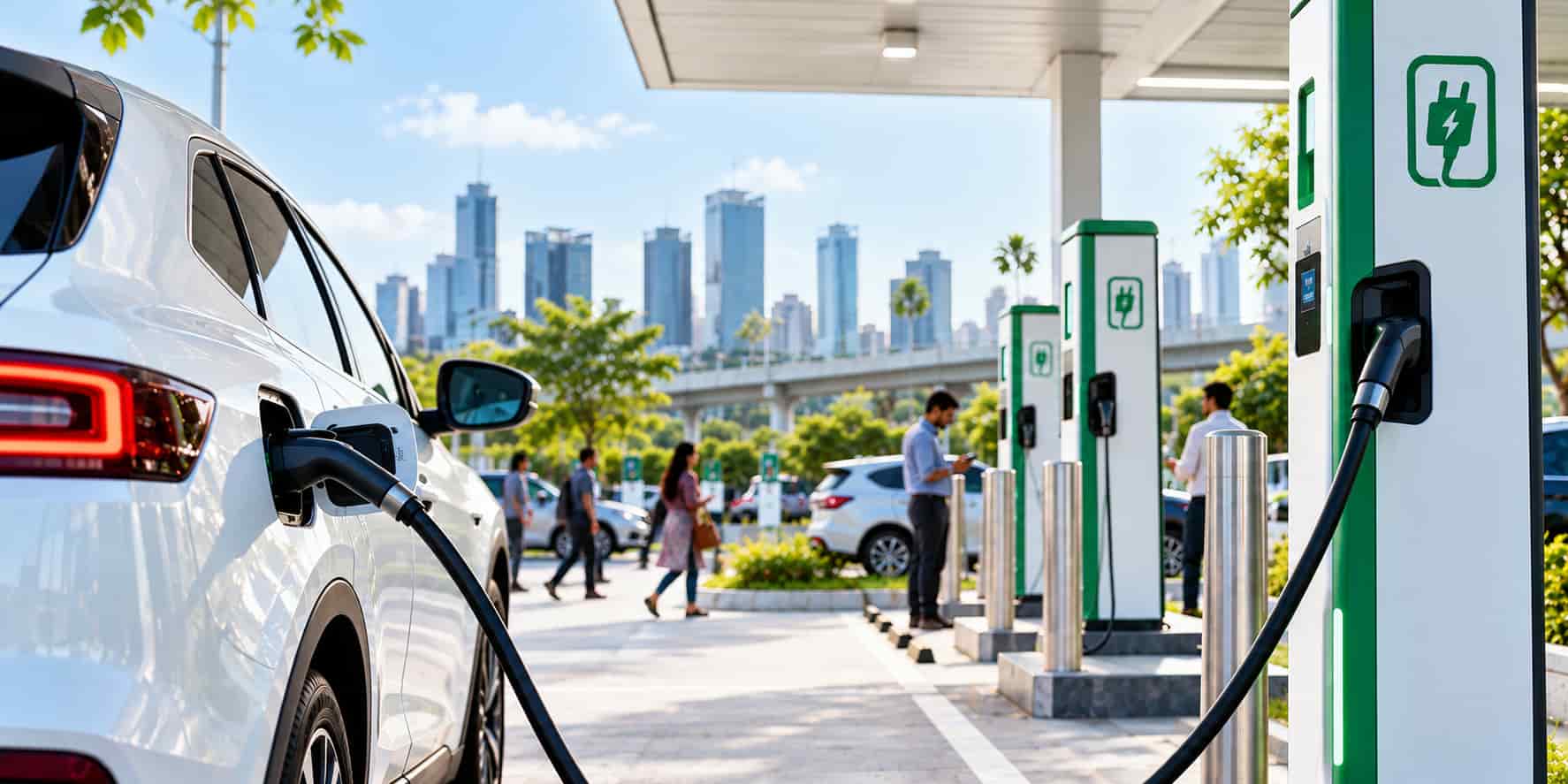
If speed of adoption is the dominant lever, the more urgent bottleneck shifts from gigafactories to the physical infrastructure needed to keep that many vehicles charged. India’s battery electric vehicle fleet has grown by 57% annually since 2020, and the country is approaching a parc of 10 million BEVs, according to an industry analysis by NRI Consulting & Solutions India. Two- and three-wheelers still account for roughly 93% of that fleet, and their small battery packs charge comfortably off domestic AC connections. The harder problem lies further up the vehicle chain.
A single 10-bay heavy truck charging station, the same analysis notes, requires a peak power supply of 2.4 to 5.0 megawatts, roughly the electrical consumption of a 500-home residential society. That is not a manufacturing constraint at all; it is a grid and distribution-company planning constraint, and one that scales with every freight corridor India electrifies. Passenger vehicle charging carries its own version of the same problem: nearly 70% of India’s public chargers remain AC rather than DC, limiting charging speed even as India’s EV-to-charger ratio looks favourable on paper.
“Deploying high-capacity DC charging requires heavy upfront capital, and without sustained utilisation, commercial viability stays difficult,” said an executive at one of India’s leading electric-vehicle charging infrastructure developers. “The economics only work once vehicle density on a corridor reaches a certain threshold, and getting there faster is now as much a grid-planning exercise as a vehicle-sales one.”
Government spending reflects some of this shift already. The PM E-DRIVE scheme has allocated ₹2,000 crore (US$210 million) specifically towards charging infrastructure across urban corridors and freight routes, on top of the 9,594 public charging stations installed earlier under FAME-I and FAME-II.
Buses show what the transition looks like when it works
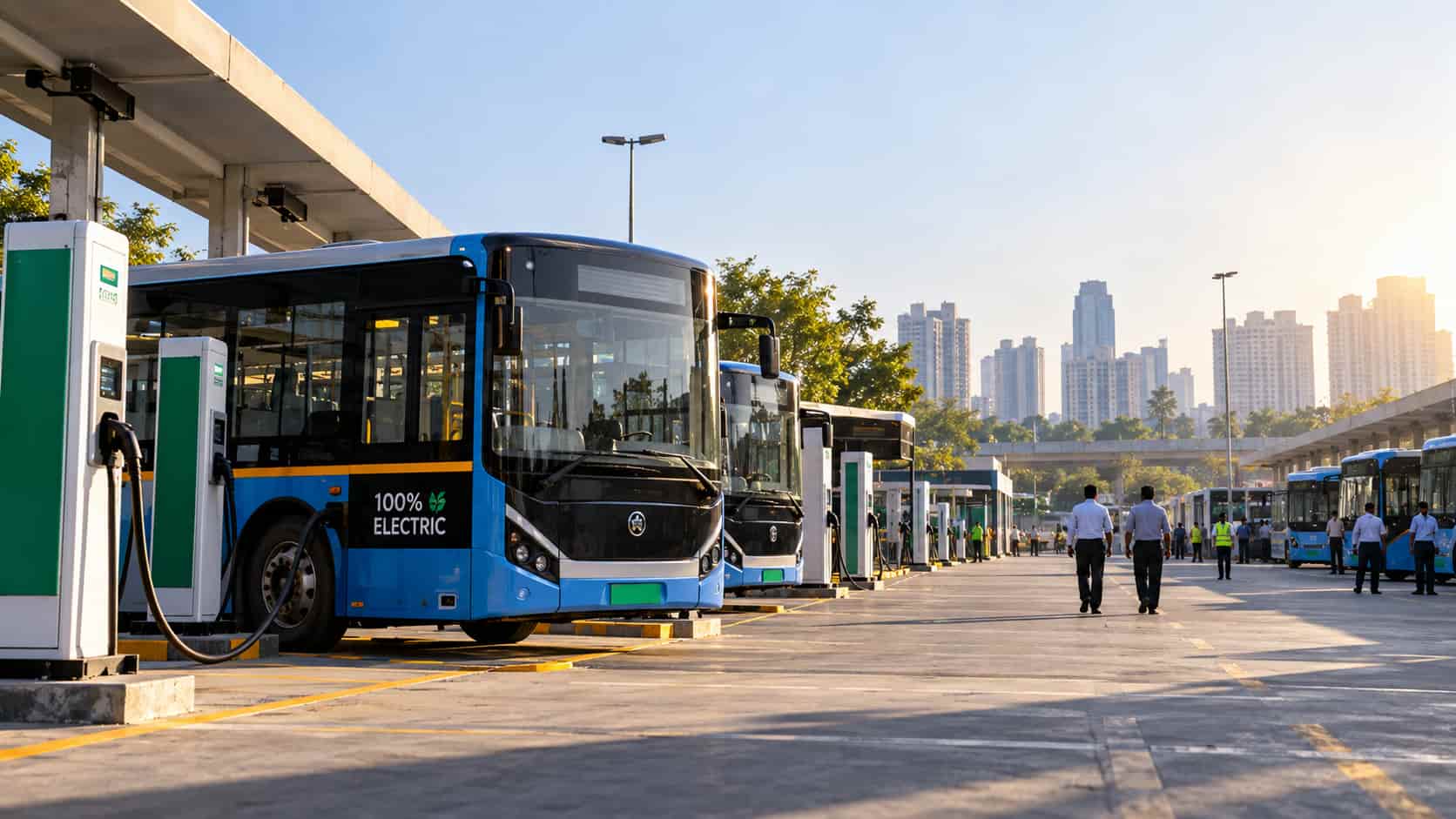
Nowhere is the tension between economics and execution clearer than in India’s electric bus rollout. A single city bus replaces 40 to 50 passenger cars while carrying hundreds of commuters daily, according to an industry account from Olectra Greentech.
India now operates over 19,000 electric buses, still only around 5% of annual bus sales, though industry estimates suggest that could exceed 50% by 2035. The PM eBus Sewa Payment Security Mechanism, layered atop the original PM eBus Sewa scheme’s ₹57,613 crore (US$6.1 billion) outlay, of which ₹20,000 crore (US$2.1 billion) is central support, is expected to help deploy over 38,000 more electric buses between FY25 and FY29 by giving transport authorities financial confidence to commit.
Yet the same sector shows how fragile that momentum can be to policy inconsistency.
In West Bengal, a recent account of the state’s e-mobility transition found that electric bus deployment stalled for years, adding barely 40 buses since an initial 2019 rollout of 80, even as market forces pushed electric rickshaws and personal electric cars ahead sharply on their own. EV registrations in Bengal reached 9.8% penetration, above the national average, almost entirely without state incentive.
“It’s a fact. Because of market forces, many autos have now started to shift to electrical mode,” a local transport expert observed in the report, noting nearly 20% of the conventional auto fleet in parts of Kolkata has already gone electric.
“A supportive charging ecosystem and predictable procurement pipeline matter more to bus operators than the underlying subsidy amount,” said a policy adviser familiar with state transport electrification programmes. “Where states have delayed tenders or switched technology mid-course, as happened with Bengal’s flirtation with CNG buses, the private capital that was ready to move simply waits elsewhere.”
What this means for the transition’s next phase
None of this diminishes the case for battery localisation. Reducing cell imports still saves India tens of billions of dollars annually under ICCT’s own numbers, strengthens supply chain resilience, and, as Indoen Energy has reported, positions India’s automotive sector for export markets rather than just import substitution.
Tata Motors’ Sushant Naik, chairman of the SIAM Electric Mobility Group, has argued that India’s auto industry has already brought imports down by around ₹20,000 crore (US$2.1 billion) through domestic manufacturing for the home market, and that the next phase should extend localisation across the value chain rather than final assembly alone.
But the ICCT arithmetic suggests India’s policy energy may be weighted towards the wrong lever. If three-quarters of the available savings come from how fast India electrifies rather than how much of the battery supply chain it controls, then grid readiness, charging corridor planning, DISCOM load forecasting and consistent state-level procurement, the unglamorous plumbing of the transition, deserve at least as much policy attention as the next cell gigafactory announcement.
West Bengal’s stalled bus programme, running alongside a thriving informal e-rickshaw market, is a small but telling preview of what happens when that plumbing lags behind consumer appetite.
Follow us on : X | LinkedIn | Facebook | Bluesky