

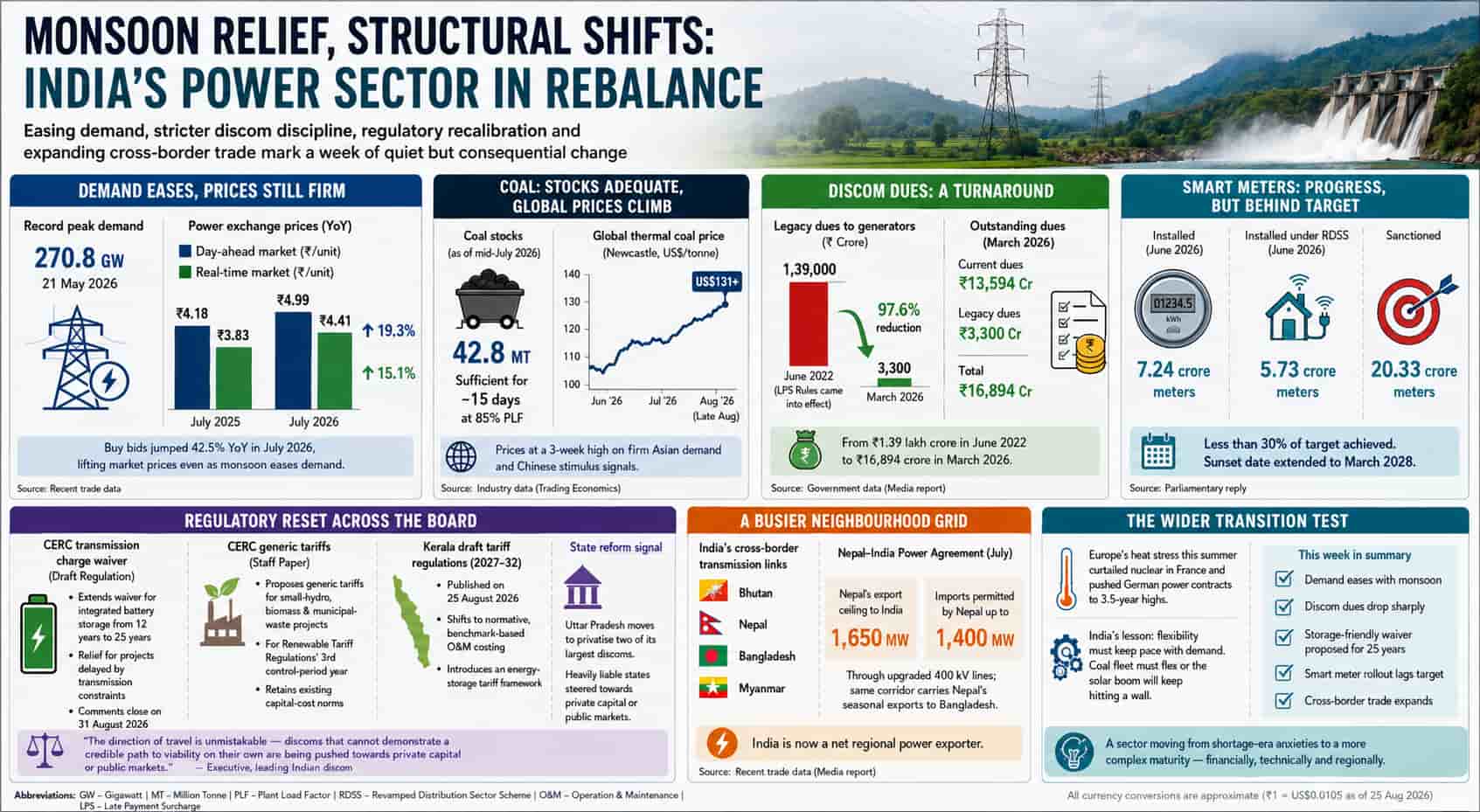
India’s power system has stepped back from the extraordinary highs of early summer, when national peak demand touched a record 270.8 GW on 21 May 2026, met through a mix of thermal, hydro, nuclear and renewable capacity. With the monsoon now established, cooling load has eased and several agricultural feeders have shifted to canal-fed irrigation, taking pressure off both demand and the exchange.
Even so, the underlying price trend through the year has run firmer than usual. The average day-ahead market clearing price rose 19.3% year-on-year to ₹4.99 (USUS$0.052) a unit in July 2026, as buy bids jumped 42.5%, as per recent trade data.
The real-time market moved similarly, up 15.1% to ₹4.41 (USUS$0.046) a unit. Even with monsoon rainfall typically depressing August prices, this year’s base sits well above last year’s, suggesting India’s demand curve has structurally shifted upward and exchange liquidity is no longer a reliable seasonal-comfort signal.
Coal remains the backbone, with roughly 230.8 GW of thermal capacity supplying nearly 70% of electricity between April and June, and stocks of 42.8 million tonnes as of mid-July sufficient for about a fortnight at 85% plant load factor. Globally, thermal coal moved the other way, climbing above US$131 a tonne in late August, its highest in three weeks, on firm Asian demand and Chinese stimulus signals, industry data shows. For India, a heavy net coal importer for blending, a sustained rally raises landed fuel costs for coastal gencos just as monsoon output eases pressure on domestic linkage coal.
“Coal availability at the plant level remains comfortable for now, but a prolonged rally in seaborne prices changes the blending economics for coastal plants quite quickly,” said a senior official at a central power sector agency.
 Discom finances: the arithmetic finally moves
The week’s most striking structural development concerns discom payment discipline. Legacy dues to generators have fallen to ₹3,300 crore (USUS$345 million) as of March 2026, down from ₹1.39 lakh crore (USUS$14.5 billion) in June 2022, when the Late Payment Surcharge Rules took effect. Current dues stood at ₹13,594 crore (USUS$1.4 billion), taking total outstanding dues to ₹16,894 crore (USUS$1.8 billion), according to a media report. That is a turnaround few expected three years ago, though the underlying ACS-ARR gap and delayed state subsidy releases have not disappeared.
Smart metering continues its slower climb: 7.24 crore meters installed nationally as of June 2026, 5.73 crore of them under the Revamped Distribution Sector Scheme, against 20.33 crore sanctioned, per a parliamentary reply — under 30% of target, with the sunset date already pushed to March 2028. This links to Indoen Energy’s earlier coverage of how India’s power grid has stopped being a pipe and is becoming a queue as congestion, not generation, becomes the binding constraint.
Regulators recalibrate, right down to the deadline
The Central Electricity Regulatory Commission’s most consequential move this week is a draft regulation revising inter-state transmission charge waivers for renewable, battery storage and pumped-storage projects, proposing to extend the waiver period for integrated battery systems from 12 years to 25 years and adding relief for projects delayed by transmission-infrastructure constraints.
Stakeholder comments close on 31 August 2026, industry data shows — the very date this analysis is filed. A near-doubling of the waiver window materially improves storage-project economics, a direct nudge toward the round-the-clock renewable contracts India’s grid increasingly needs.
Separately, CERC issued a staff paper proposing generic tariffs for small-hydro, biomass and municipal-waste projects for the renewable tariff regulations’ third control-period year, retaining existing capital-cost norms, industry data shows.
At the state level, Kerala’s regulator published draft tariff regulations for 2027–32 on 25 August, shifting from flat-escalation to normative, benchmark-based O&M costing and introducing an energy-storage tariff framework, according to a media report.
Meanwhile, Uttar Pradesh’s move to privatise two of its largest discoms signals that states with the heaviest liabilities are increasingly being steered towards private capital or public listing rather than repeated bailouts.
“The direction of travel is unmistakable — discoms that cannot demonstrate a credible path to viability on their own are being pushed towards private capital or public markets,” said an executive at a leading Indian discom.
A busier neighbourhood grid
Cross-border trade expanded further this week. India now maintains transmission links with Bhutan, Nepal, Bangladesh and Myanmar, making it a net regional power exporter, as per recent trade data. Under a July agreement, Nepal’s export ceiling to India rose to 1,650 MW, with imports permitted up to 1,400 MW through upgraded 400 kV lines, the same corridor that carries Nepal’s seasonal exports onward to Bangladesh.
The wider transition test
None of this week’s developments is dramatic alone, but together they show a sector maturing past shortage-era anxieties into more complex problems: financial discipline that must be sustained, a metering rollout that is technically sound but socially contested, and a regulator trying to keep pace with storage and flexibility all at once.
Europe’s continuing heat-driven grid stress this summer, which forced nuclear curtailments in France and pushed German power contracts to 3.5-year highs, is a reminder of what happens when flexibility lags demand growth — a caution India’s own coal-flexibilisation debate, covered in Indoen’s earlier analysis of why India’s coal fleet must learn to flex or its solar boom will keep hitting a wall, would do well to heed.
Follow us on : X | LinkedIn | Facebook | Bluesky