
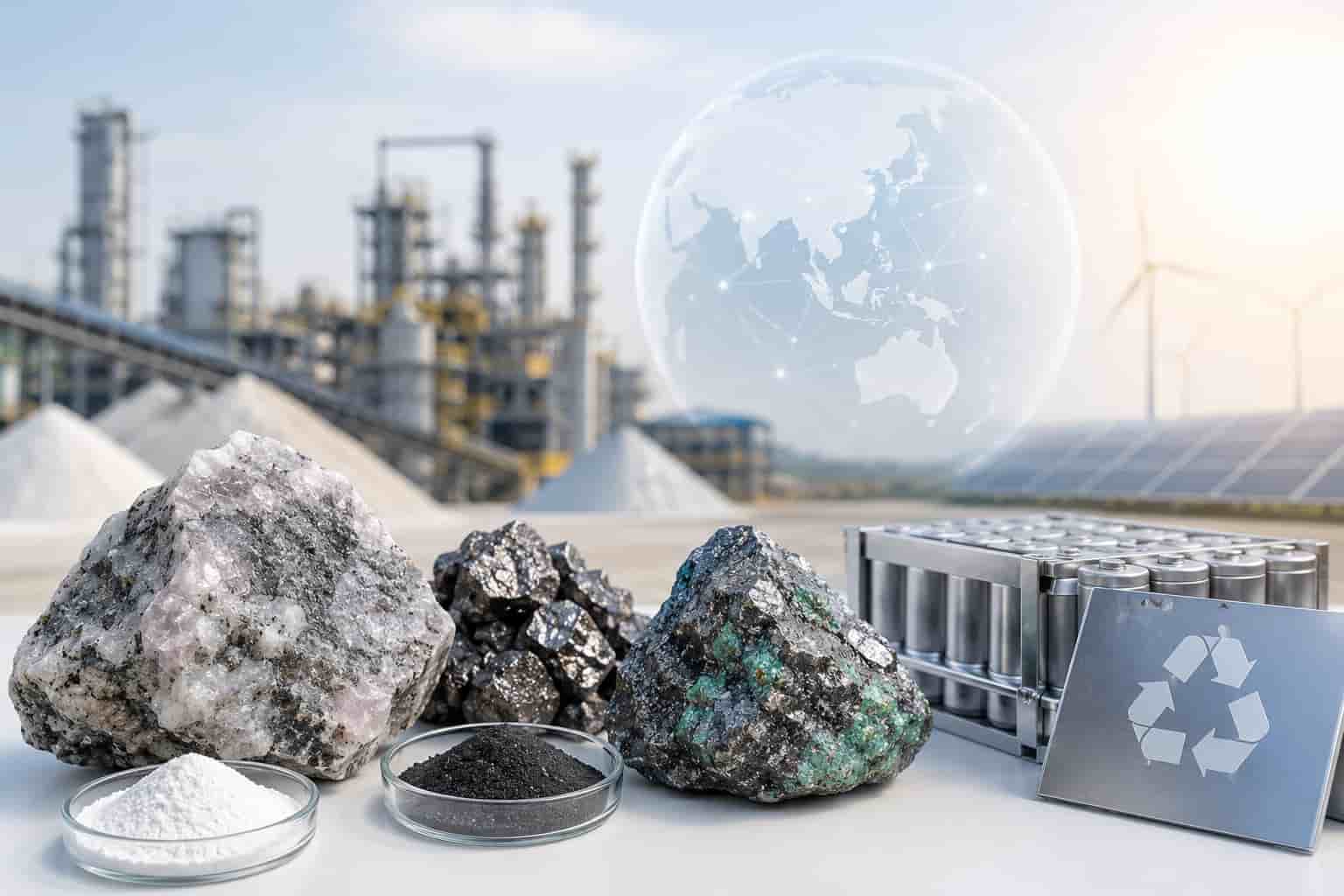

India’s $330-m lithium and nickel processing push signals a shift from resource security to industrial capability
India is preparing to launch an incentive programme worth roughly ₹30 billion ($313 million) to encourage domestic processing of lithium and nickel, two minerals that sit at the heart of battery manufacturing and the broader clean-energy supply chain.
While India has already moved aggressively into critical mineral exploration and overseas resource acquisition, the proposed scheme indicates a strategic shift towards building refining and processing capabilities within the country.
The significance extends well beyond mining. Globally, the most valuable segments of the battery supply chain lie in processing, refining and materials manufacturing rather than extraction alone.
China’s dominance in critical mineral processing has become a major geopolitical concern for governments seeking greater supply-chain resilience. By incentivising domestic processing, India appears to be targeting a critical weakness in its energy-transition ecosystem.
The move also aligns with a broader industrial-policy pattern visible across electronics, advanced manufacturing, EVs and clean-energy technologies. If implemented effectively, the scheme could help attract downstream battery investments, reduce import dependence and strengthen India's position in emerging energy-transition value chains.
The challenge, however, will be achieving scale and competitiveness against established global processors, particularly in China.
Inox’s $95-m Vena acquisition signals a new consolidation phase in India’s renewable-energy market
Inox Clean Energy’s proposed acquisition of Vena Energy India’s roughly 1.6 GW operational renewable portfolio and a development pipeline that reportedly takes the platform to around 6 GW represents far more than a large clean-energy transaction.
The deal, valued at approximately ₹6,000 crore (US$95 million), reflects the growing appetite among Indian energy groups to acquire operating renewable assets rather than build portfolios entirely from scratch. As project pipelines become larger and financing conditions tighten, scale is increasingly becoming a competitive advantage in renewable power development.
The transaction also highlights a broader shift in ownership patterns across India's clean-energy sector. International investors that entered the market during the early growth phase are increasingly monetising mature assets, while domestic industrial groups are emerging as long-term infrastructure owners.
Such transactions allow developers to secure operational cash-generating assets while gaining access to future project pipelines, transmission connectivity and land banks that have become increasingly valuable in a competitive market.
For India's energy transition, the significance lies in the increasing financial sophistication of the renewable sector. The next phase of growth is likely to be driven not only by project construction but also by mergers, acquisitions and portfolio optimisation.
As India seeks to rapidly expand renewable capacity to support rising electricity demand and decarbonisation goals, large-scale asset consolidation could become a defining feature of the market's evolution.
Suzlon’s 70 GW ambition reflects the emergence of integrated renewable-energy platforms
Suzlon has unveiled its “Suzlon 2.0” strategy, targeting 10 GW of annual renewable-energy sales, 70 GW of assets under management and a 15 GW order book by FY31.
More significant than the capacity targets themselves is the company’s decision to expand beyond its traditional wind-turbine business into solar, battery energy storage systems (BESS), project development and renewable asset management.
The announcement reflects a broader structural shift occurring across global renewable-energy markets. As renewable penetration rises, value creation is increasingly moving away from equipment manufacturing alone towards integrated platforms that combine generation, storage, project execution and long-term asset management. Stable recurring revenues from managed assets are becoming as important as equipment sales.
For India, the development is noteworthy because it illustrates how domestic renewable-energy companies are adapting to an increasingly complex electricity system where dispatchability, storage and lifecycle asset performance matter as much as capacity additions. Suzlon’s entry into solar and BESS suggests that future competition may revolve around integrated energy-delivery capabilities rather than individual technologies.
$105-million funding for Indian hydrogen developer points to growing investor confidence in industrial decarbonisation
Indian green hydrogen developer Hygenco's successful raising of US$105 million from new investors is a notable signal that capital is beginning to flow beyond renewable power generation into harder-to-abate industrial sectors.
While green hydrogen remains commercially challenging, investors appear increasingly willing to back developers that can demonstrate viable industrial demand, particularly from sectors such as steel, refining and chemicals where direct electrification is difficult.
The funding round arrives at a critical moment for India's hydrogen ambitions. The country has established an ambitious policy framework through the National Green Hydrogen Mission, but the success of the sector ultimately depends on attracting substantial private capital.
Early-stage financing remains one of the biggest constraints for hydrogen projects because of high production costs, uncertain offtake arrangements and evolving global market standards. Capital injections of this scale therefore provide an important test of investor appetite for emerging clean-energy technologies.
More broadly, the deal reflects a shift in energy-transition finance from relatively mature sectors such as solar and wind towards industrial decarbonisation technologies. If replicated at scale, such investments could help position India not merely as a consumer of green hydrogen but as a potential manufacturing and export hub in a future low-carbon industrial economy.
The pace at which private capital continues to support hydrogen developers may become one of the most important indicators of whether India's hydrogen ambitions move from policy vision to industrial reality.