
For much of the past decade, India's solar planners have treated land as a zero-sum contest with agriculture — every hectare given to a solar park was assumed to be a hectare taken from a farmer. A new assessment from The Energy and Resources Institute (TERI) upends that assumption.
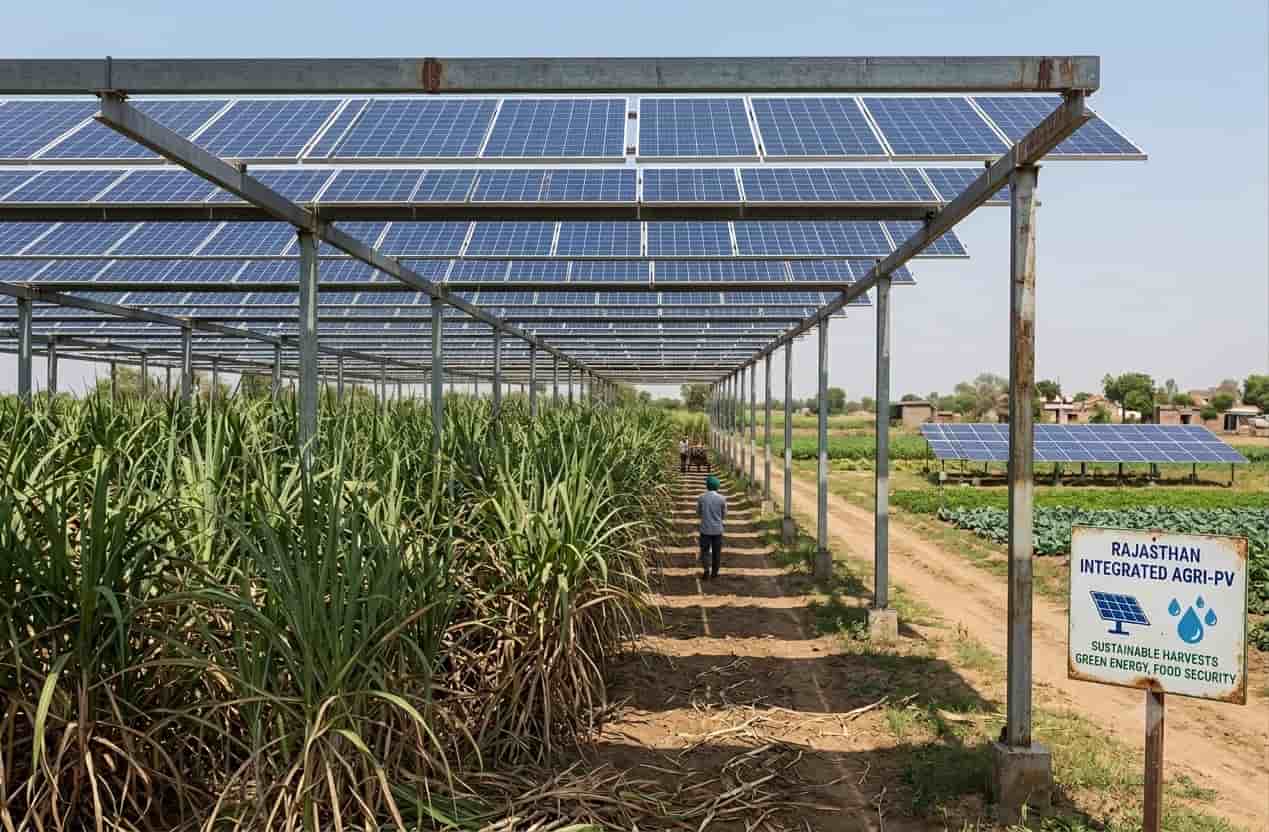
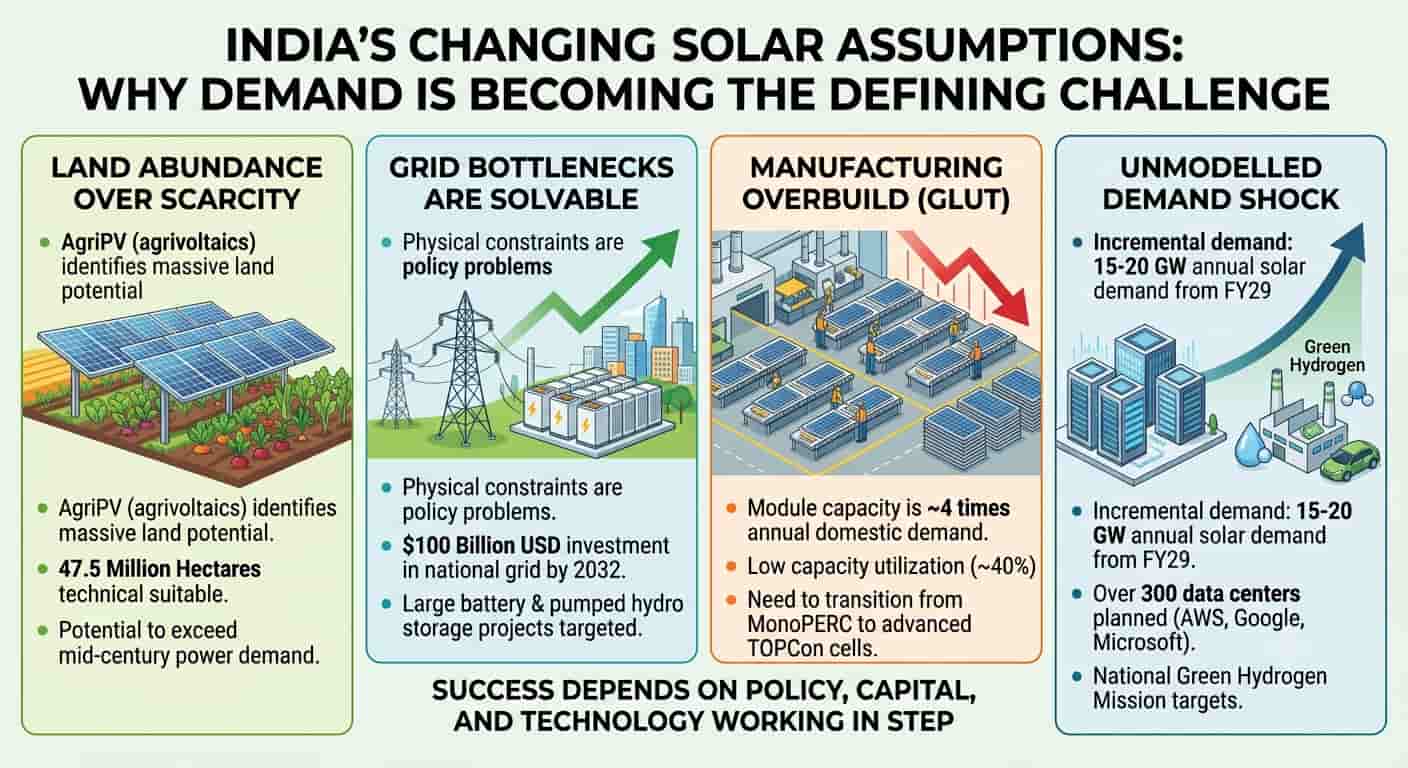
Using a national geospatial screening model that excluded flood-prone and steeply sloped terrain, the institute identified 47.5 million hectares of India's 160 million hectares of cropland as technically suitable for agrivoltaic (AgriPV) deployment — panels mounted above active farmland.
Rather than land scarcity, the report found that system integration, grid expansion and financing will determine how fast such deployment can scale, since the country's technically deployable land far exceeds its projected mid-century electricity demand.
The scale of the finding is striking. Cropland alone, in TERI's high-potential scenario, could generate roughly 12,775 terawatt-hours of solar electricity a year from around 8,000 GW of installed capacity — enough, on its own, to meet India's projected 2050 electricity demand. Combine cropland with grazing land, rooftops and floating solar, and the theoretical ceiling rises to nearly 27,000 TWh.
Against that backdrop, India's current installed solar base of roughly 157 GW looks less like a ceiling and more like the starting point of a much larger expansion.
 What makes the finding more than an academic curiosity is its effect on farm incomes. Pilot data cited in the report showed leafy vegetables and fruits grown under AgriPV panels recording yield gains of 10–20%, alongside water savings of around 30%; wheat yields fell, but higher realised market prices and quality gains offset the loss.
Rice paddies remain a harder case, requiring further design work.
“For a very long time, the debate around solar land use in India has been framed as farmers versus developers,” said a researcher at a New Delhi-based energy think tank. “What this data suggests is that, for a meaningful subset of crops, the framing was wrong — the panel and the plant can share the same acre productively.”
Why the grid story has become a distraction
None of this means India's grid challenges have disappeared — only that they are not the constraint they are often described as.
India added a record 44.6 GW of solar capacity in the 2025–26 financial year, nearly double the previous year's addition, taking installed capacity to around 157 GW and making the country the world's second-largest solar market after China.
Roughly 40% of solar output produced in western desert regions has struggled to reach demand centres because of inadequate transmission, leaving developers such as Adani, NTPC and JSW curtailing output at peak hours to protect grid stability.
New Delhi's response has been to spend its way out of the bottleneck rather than slow deployment: a programme worth roughly US$100 billion is under way to expand the national transmission grid by about 30% by 2032, alongside large battery storage projects — including a 5,000-MW system in Rajasthan — and more than 100 GW of pumped hydro storage targeted by 2047.
This is a well-rehearsed story on Indoen Energy (see our earlier coverage of India's US$95-billion grid challenge), and the spending numbers keep climbing. What is less rehearsed is the recognition, implicit in the TERI findings, that grid and financing constraints are policy problems with known solutions, not physical scarcities — a materially different kind of risk for investors to price.
The manufacturing glut nobody wanted
If land and grid are less binding than assumed, India’s domestic manufacturing base is where the real stress has concentrated — and the numbers are stark.
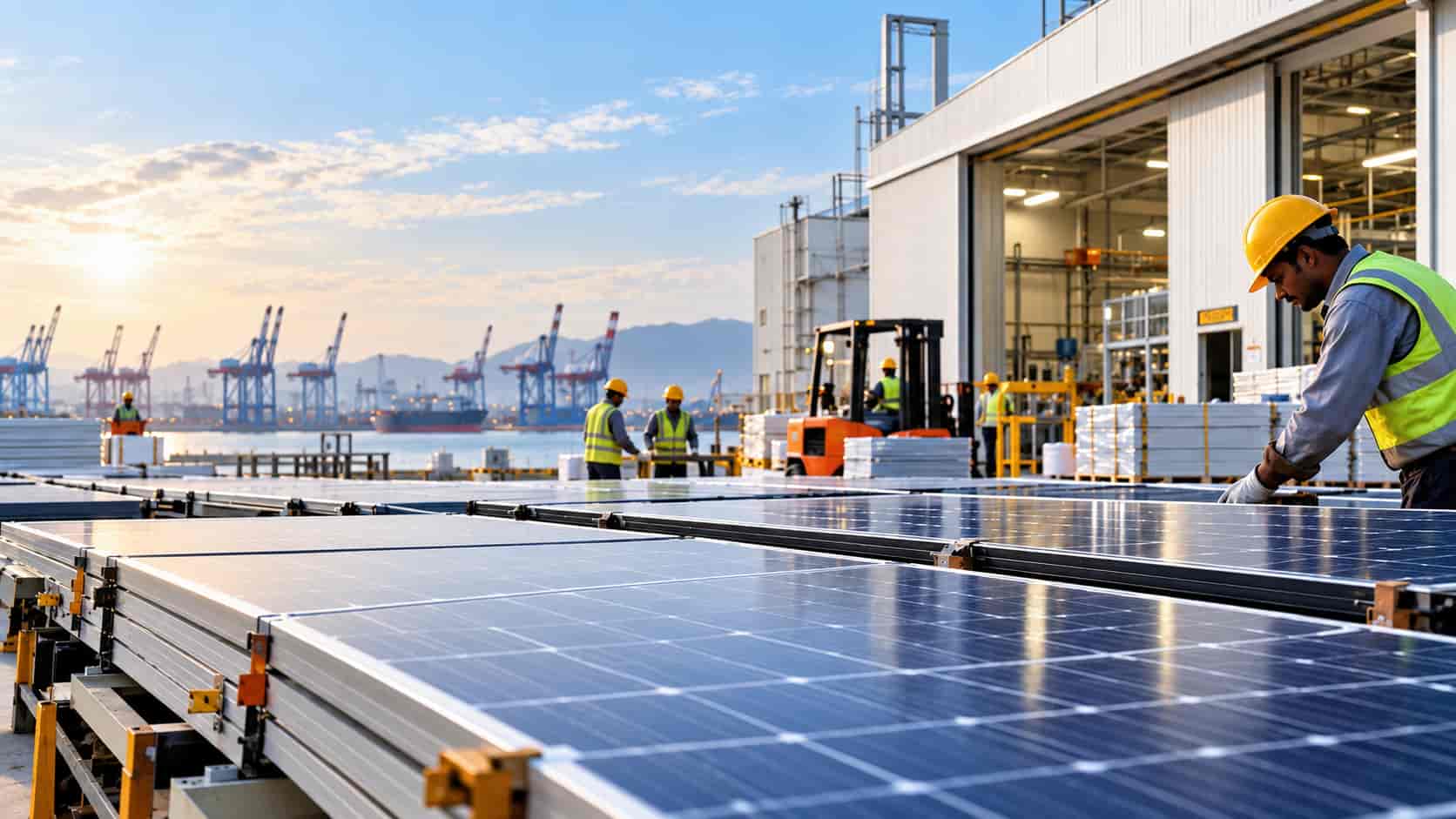
The country added 119 GW of solar module capacity and more than 9 GW of cell capacity in 2025 alone, taking total module capacity to roughly 210 GW and cell capacity to 27 GW. Domestic demand, by contrast, runs at only 40–45 GW annually.
Industry bodies estimate that India's module manufacturing base has expanded to nearly four times annual demand, and capacity utilisation at module assembly plants has fallen to around 40%, down from more than 70% in 2022–23 when export demand from the United States was strong.
“The emerging oversupply is beginning to reshape industry dynamics and competitive positioning,” an executive at one of India’s leading renewable energy developers said, reflecting the strain rippling through the supply chain. “Firms with next-generation technology and vertical integration will get through this phase; those still running older module lines are the ones facing real margin pressure.”
Nearly 30 GW of existing capacity remains dependent on ageing MonoPERC technology, which is being rapidly displaced by more efficient TOPCon cells — a transition that will decide which manufacturers survive the shakeout as much as demand growth will.
Layered on top of the manufacturing glut is a geographic one.
 Seven states account for roughly 85% of India’s installed solar capacity, with Rajasthan and Gujarat holding the top two ranks for a decade running, while early leaders such as Tamil Nadu, Andhra Pradesh and Madhya Pradesh have slipped in relative share — a pattern experts attribute to land-acquisition friction and grid-evacuation constraints in the laggard states rather than any lack of solar resource.
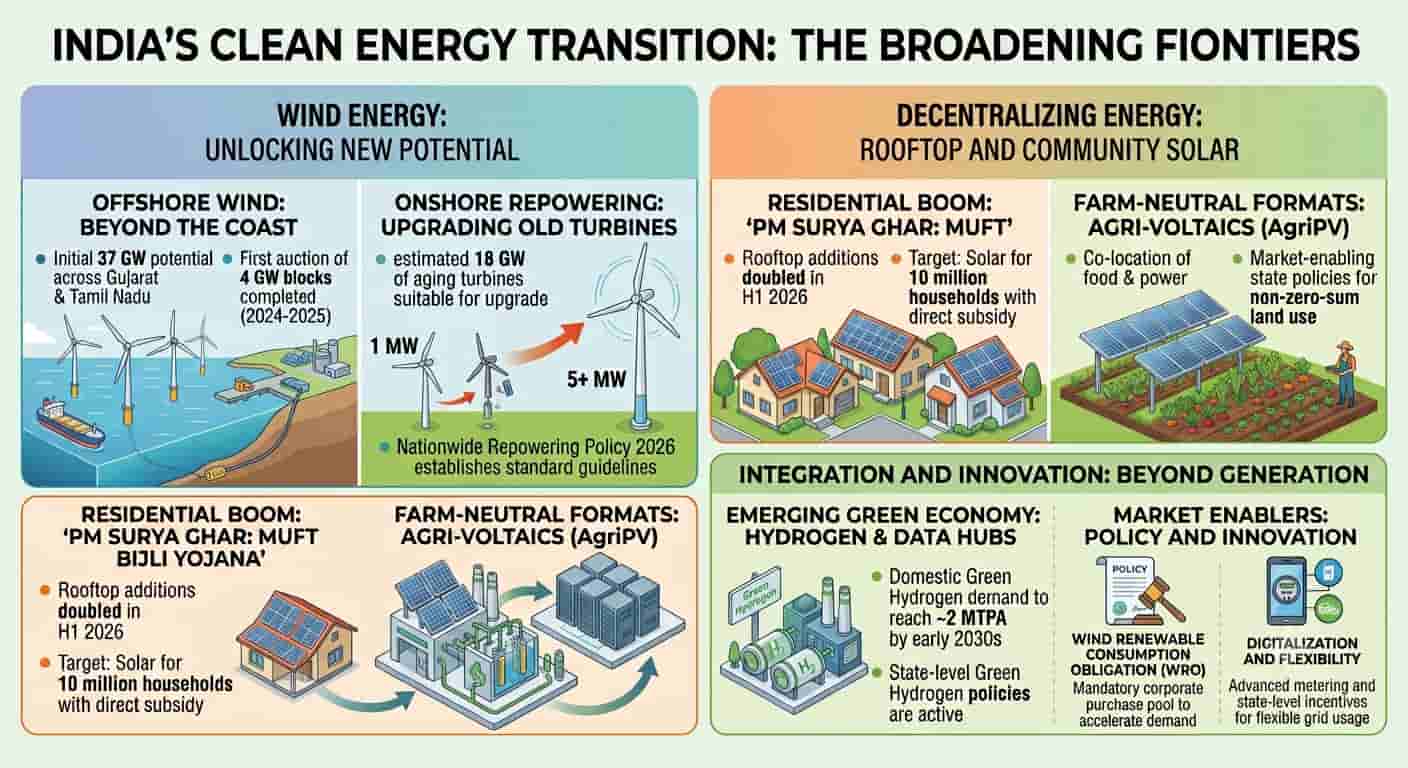
Addressing this, analysts argue, will require state-level land banks, faster transmission planning, and incentives for land-neutral formats such as floating solar and AgriPV, rather than forcing utility-scale projects into locations with weaker fundamentals.
The demand shock nobody has modelled yet
The most underappreciated variable in India’s solar arithmetic may be demand itself.
A report from Equirus Securities argues that data centres, green hydrogen production and round-the-clock (RTC) power commitments could add an incremental 15–20 GW of annual solar demand from FY29 — demand that current government and analyst forecasts do not yet capture. On that basis, annual installations could rise from around 50 GW in FY27 to nearly 85 GW by FY30.
The scale behind that projection is easy to underestimate. More than 300 data centre projects are reportedly planned across India, with commitments from AWS, Microsoft and Google; each 100-MW data centre, by Equirus's estimate, would require roughly 250 MW of solar, 150 MW of wind and close to 450 MWh of battery storage to run entirely on renewable power.
Green hydrogen adds a second, parallel call on capacity: each million tonnes of production under the National Green Hydrogen Mission's five-million-tonne 2030 target would require around 20 GW of dedicated solar. Battery storage demand, meanwhile, is projected to grow nearly sevenfold, from 34.7 GWh in the 2022–27 period to 236.2 GWh in 2027–32.
This is where India’s solar story runs slightly ahead of its own headlines: even as generation data shows solar output up more than 50% year-on-year in May 2026 and renewable generation as a whole rising close to 19%, the sector is being asked to plan for a demand curve that barely existed in the models used to size it eighteen months ago.
“The industry has spent the last two years arguing about whether the grid can absorb the solar we already have,” said a policy adviser familiar with the sector's planning discussions. “The more interesting question now is whether anyone has correctly sized the solar we are going to need for data centres and hydrogen plants that haven't been switched on yet.”
The real test ahead
Put together, these four threads — an abundant and arguably under-utilised land resource, a grid problem that is expensive but solvable, a manufacturing sector overbuilt relative to today's demand, and a demand curve about to be reshaped by artificial intelligence and green hydrogen — suggest India's solar sector is entering a phase where success will be determined less by physical scarcity than by whether policy, capital allocation and technology choices move in step with each other.
Renewable Purchase Obligation enforcement, faster inter-state transmission clearances, land banks in under-represented states, and technology-neutral incentives for AgriPV and floating solar all sit within government control. Getting those levers right, rather than adding more gigawatts of capacity to an already stretched supply chain, may be the harder — and more consequential — task ahead for New Delhi's energy planners.