

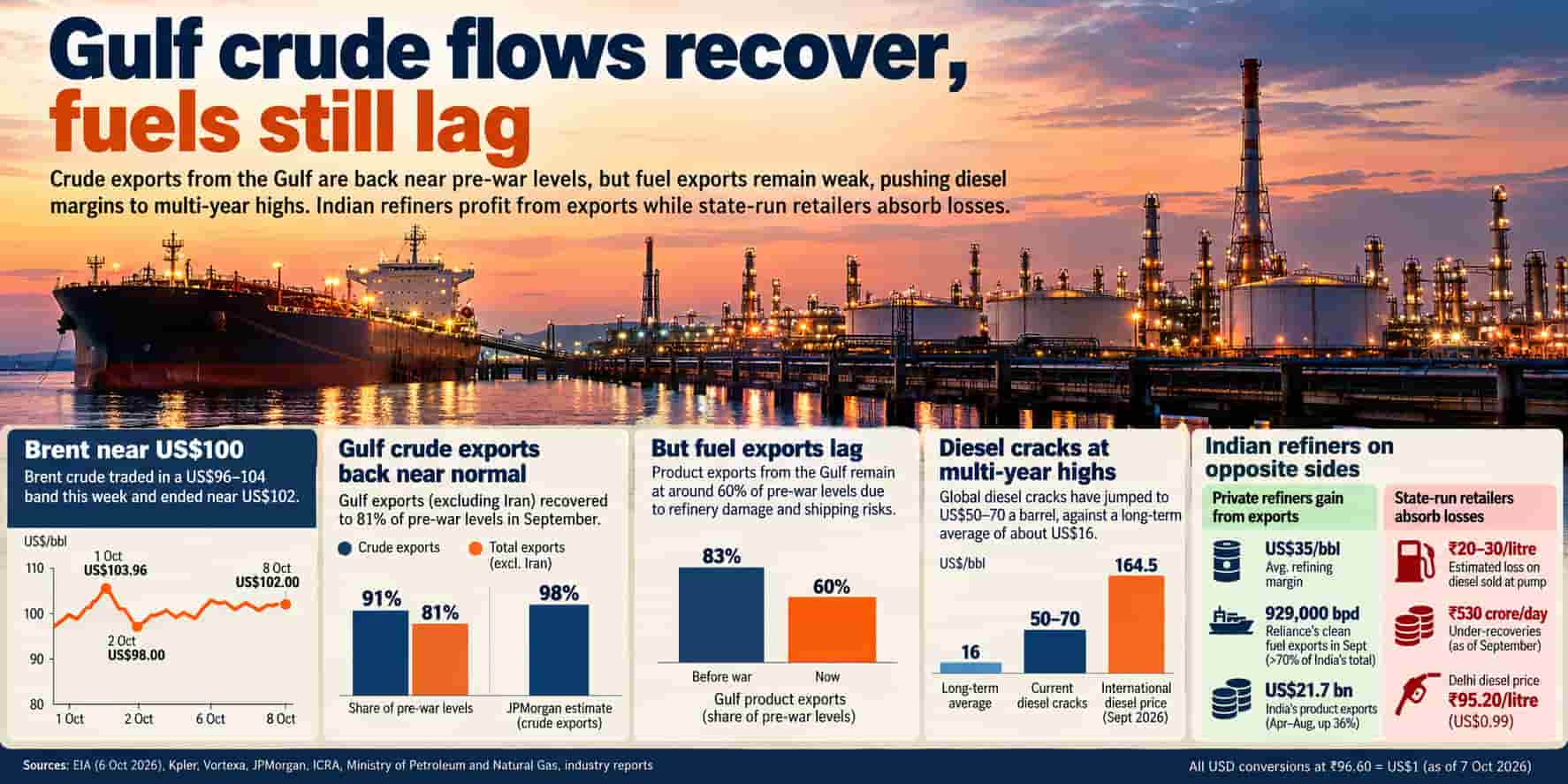
Brent spent the week in a US$96-104 band. On 1 October alone it swung from US$96.55 to US$103.96 and closed about 4% higher, near US$102. It dipped towards US$98 on 2 October after the G7 announcement, then recovered. By Monday it was at US$100.32, and it ended Wednesday near US$102 as Houthi claims of fresh strikes on Saudi facilities kept a floor under prices.
The Energy Information Administration’s (EIA’s) 6 October outlook shows how sticky the mood is. It raised its fourth-quarter Brent forecast to US$105 a barrel, US$14 higher than a month ago, citing diesel tightness and the attacks on Saudi Arabia’s East-West pipeline. For India, every US$1 on the basket adds roughly ₹8,578 crore (USUS$890m) to the annual import bill.
Crude is back, fuels are not
New export data explains the split. Kpler and Vortexa figures show Gulf exports, excluding Iran, at 81% of pre-war levels in September, with crude alone near 91%. JPMorgan puts crude at 98%. Goldman’s 23.3 million bpd estimate, which we cited last week, counts more broadly. The numbers differ, but the direction is the same.
Fuels tell another story. Product exports from the Gulf are still at about 60% of pre-war levels, held back by refinery damage and shipping risk. Only around 60% of Gulf crude now crosses Hormuz, against 83% before the war. Iranian exports have fallen to zero under the US blockade.
“The market has stopped worrying about barrels and started worrying about molecules like diesel,” said an analyst tracking global crude markets. For India, the lesson is simple. Crude availability is no longer the problem. Price and product are.
 Freight is the new premium
Here is the week’s most striking number. A very large crude carrier now earns an all-time high of US$1.3 million a day, 43 times January’s rate. Freight adds about US$33 to every barrel leaving the Gulf, against US$1.73 in January, and now makes up 27% of delivered cost, up from 3%.
Saudi Aramco has responded. It set November Arab Light for Asia at US$5 a barrel below Dubai/Oman, the lowest since June 2020, while raising Europe’s price by US$3. That cushions Indian refiners, but only partly.
It also explains an odd gap. The Indian basket traded around US$117-122 in early October, while Brent futures hovered near US$100. Indian refiners buy physical barrels, not paper. Physical grades have run well above the futures screen, with the EIA’s Europe Brent spot at US$114.89 on 22 September.
Sourcing shifts under a sanctions shadow
As per Kpler data, India imported about 5.3 million bpd in September, up 600,000 bpd on August. Middle East supply averaged 3 million bpd, a return to pre-war levels, while Russian crude fell to 1.75 million bpd, from 2.1 million in August and a record 2.82 million in July. Russia still looks like the largest single supplier, at roughly a third of the total.
The push to trim comes from Washington. A US sanctions law signed last month allows tariffs of up to 100% on major buyers of Russian energy. Refiners are cutting back, not quitting, because the barrels remain competitive.
Diesel splits India’s refiners
Diesel is where the real money sits. Diesel cracks are at US$50-70 a barrel, against a long-term average of about US$16, according to ICRA. International diesel averaged US$164.5 a barrel in September, nearly double a year earlier. Russia says it will not supply diesel unless sanctions ease, and China suspended exports this week.
The G7’s response is modest. Its 100-million-barrel release over four months, with diesel front-loaded, equals roughly one day of global consumption.
Indian private refiners are the winners. Gross refining margins averaged about US$35 a barrel. Reliance exported 929,000 bpd of clean fuels in September, over 70% of India’s total, and India’s product exports rose 36% to US$21.7 billion in April-August. The government has lowered the windfall duty on diesel and jet fuel exports for October. It works out to about US$27 a barrel, still capturing at least a third of export gains, and Reliance’s SEZ refinery is exempt.
“The export levy is there to keep supply at home first, and we revisit it as cracks move,” said a senior official at the Ministry of Petroleum and Natural Gas.
State-run marketers are on the other side. ICRA estimates an opportunity loss of ₹20-30 a litre (USUS$0.21-0.31) on diesel sold at the pump. Delhi prices stand frozen at ₹102.12 (USUS$1.06) for petrol and ₹95.20 (USUS$0.99) for diesel, with daily losses of ₹530 crore (USUS$55m) as of September. Private retailer Nayara raised petrol by ₹5 (USUS$0.05) and diesel by ₹3 (USUS$0.03) on 3 October, a divergence worth watching.
“Exports reward whoever can ship; the pump rewards nobody right now,” said an executive at a leading Indian refiner.
Policy watch
OPEC+ held November output unchanged on 4 October. Its seven core members pumped about 25 million bpd in August, roughly 5 million bpd below pre-war levels, so the quota is largely symbolic. The war, not the group, now sets supply. The capacity audit for 2027 baselines has been delayed, and the next meeting is on 1 November.
Closer home, Oil Minister Hardeep Puri has said India will keep exporting diesel, with refining capacity rising from 5.36 million bpd to 5.8 million bpd next year. BPCL is also reportedly readying a bond of up to US$3 billion to fund a Brazilian oil project, a sign that sourcing diversification is moving upstream.
India’s 88% import dependence is now showing up first as a pricing question rather than a supply one. Barrels arrive, but someone must absorb the diesel premium. This week, that someone is the state-run retailer.
Follow us on : X | LinkedIn | Facebook | Bluesky