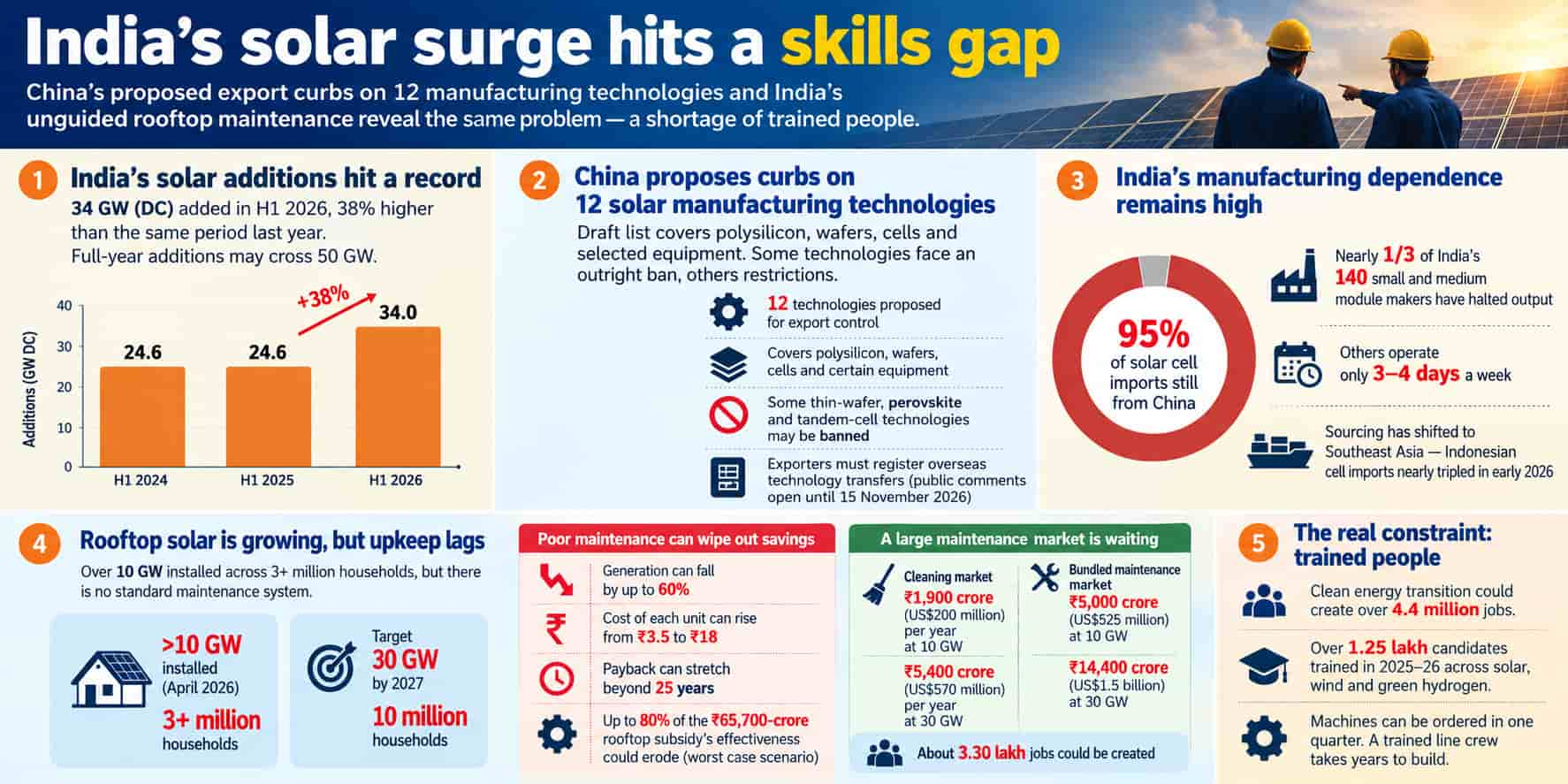
India’s solar build-out has been running hot. A Wood Mackenzie analysis estimates that the country added 34 GW (DC) in the first half of 2026. That is 38% above the same period last year. Developers rushed to commission projects before a domestic-content deadline for solar cells. Full-year additions may cross 50 GW.
The factory side tells a different story. As per recent reporting, nearly a third of India’s 140 small and medium module makers have halted output. These firms hold about 60% of capacity. The rest run only three to four days a week. The same reporting says India still relies on China for around 95% of its solar cell imports.
Now Beijing is tightening the tap on know-how. On 16 October, China’s commerce and science ministries proposed adding 12 solar manufacturing technologies to its export-control list, according to a media report. They cover polysilicon, wafers and cells. Some thin-wafer, perovskite and tandem-cell technologies would face an outright ban. Others would be restricted. Public comments close on 15 November. Until the final list is out, exporters must register certain overseas technology transfers. That registration also gives Beijing a record of every transfer.
Look closely at what is targeted. The draft covers production processes and selected equipment. Finished panels are not on the list. Modules will keep arriving. The recipe may not.
A brokerage report carried by a news agency reads the move as positive for Indian makers in the long run, because it may speed up backward integration. It also expects short-term disruption. India still depends on China for specialised equipment, industrial gases, chemicals, spare parts, process software and skilled engineers.
So far, import substitution has moved the dependence around. It has not ended it. Wood Mackenzie notes that direct cell imports from China fell after the domestic-content rule, but sourcing shifted to Southeast Asia.
Indonesian cell imports nearly tripled in early 2026. In the first five months, India imported 5 GW of wafers and 20 GW of cells. The same analysis expects utility-scale system prices to rise 20% by the fourth quarter. Indoen has earlier tracked how makers shut out of the US are turning to the missing links of the chain. The curbs now test that pivot.
There is a policy contradiction here. India plans to extend its approved-manufacturers mandate to wafers from June 2028. Wafers are exactly where China proposes bans. Domestic builders are already moving. Indoen reported earlier on an US$815 million plan for a 12 GW ingot and wafer plant in Kurnool. Such plants need tools and process experience. If these do not arrive, the calendar may have to bend. It has bent before. India has already pushed one deadline to December 2026 for some projects, citing shortages.
Where the crew comes from
Machines are only half the problem. A recent industry commentary argues that India’s next solar bottleneck may be skilled manpower. It points to an estimate that the clean energy transition could create over 4.4 million jobs. A large share would sit in solar manufacturing, installation and operations. The same commentary links weak skills to returns. Delays, lower plant performance and higher operating costs all reduce what investors earn. Skills, in other words, are a financing risk and not only a labour issue.
The gap is already visible on shop floors. “Machines can be ordered in one quarter. A trained line crew takes years to build,” said an executive at one of India’s larger module manufacturers.
India is training people. Another commentary notes that over 1.25 lakh candidates were trained in 2025-26 across solar, wind and green hydrogen. It also warns that universities turn out engineers who rarely know solar manufacturing. Weak skills mean slower output and more defects.
Link this to the curbs. Skilled engineers sit on the same list of Chinese dependencies. Know-how travels with people. A cell line needs staff who have run one before. If technology transfer is gated, that experience gets gated too. Training then stops being a welfare scheme. It becomes industrial policy.
 The unwatched fleet
The same shortage shows up on rooftops. A June 2026 study by a New Delhi-based energy and environment think tank puts residential rooftop capacity above 10 GW in April, across more than 3 million households. The target is 10 million households and 30 GW by 2027. Indoen reported in October that the flagship scheme had reached 50.06 lakh households and 14.8 GW.
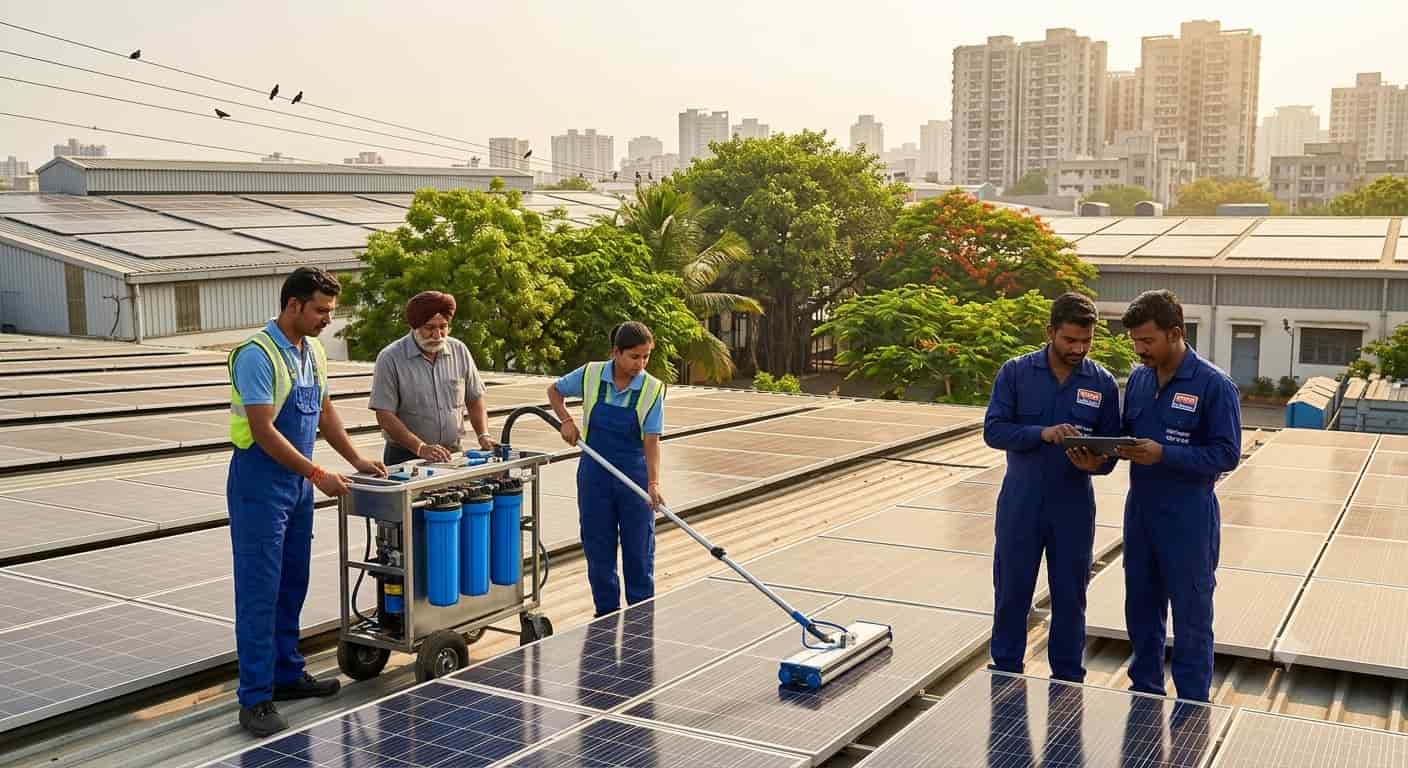
Installation is racing ahead. Upkeep is not. The study surveyed more than 60 vendors. The scheme promises five years of free maintenance. But it does not define the scope or the number of visits. Cleaning is usually left out. The “free” cover is mostly built into the installation price. Service is reactive, not scheduled. After five years, few households want to pay for it.
Nobody is watching output either. Rooftop systems are not audited. Discoms see only net-metered flows, not what each roof produces.
In the study’s scenarios, the stakes are large. Irregular upkeep can cut generation sharply. Research cited in the study puts the loss at up to 60%. A household’s lifetime savings can fall to zero. Payback can stretch beyond 25 years. The cost of each unit can rise from ₹3.5 to ₹18 (US$0.04 to US$0.19).
The state has skin in the game too. The capital subsidy for the 30 GW target is ₹65,700 crore (US$6.9 billion). In the worst case, up to 80% of that subsidy’s effectiveness could erode. For discoms, the cumulative hit at 10 GW could reach ₹16,000 crore (US$1.7 billion) under severe underperformance. These are scenarios, not realised losses. The study itself notes that subsidies are paid at installation milestones.
The flip side is a market. Cleaning alone is worth ₹1,900 crore (US$200 million) a year at today’s 10 GW. At 30 GW, it grows to ₹5,400 crore (US$570 million). Bundled maintenance moves from ₹5,000 crore (US$525 million) to ₹14,400 crore (US$1.5 billion). More than 70% of that opportunity sits in five states. The study also estimates about 3.30 lakh jobs.
“The scheme pays for the system. Nobody yet pays for the system to keep working,” said a researcher at a New Delhi-based energy think tank.
Put that jobs figure beside the training figure. A year of training across three sectors is well under half of it. The two are not like for like. But the scale gap is plain.
There is a small hopeful turn. The ministry now requires new inverters under the scheme to carry SIM-based telemetry. Generation data will flow to a national portal. Whoever can read that data can sell maintenance on performance. Older systems stay dark, though, and retrofits will cost money. Indoen’s earlier analysis of rooftop solar’s two economies began from the same point. Headline capacity numbers hide a more revealing reality.
What to watch
These two problems look separate. They share a root. Tariffs and mandates cannot produce know-how or trained hands. Duty walls helped build module lines. Mandates will pull cells and then wafers. But capability arrives slowly. And subsidies still reward installation, not output.
There are fair counterpoints. China’s list is a draft, open for comment until 15 November. Unlisted equipment is generally outside it. India can seek tools and training from other countries, or build its own research base. Maintenance may also organise itself once telemetry and standard service packages arrive.
Three signals matter next. First, the final Chinese catalogue after consultation. Second, whether the ministry sets standard maintenance rules for rooftops. Third, whether the 2028 wafer date holds. India’s next solar milestone may be counted in trained people, not gigawatts.