
India’s struggle with extreme heat is entering a dangerous new phase—one where rising temperatures are no longer just a seasonal hazard but a structural risk embedded in urban design, public policy and economic systems.
A growing body of research, including recent academic and policy analyses, suggests that the country’s current approach to heat—largely reactive, fragmented and emergency-driven—is increasingly out of step with the scale and persistence of the threat.
At the heart of this critique is a simple but unsettling idea: India is not failing to recognise heat as a problem; it is failing to plan for it systematically.
A recent analysis highlighted in Harvard University-linked research argues that most heat action plans in India remain focused on short-term responses such as issuing alerts, opening cooling centres, or adjusting work hours. While these measures have saved lives, they do little to address the deeper drivers of heat vulnerability—urban density, lack of green cover, poor building design, and socio-economic inequality.
This reactive approach is increasingly being questioned by climate experts who argue that India’s heat strategy must evolve from ‘managing emergencies’ to ‘reducing exposure.’
In practice, this means embedding heat resilience into long-term urban planning, infrastructure design and economic policy. According to analyses referenced by platforms such as PreventionWeb, India’s adaptation efforts remain skewed towards immediate crisis response, rather than systemic resilience-building.
The consequences of this gap are already visible. Cities across India are experiencing more frequent and intense heatwaves, driven by a combination of climate change and localised factors such as the urban heat island effect.
Concrete-heavy landscapes, shrinking water bodies, and limited tree cover are amplifying temperatures, often pushing them beyond survivable thresholds for vulnerable populations.
Planning gaps, economic risks, and policy fragmentation
Experts point out that while India has made progress in disaster management frameworks, heat has not been integrated into these systems with the same urgency as floods or cyclones. This creates a paradox: a slow-onset disaster that causes widespread health and productivity losses but remains under-prioritised in planning and budgeting processes.
A recent piece in Down To Earth reinforces this concern, arguing that climate resilience—including heat adaptation—must be woven into the ‘fabric of policy.’ This goes beyond standalone climate plans and requires integration across sectors such as housing, transport, water management and public health. Without such integration, adaptation efforts risk remaining piecemeal and ineffective.
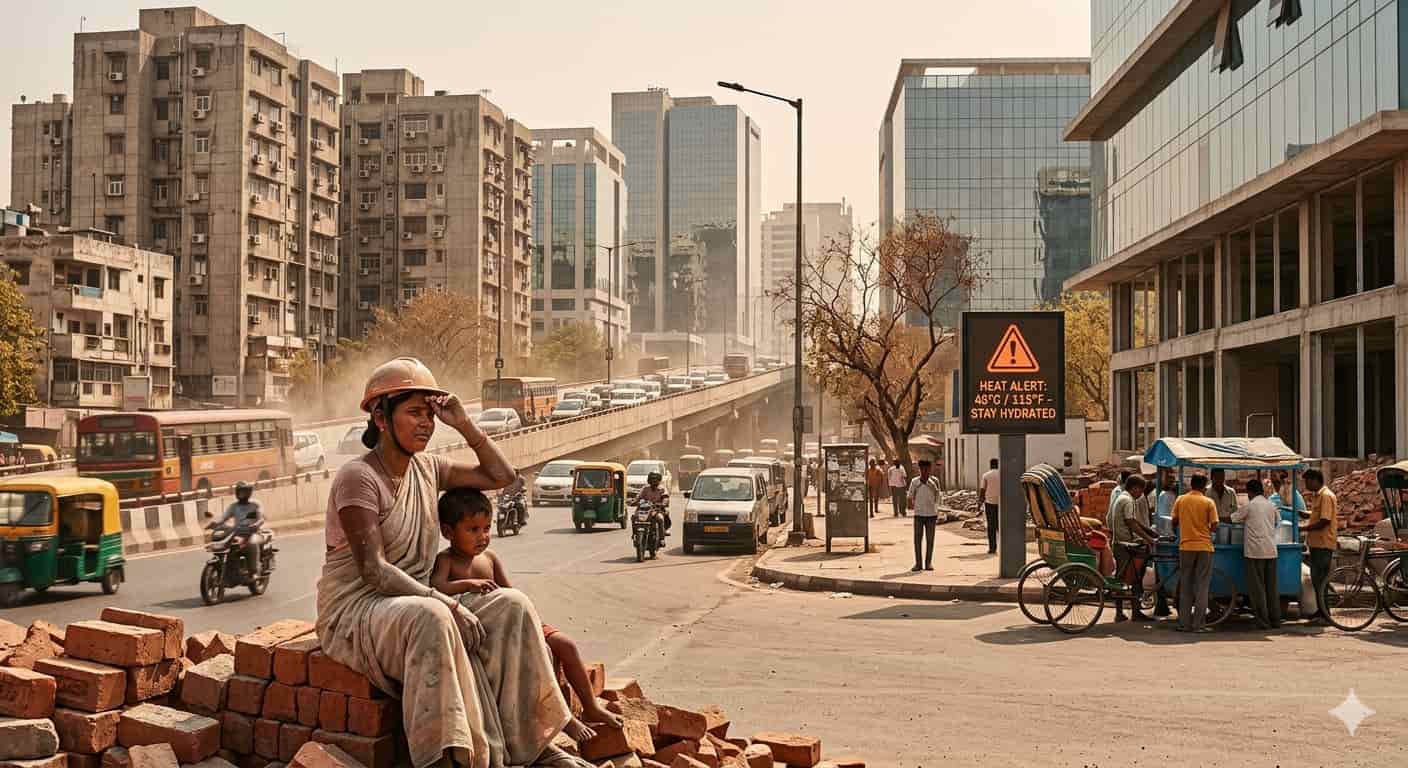
The economic implications of this planning gap are equally significant. Extreme heat is already affecting labour productivity, particularly in sectors such as construction, agriculture and informal services. Studies suggest that India could face substantial GDP losses due to heat stress, as outdoor work becomes increasingly difficult during peak summer months. This introduces a new dimension to the climate debate—one where heat is not just an environmental issue but a macroeconomic risk.
“There is a tendency to treat heat as a public health issue alone,” said a policy analyst familiar with climate adaptation frameworks. “But in reality, it is becoming a productivity shock, an infrastructure challenge, and a social equity issue all at once.”
Recent research from the University of Oxford’s Smith School further complicates the narrative by focusing on institutional readiness.
Their work on heat preparedness in India’s schools suggests that adaptation efforts often fail to account for the lived realities of vulnerable populations—children, outdoor workers and low-income households. Schools, for instance, are rarely designed to cope with extreme temperatures, yet they serve as critical community spaces during heatwaves.
This gap between policy intent and ground-level implementation reflects a broader challenge: the absence of a unified framework for heat adaptation. While multiple ministries and agencies are involved, coordination remains weak, leading to fragmented interventions. Heat action plans exist in several cities, but their scope and effectiveness vary widely, and they are often not backed by adequate funding or enforcement mechanisms.
From emergency response to systemic resilience
At the same time, there is growing recognition that technological and design innovations could play a crucial role in addressing the crisis. Passive cooling techniques, reflective building materials, urban greening, and water-sensitive design are increasingly being discussed as scalable solutions. However, adoption remains limited, particularly in informal settlements where the need is greatest.
This raises a critical question: can India move from pilot projects to systemic transformation? The answer may depend on how quickly policymakers can integrate heat resilience into mainstream development planning. For instance, incorporating heat risk into building codes, urban master plans and infrastructure investments could significantly reduce long-term vulnerability.
Yet, such shifts are easier proposed than implemented. Urban governance in India is often constrained by limited capacity, overlapping jurisdictions and financial constraints. Moreover, climate adaptation competes with other pressing priorities such as housing, sanitation and economic growth, making it difficult to secure sustained political attention.
There is also a counterargument worth considering. Some experts caution against over-centralising heat adaptation strategies, arguing that local contexts vary significantly across India’s diverse climatic zones. What works in Ahmedabad may not be suitable for Chennai or Delhi. This suggests that while a national framework is necessary, it must allow for local flexibility and innovation.
Even so, the broader direction of travel is clear. India’s current approach—focused on emergency response—is unlikely to be sufficient in a future defined by more frequent and intense heatwaves. The shift towards long-term, integrated planning is not just desirable; it is becoming unavoidable.
What makes the current moment particularly significant is the convergence of multiple pressures. Rising temperatures, rapid urbanisation and economic vulnerability are interacting in ways that amplify risk. At the same time, global climate discourse is increasingly emphasising adaptation alongside mitigation, creating both pressure and opportunity for countries like India to rethink their strategies.
In this context, heat adaptation could emerge as a defining test of India’s broader climate resilience agenda. Success will require not just better plans, but a fundamental rethinking of how cities are designed, how policies are integrated and how resources are allocated.
The stakes are high. Without systemic changes, extreme heat could exacerbate existing inequalities, disproportionately affecting those with the least capacity to adapt. But with the right interventions, it could also drive innovation in urban design, public health and climate governance.
As one expert put it, “Heat is the most democratic of climate risks—it affects everyone. But the ability to cope with it is deeply unequal. That is where policy must intervene.”
India’s challenge, therefore, is not just to survive hotter summers, but to build a future where rising temperatures do not translate into rising vulnerability.
The shift from reactive response to proactive planning will determine whether the country can turn a growing crisis into an opportunity for resilience.
Cover image: AI-generated (representative)