


The consumption of commercially traded primary energy sources in India increased by around 6% in 2017 from the previous year. In years to come, the demand for energy will continue to increase to meet the increased domestic requirements.
It is increasingly becoming evident that clean energy sources are gaining importance day-by-day. However, this leaves a pertinent question to be answered: whether India will cease to depend on coal anytime soon?
Reports show that about 90GW, or about 50% of the total coal-fired generation capacity, had been lying underutilized for several months in the last year owing to low demand for generation from consumers, while the functioning plants were mostly on sub-optimum levels. The demand for the electricity is not expected to go up in the near-term as well.
The unofficial strategy of the government, for the time being, will be to go slow go on seeking fresh investment in the thermal domain so that more plants don’t turn non-performing assets (NPAs), leaving the banking sector in turmoil.
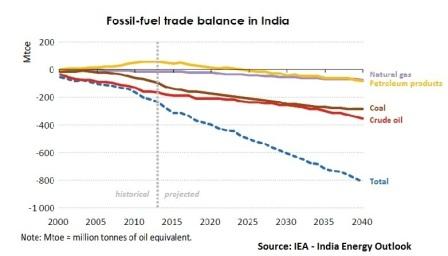 On the other hand, 50GW of coal-fired capacity is under development in various stages currently and has an uncertain future. While it will mean roughly US$45 billion of investments turning into NPAs sooner than later, it will also dissuade major power financiers from making further investments in the sector.
Private firms are now keener on investing in solar energy than in thermal power sector due to the high installation and generation costs for the latter, of late. Developers new to the sector or those stuck with earlier projects are considering safe ways to exit.
Commissioning of a solar-based power plant was very costly a couple of years ago. However, government subsidies have now reduced the cost significantly. While a 1,000MW of solar power plant currently needs an investment of US$746 million, the same capacity of coal-based power plant needs an investment of close to US$895 million.
Meanwhile, the government is making all efforts to upgrade technologies of existing coal plants so that they cause less-emission. Of the over 180GW of installed coal-fired generation capacity, India has already adapted emission-friendly supercritical technologies for 40GW. While adaptation for another 45GW is in underway, there are definite plans for converting the remaining 85MW to higher technologies over a period of time.
Further, the government has decided that all power plants that would be built in 13th Plan Period (FY 2017 – FY 2022) would be super critical or ultra-supercritical plants.
In August last year, the cabinet committee cleared an R&D proposal for development of advanced ultra supercritical (AUSC) technology for power plants and established a consortium of three state-run entities such as BHEL, Indira Gandhi Centre of Atomic Research and NTPC for this purpose.
The consortium will develop AUSC technology at a project cost of US$232 million. The technology is expected to be used for 50% of the 80GW thermal capacity addition envisaged for the 13th plan period (FY 2017-FY 2022).
On the other hand, the government is also optimistic that a revival in gas-based generation would enhance the power situation of the country by another 80bKwh a year. In what is seen as an effort to rescue a number of stranded gas assets, the government earlier decided to import cost-effective natural gas and subsidize it to 31 gas-fired power projects with a combined capacity of 14,000MW.
Government expects the move will save these fuel-starved power stations from turning into non-performing assets worth US$9.6 billion in their lenders’ account books.
It is highly likely that coal power capacity need not be expanded in the immediate coming years. However if the domestic demand increases significantly with the expanding economic activities in the rural areas, a renewed dependence on coal cannot be avoided as well.