
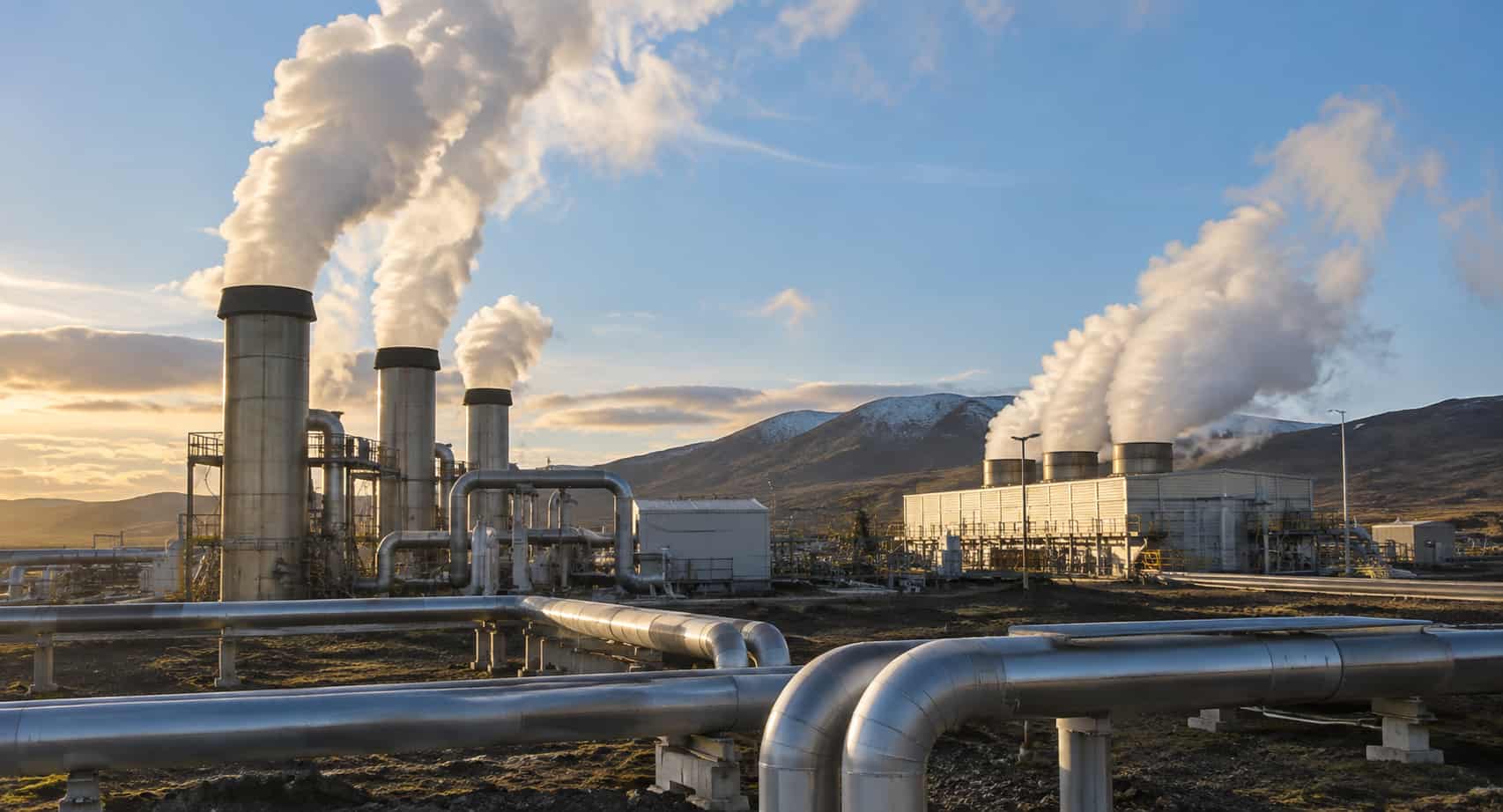
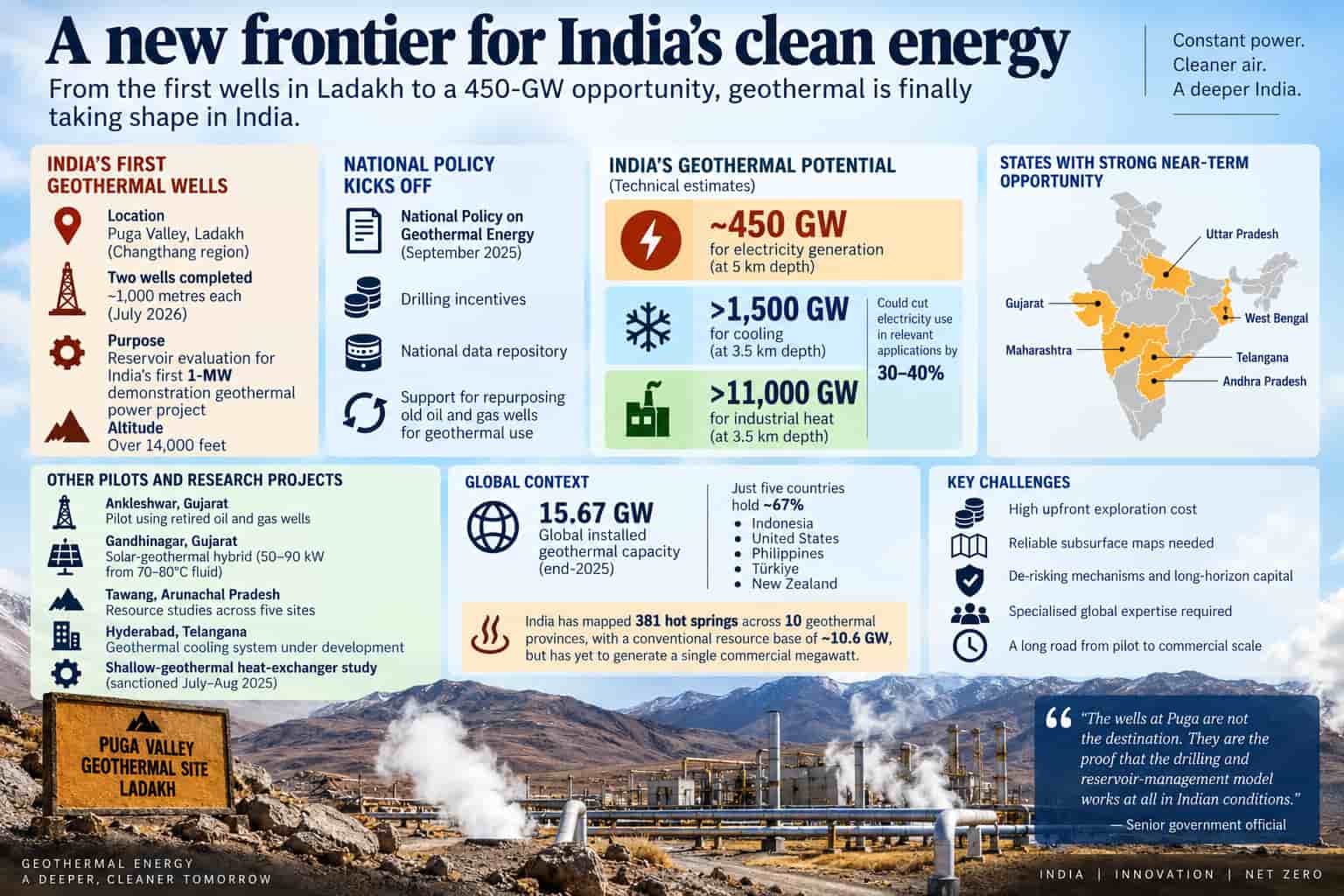
In July 2026, the ONGC Energy Centre completed two wells at Puga Valley, in the high-altitude Changthang region of Ladakh. Each runs to about 1,000 metres, and together they will support reservoir evaluation for what is meant to become India’s first one-megawatt demonstration geothermal power project, according to a government backgrounder released on 4 September.
For a country that talks in gigawatts, one megawatt sounds almost trivial. But the wells matter because they are the first tangible output of the National Policy on Geothermal Energy, notified in September 2025 under the Ministry of New and Renewable Energy.
The policy is India’s first serious attempt to turn a resource that has been discussed for decades — Ladakh’s hot springs were first surveyed in the 1970s — into an actual industry, with drilling incentives, a national data repository and support for repurposing old oil and gas wells for geothermal use.
The timing is not incidental. Puga sits at over 14,000 feet, in one of the most logistically hostile parts of the country, and drilling there had already been delayed once by winters and terrain, as industry reporting on the project has noted. Getting even a modest pilot working is, in that sense, a genuine engineering achievement rather than a symbolic one.
The number that changes the conversation
What makes geothermal worth a second look, though, is not Puga. It is a study published in May 2026 by the Council on Energy, Environment and Water (CEEW) and Project InnerSpace, titled The Future of Geothermal in India. The report puts India’s technical potential for geothermal electricity generation at roughly 450 GW, drilling to a depth of five kilometres — a figure that sits close to India’s entire current installed power capacity of around 500 GW across all sources combined.
That is the kind of number that ought to stop a reader mid-scroll. It also comes with two companion figures that are, if anything, more striking: over 1,500 GW of technical potential for geothermal cooling, and more than 11,000 GW for industrial heat, both assessed to a depth of 3.5 kilometres. The cooling number alone, the report suggests, could cut electricity use in the applications concerned by 30 to 40% — relevant at a moment when air-conditioning demand is one of the fastest-growing drains on India’s grid.
The study names Gujarat, Uttar Pradesh, West Bengal, Telangana, Maharashtra and Andhra Pradesh as the states with the strongest near-term opportunity, and it points to India’s existing oil and gas expertise — drilling crews, subsurface data, well-abandonment protocols — as a head start rather than a distraction.
 Borrowing from the oil patch
The overlap with oil and gas is more than a footnote. The government’s own policy explicitly permits repurposing abandoned or unproductive hydrocarbon wells for geothermal use, and a pilot in Ankleshwar, Gujarat is already testing exactly that: evaluating electricity generation from retired oil and gas wells, with baseline geological data already collected, according to the government release cited above.
Four other research projects sanctioned between July and August 2025 fill out the picture: a solar-geothermal hybrid in Gandhinagar that has already demonstrated 50 to 90 kilowatts of generation from wells producing fluid at 70–80°C; resource studies across five sites in Tawang, Arunachal Pradesh; a geothermal cooling system under development in Hyderabad; and a shallow-geothermal heat-exchanger study.
None of this is close to commercial scale. All of it is the unglamorous groundwork any resource needs before investors take it seriously — and it is precisely the kind of technical and regulatory muscle India’s oil and gas sector has spent decades building, as industry reports on the CEEW study have separately observed.
Where India stands in the wider picture
Geothermal is not a new industry globally, which makes India’s absence from it more conspicuous. Global installed geothermal capacity reached 15.67 GW by the end of 2025, and just five countries — Indonesia, the United States, the Philippines, Türkiye and New Zealand — together hold around 67 % of it, per the same government release.
India, despite mapping 381 hot springs across ten geothermal provinces and a theoretical resource base of roughly 10.6 GW using conventional methods, has yet to generate a single commercial megawatt.
“For a ministry used to gigawatt-scale renewable auctions, geothermal forces a different kind of patience — this is exploration risk, not procurement risk,” said a senior official working with the government, describing the thinking behind the National Policy on Geothermal Energy. “The wells at Puga are not the destination. They are the proof that the drilling and reservoir-management model works at all in Indian conditions.”
That gap between mapped potential and installed capacity is where India’s international partnerships come in. The government has flagged geothermal energy as a specific area of cooperation with Australia and Iceland, and under a bilateral memorandum with Saudi Arabia — a fairly unusual grouping that reflects how narrow and specialised the global geothermal expertise pool still is, and how much of it India will need to import in the near term.
The exploration-risk problem
Geothermal exploration is expensive precisely because so much of the cost is spent finding out whether a well will work before it produces a single unit of power — unlike solar or wind, where the resource is visible before a rupee is committed. Reliable subsurface maps, de-risking mechanisms and long-horizon capital are, by most accounts, the binding constraints rather than the size of the resource itself.
India’s experience with pricing similar risks elsewhere in its energy transition is not encouraging on timelines. Insurers are only now beginning to properly price clean-energy replacement and construction risk, years after solar and storage capacity had already scaled. Domestic manufacturing behind the country’s battery storage boom has similarly lagged well behind deployment targets. Geothermal, which needs patient exploration capital before any deployment can begin at all, may face an even steeper version of the same gap.
“The 450-GW figure is a technical ceiling, not a forecast,” said a researcher at a New Delhi-based energy think tank. “What actually gets built depends on whether India treats geothermal as a niche pilot programme or gives it the kind of dedicated financing window that solar had a decade ago.”
What geothermal could actually solve
The honest counterargument is that geothermal, even at its most ambitious, is not going to rival solar or wind as India’s primary source of new capacity any time soon.
Its real value lies elsewhere: it runs continuously, independent of sunlight or wind speed, and it can be sited to serve direct heating, cooling and industrial-process needs that renewables cannot easily reach. In a power system increasingly worried about firming variable renewables and about the electricity appetite of data centres and urban cooling, that profile is worth more than the headline capacity figures alone suggest.
Two wells in a Himalayan valley will not, by themselves, change India’s energy mix. But set beside a domestic resource estimate large enough to rival the country’s entire power fleet, and a policy framework barely a year old, Puga starts to look less like a curiosity and more like the opening move in a sector India has only just decided to take seriously.
Follow us on : X | LinkedIn | Facebook | Bluesky