
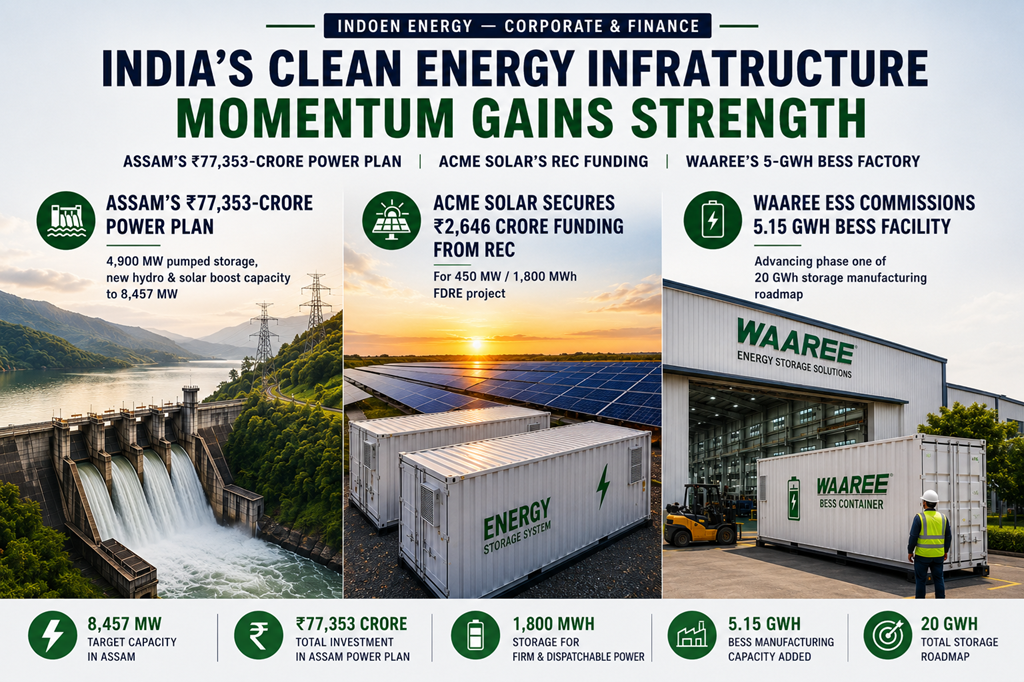

Assam unveils $8bn power plan to expand capacity to 8,457 MW
Assam has unveiled the largest investment programme in its power sector history, committing ₹77,353 crore (US$8bn) across hydro, pumped storage, solar, thermal, and transmission to increase the state's installed generation capacity from around 450 MW today to 8,457 MW.
The plan, presented in the state budget by Finance Minister Jayanta Mallabaruah, will be financed through a combination of state resources, centrally sponsored schemes, externally aided projects and public-private partnerships.
The most significant component comprises four pumped-storage power projects totalling 4,900 MW, with private investment estimated at ₹27,100 crore (US$2.8bn). Pumped hydro at this scale provides long-duration storage and grid-balancing capacity that battery systems alone cannot deliver at comparable cost.
It also positions Assam as a potential balancing node for the northeastern grid as intermittent renewables scale up across the region. The plan also includes eleven new hydropower projects at various stages, a proposed 3,200 MW thermal plant at Bilasipara, and new transmission lines and substations.
The 120 MW Lower Kopili Hydroelectric Project is already supplying power during trials.
The strategic logic extends beyond Assam's own demand. Northeast India has long been a power-deficit region, despite significant hydro potential, constrained by inadequate transmission connectivity and limited private investment appetite.
A credible state-level investment pipeline of this scale, combining government-backed schemes with private-sector pumped hydro, signals a shift in how the region is positioning itself within India's evolving national power architecture.
Surplus generation capacity in Assam would support the stability of the eastern grid and reduce the region's chronic dependence on coal-heavy generation.
The commitment also reflects a wider trend in Indian state energy policy: state governments are increasingly framing energy self-sufficiency as an industrial and fiscal imperative, not merely a welfare objective.
Chief Minister Himanta Biswa Sarma linked the investment directly to the 'Viksit Assam' growth agenda. Execution risk remains the central question, Assam's track record in delivering large infrastructure projects is mixed, but the policy direction, financial architecture and political backing are substantively more credible than comparable state-level announcements from the preceding decade.
(Source: Economic Times Energy)
ACME Solar secures $275m REC funding for 450 MW FDRE project
ACME Solar Holdings has secured ₹2,646 crore (US$275m) in long-term project financing from REC Limited to construct its ACME Greentech Seventh 450 MW/1,800 MWh Assured Peak Power Project. REC will serve as the sole lender for 20 years.
The project is underpinned by a 25-year power purchase agreement with SJVN Limited at a tariff of ₹6.74 per unit—a rate that reflects the cost premium for firm and dispatchable renewable energy (FDRE) relative to standard solar tariffs, which have hovered well below ₹3 per unit in recent competitive auctions.
The project combines solar generation with a 1,800 MWh battery energy storage system designed to deliver power during peak-demand windows, rather than only when solar irradiance is available. This is the defining characteristic of FDRE: contracted dispatchability, achieved through integrated storage, at a tariff that compensates developers for the additional capital and operational costs of BESS.
ACME now operates an 8,070 MW diversified portfolio across solar, wind, FDRE and hybrid configurations, with 5,080 MW under construction, including approximately 18 GWh of BESS capacity, one of the largest storage pipelines among Indian independent power producers.
What is structurally significant here is not the individual transaction but the pattern it represents. This is at least REC's fourth distinct project-financing commitment to ACME's FDRE portfolio, a series that also included a ₹3,184 crore (US$330m) commitment for a 280 MW FDRE contracted with NHPC, a ₹2,716 crore (US$282m) financing from PFC for the 300 MW ACME Sigma FDRE project, and a ₹3,892 crore (US$404m) loan from SBI for a 400 MW project contracted with NHPC in Barmer.
Collectively, these deals demonstrate that India's state-owned financial institutions have moved from cautious engagement with storage-integrated renewables to systematic, large-ticket deployment, a critical structural shift enabling FDRE to scale.
For India's electricity system, FDRE offers a qualitative upgrade over standard variable renewable energy: it enables grid operators to schedule clean power during evening demand peaks, rather than relying on coal or gas for dispatch flexibility.
The tariff premium of ₹6.74/unit, compared with sub-₹3 for conventional solar, reflects the market's current pricing of dispatchability. If FDRE tariffs continue to attract both institutional lenders and state utilities willing to sign 25-year PPAs at these levels, the economics of peak-supply decarbonisation become materially clearer.
(Source: Financial Express)
Waaree ESS commissions 5.15 GWh BESS facility, advancing 20 GWh storage roadmap
Waaree Energy Storage Solutions (Waaree ESS), the battery storage subsidiary of India's largest solar module manufacturer, Waaree Energies, has commissioned a BESS container manufacturing facility with an annual capacity of 5.15 Gwh at Rola in Gujarat.
The plant was upsized from the originally planned 3.5 GWh through production-process optimisation and improvements in battery cell energy density.
Equipped with Industry 4.0 automation, automated guided vehicles, intelligent material handling, and integrated quality assurance systems, the plant is designed to produce utility-scale and commercial-and-industrial BESS containers.
This is the first phase of Waaree ESS's stated 20 GWh integrated manufacturing roadmap, which will ultimately encompass lithium cell production, battery pack assembly, and container manufacturing. Lithium cell and battery pack facilities are expected to be operational later in the current financial year.
The broader ambition, backed by ₹1,003 crore (US$104m) raised from strategic investors in January 2026, is to build a fully domestic energy storage value chain that reduces India's dependence on imported cells and sub-components, the overwhelming majority of which currently originate from China.
India's battery storage manufacturing base has expanded rapidly in terms of announcements, but remains early-stage in terms of commissioned capacity. Waaree ESS's commissioning is structurally significant because it marks the start of real production infrastructure, not merely a policy aspiration or a capacity target in a tender document.
The facility's location in Gujarat, India's leading manufacturing state and the hub of Waaree's solar module operations, also reflects the logic of co-locating storage manufacturing with India's existing renewable supply chain, reducing logistics costs and enabling integration across the value chain.
The wider context matters: India's FDRE and grid-scale storage tender pipeline now spans tens of gigawatt-hours of contracted capacity. The country cannot meet these commitments, or its 500 GW renewable target, without domestic BESS manufacturing at scale.
Waaree ESS's 5.15 GWh facility does not resolve the supply-chain question on its own, but it is one of the first credible proof points that Indian companies are building the manufacturing depth to support the storage-integrated renewable buildout that policy has been calling for.
(Source: Renewables Now)
Follow us on : X | LinkedIn | Facebook | Bluesky