
India’s battery storage sector is growing on two tracks that are moving at very different speeds, and the gap between them has just been measured in hard numbers.
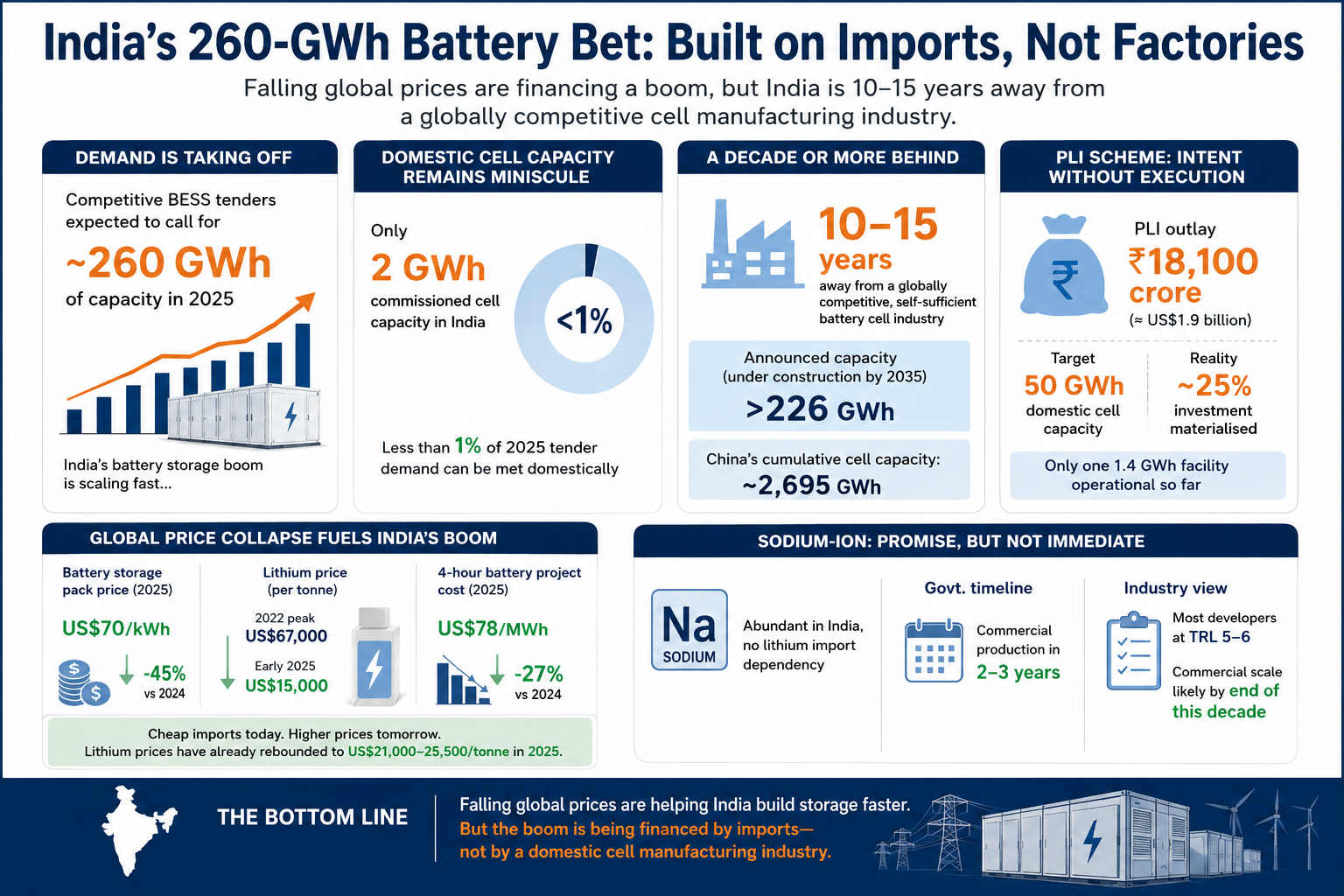
On one track, demand is racing ahead. Competitive tenders for battery energy storage systems (BESS) are expected to call for around 260 gigawatt-hours (GWh) of capacity this year alone. On the other hand, India’s ability to build the cells that go inside those batteries is barely moving. The country currently has just 2 GWh of commissioned cell manufacturing capacity, industry assessments suggest — meaning less than 1% of this year’s tendered demand could theoretically be met from domestic cells, even if every commissioned line ran at full output.
The scale of the shortfall was set out clearly in research published this week. India is likely to remain 10 to 15 years away from a globally competitive, self-sufficient battery cell industry, according to a media report citing new analysis from a global energy research firm.
More than 226 GWh of cell manufacturing capacity has been announced for construction through 2035, but execution delays, financing constraints and continued reliance on Chinese and South Korean technology licensors are slowing the build-out. For comparison, China’s cumulative cell capacity already stands at roughly 2,695 GWh.
A subsidy scheme that has struggled to convert intent into output
The gap is not for lack of policy support. The Production-Linked Incentive scheme for Advanced Chemistry Cells was designed to bring 50 GWh of domestic cell capacity online, backed by an outlay of roughly ₹18,100 crore (around US$1.9 billion).
In practice, only about a quarter of the expected investment has materialised, and barely any facilities have been built, as per recent reporting. One electric-vehicle maker has brought a single 1.4 GWh facility online — a fraction of the scheme’s target — making it, for now, the PLI programme’s only meaningful success story.
This is where the storage boom Indoen Energy has tracked for much of this year runs into an uncomfortable truth: the rapid scaling of India’s battery infrastructure and the capital flowing into grid-scale storage are, for now, mostly financing imported cells rather than domestic manufacturing.
“There is a real tension between the push for localisation and the economics developers actually face today,” said an executive at one of India’s leading renewable energy developers. “Locally manufactured cells currently cost 25 to 40% more than imported ones, largely because of scale, financing costs and an underdeveloped supplier base. Until that gap closes, tenders will keep rewarding whoever can deliver the cheapest landed cell, wherever it is made.”
That cost gap also cuts against tighter localisation rules.
Raising the domestic content requirement for BESS projects from the current 20% to a full 100% would increase capital costs by around 30% for a benchmark 100 MW/200 MWh project, according to the same analysis. A policy designed to build domestic capacity would, in the near term, make Indian storage measurably more expensive — precisely as global battery prices are falling to record lows.
 The window that made the maths worse
That global price collapse is the second half of the story, and it complicates India’s position further rather than easing it.
Stationary battery storage packs fell to around US$70 per kilowatt-hour in 2025, roughly 45% cheaper than the year before, industry reports suggest. The fall was driven largely by Chinese manufacturers, who had built roughly twice the factory capacity the world needed and cut prices sharply to keep those factories running.
Lithium prices fell in step: the lithium inside a typical 57-kilowatt-hour battery dropped from around US$67 at its 2022 peak to about US$15 by early this year. The global benchmark cost for a four-hour battery project fell 27% year-on-year to US$78 per megawatt-hour in 2025, the lowest level recorded since tracking began in 2009.
For Indian developers, this is a genuine windfall — tenders are being won at prices that would have seemed implausible three years ago. But it is a windfall built on someone else’s overcapacity, not on India’s own industrial base. And it may not last. Battery-grade lithium carbonate has already rebounded to between roughly US$21,000 and US$25,500 a tonne this year, more than double its mid-2025 trough, though long-term supply contracts have so far insulated finished battery prices from that rebound.
When those contracts expire, higher lithium costs will begin flowing into the price of every battery India buys — a country that, by then, may still be years away from making a meaningful share of them itself.
 Sodium-ion: A genuine escape route, or a talking point running ahead of the technology
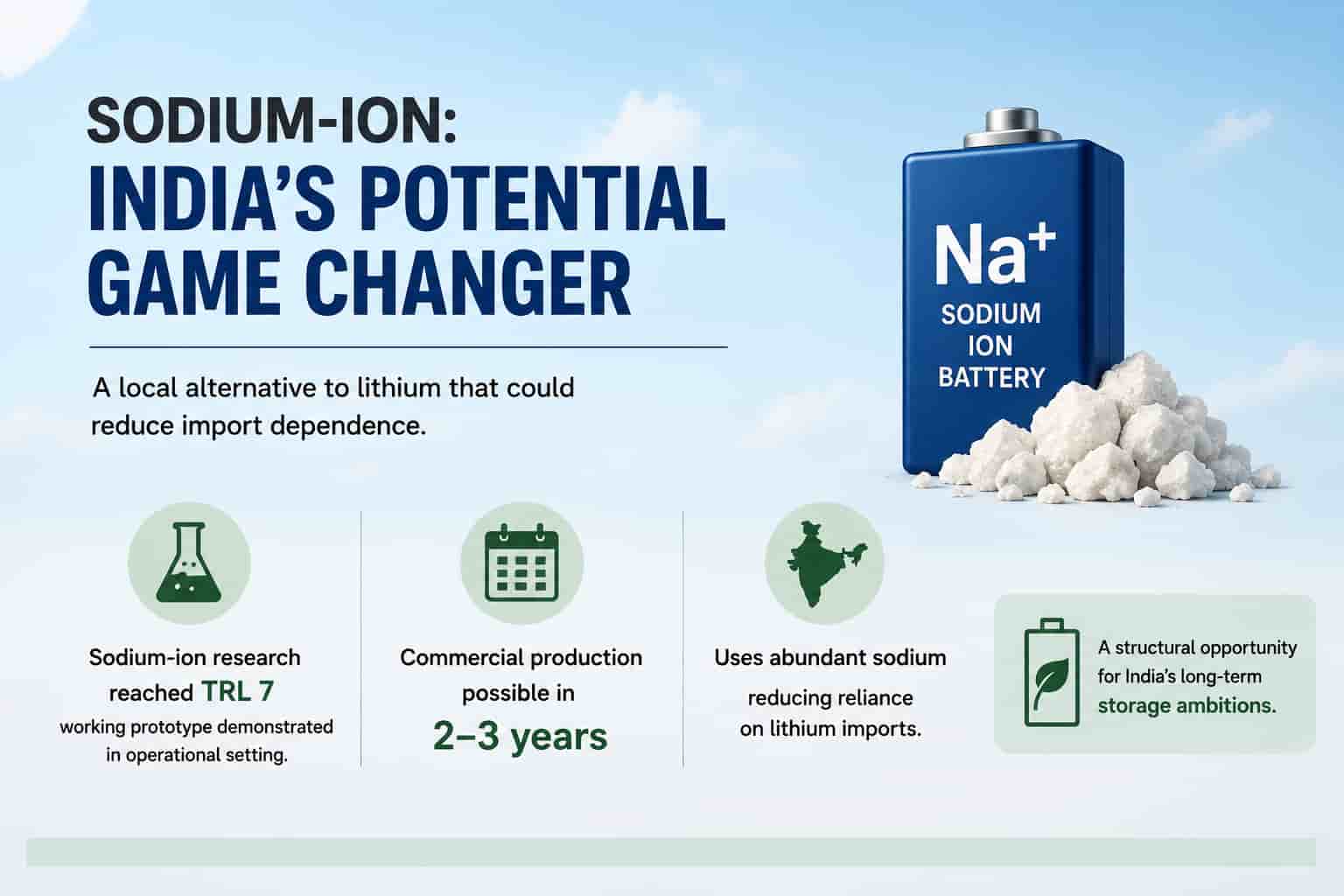
The most commonly cited way around this dependency is sodium-ion battery technology, which uses a metal that is abundant domestically and does not carry lithium’s import burden.
India’s Renewable Energy Secretary said this week that sodium-ion research has reached Technology Readiness Level (TRL) 7 — a stage at which a working prototype has been demonstrated in an operational setting — and that commercial production could follow within two to three years, according to a media report.
Other coverage of the same remarks framed sodium-ion as a technology finally within reach of Indian industry rather than a distant research goal.
That timeline deserves some scrutiny. Separate industry assessments have placed the bulk of sodium-ion developers at TRL 5–6, well short of the TRL 8–9 typically associated with commercial deployment. The gap between a government official’s public timeline and independent technical assessments is not necessarily a contradiction — technologies can move quickly once a threshold is crossed — but it is a reminder that “two to three years” is an optimistic case, not a settled one.
“Sodium-ion is a genuine structural opportunity for India, because it breaks the direct link to lithium imports,” said a researcher at a New Delhi-based energy think tank. “But the realistic commercial window is closer to the end of this decade than to next year. Most of the storage capacity being tendered right now will already be built, with imported lithium-ion cells, before sodium-ion reaches meaningful scale.”
What this means beyond the storage sector
The pattern here echoes a debate already playing out elsewhere in India’s energy transition. Indoen Energy has previously examined how battery supply remains the weak link in the country’s electric-vehicle ambitions, and how critical mineral dependency is emerging as a bigger long-term energy security question than oil or coal.
The battery-cell story adds a third, closely related strand: even where India controls the demand — through tenders, subsidies and stated localisation targets — it does not yet control the supply chain that fulfils that demand.
There is also a global financing dimension worth noting. In markets such as the United Kingdom, developers have begun using hybrid financing structures — combining merchant revenue with long-term offtake contracts — to make battery storage bankable as a distinct, lower-risk asset class, as per recent reporting on one such UK deal. Similar innovation in project finance could eventually help Indian developers raise capital on better terms, though none of the structures reported so far addresses the underlying manufacturing gap; they make it easier to finance storage projects, not to build the cells inside them.
None of this means India’s storage ambitions are misplaced.
Falling global prices are, on balance, good news for a country trying to scale renewables quickly and cheaply. But the current moment is best understood as a financing opportunity rather than an industrial achievement. Cheaper batteries are helping India build storage faster; they are not, yet, helping India build storage capacity of its own.
Follow us on : X | LinkedIn | Facebook | Bluesky